Multi-faceted Toronto producer Egyptrixx has certainly kept himself busy in the years following the release of 2011’s highly rewarding Bible Eyes LP, starting his side project Hiawatha, delivering fresh mixes, and even dropping the odd short-format release or one-off tune. However, the artist born David Psutka is finally ready to follow up his debut album with another full-length for trusty UK outpost Night Slugs. A/B til Infinity is currently slated for release sometime in November, though we have little other information regarding the record outside of its tracklist, which is included below. But Egyptrixx did share a brand-new DJ set with his announcement, a 14-track mix described as a “scrapbook of ideas” which influenced the artist’s upcoming sophomore album. Psutka’s NSMIX004 can be streamed below, where its tracklist can also be found.
1. Ax//s (intro) 2. A/B til Infinity 3. Alta Civilization 4. Bad Boy (reduced) 5. Adult 6. Disorbital 7. Water 8. My Life is Vivid, My Eyes are Open 9. A.C.R.R.
To describe Jami Welch (a.k.a. Seams) as an English producer now residing in Berlin hardly makes him sound that remarkable. Welch’s relationship with the city is, however, slightly different than that of his countrymen who simply have been drawn there by the allure of Berghain and a rich techno heritage. He is, by his own admission, somewhat disconnected from Berlin’s dance music community; while he acknowledges the influence of club music, his roots lie in guitar bands and the more headphone-centric end of the electronic spectrum. This vantage point as a semi-outsider manifests itself in his music too. Stylistically, his most obvious contemporaries are probably artists like Gold Panda and Jon Hopkins—electronic producers whose music is rooted in sprawling, cinematic structures as much as it is the dancefloor-ready tones of house and techno. Though his productions certainly share stylistic characteristics with the robust strains of electronic music that one generally associates with Berlin, they nonetheless seem to exist in a realm removed from the city’s club culture. That said, the German capital still has an integral presence within Welch’s music; in fact, it’s the conceptual cornerstone of his debut album, Quarters, which loosely takes its name and inspiration from having been written and recorded across four different locations around Berlin.
Welch’s first experience with the city came three years ago, when he spent a summer interning at SoundCloud while he was still at university. “I fell in love with the place and recorded [the first Seams EP] Tourist during that time,” he says. “That was made heavily using field recordings and lots of outdoors, summertime kind of stuff. Having never really lived in a city as an adult—I studied in Birmingham [in the UK], but it didn’t really have that same thing—I really fell in love with being in a place where things are always going on, but you can also take life at its own pace. It’s a nice in-between from London and the middle of nowhere.”
That EP would prove to be the first in a string of releases from Welch that are inherently tied to the locations in which they were composed. Following his summer in Berlin, Welch returned to Birmingham to finish a degree in sound engineering, before retreating, somewhat begrudgingly, to his small hometown in Hampshire. It was there that he recorded and released his second EP, 2011’s Sleeper. (For the record, there was one Seams release between the two EPs, the two-track “Focus Energy” b/w “Motive Order” for the Pictures Music imprint.) Sleeper was a notably insular work, one with an undertone of darkness and isolation that wasn’t really present on his debut EP. Welch attributes these tonal differences to the contrasting environments the two records were recorded in. “I feel like, I guess, depending on the mood that you’re in, you absorb your surroundings and you interact with them differently,” he explains. “By talking about my surroundings, it’s kind of just a proxy for talking about where I’m at myself. The Tourist EP, for me at least, felt very light and airy and open, as I was feeling very exploratory and I was excited and experiencing lots of new stuff. With Sleeper, I was back home in a very small room feeling miserable and a bit stuck, so to me [that EP] feels more claustrophobic.”
This approach of relating an emotional dialogue via a musical response to his surroundings is a constant undercurrent in Welch’s work as Seams. “I think, for me, I’ve always found it hard to have something to say; to find a story or a narrative, a more emotional thing that I was trying to get across,” Welch says. “Something I felt I was always very aware of, and something that I felt translated to music better for me, was a sense of place and surroundings. So I started making stuff that was very field recording-heavy, and each tune I made was about recreating that experience.”
“I think you can lose the magic of music by getting too literal, in terms of lyrical content or emotional stuff,” he continues. “If you hear something and it reminds the listener of a place or an experience of their own, then there’s something there you can communicate with. You can speak in relative terms, by relating comparative experiences to people without being explicit.”
Following the release of Sleeper, Welch returned to Berlin as a full-time employee of SoundCloud and began to approach the prospect of writing an LP. For all the talk of location and environment, however, he’s quick to explain that despite its titular premise, Quarters isn’t as tightly bound to its geographic concept as its predecessors. Although the tone of the album is noticeably lighter than that of his previous EP, which one guesses may be attributed to Welch’s relocation, this time around he consciously detached himself from the idea of responding directly to his environment. “With the album itself, my intention wasn’t to make something that was talking about Berlin, or the different places where I was when I was making it,” he says. “Actually, the thing that made me finally able to make an album was stepping back from the concept. I kind of went back to just making tracks, but at the same time, I ended up moving house three or four times through that process, so it had an effect through osmosis rather than being something that I was super aware of at the time.”
As a result, the four quarters of the LP’s title are essentially rough geographical reference points, with each one representing a shift in Welch’s life as he was composing the piece. Three of these touchstones are different places of residence he moved between following a break-up, while the fourth, which is represented by closing track “TXL,” is the departure lounge at Berlin’s Tegel Airport. “There’s a timeline to it,” he explains, “but the ordering of the album doesn’t go from place to place to place. It’s mixed up, but those were the factors that dictated the changes of scene.”
“Rilo” from Quarters
This move away from the constraints of a central theme seems to be audible within Quarters. While there are certainly shifts in mood across the course of the record, they’re far subtler than the contrasting openness and claustrophobia of Tourist and Sleeper. There’s more of a mixture of light and darkness within each song, and the boundaries between them seem less overtly defined. “One thing that helped,” Welch says, “was striving less for a uniform sound. Before I always felt that for an EP or an album to work it should use the same sounds all the way through, and I was into the concept leading the process. But this time around I went back to being more experimental with how I start a track. It was much more based around longer, jam-like improvised things that I then tidied up, rather than having an idea outright at the beginning. There’s no sampling this time either; it’s more synths and drum machines. I was chasing textures in my head rather than ideas. I wanted it to be a bit more drawn out and minimal in its approach, by chasing more rhythmical stuff rather than trying to convey particular experiences. So I sort of dropped the concept, in my head at least.”
Whether it was a conscious intention of Welch’s or not, Quarters also feels more aligned with the dancefloor than his previous EPs. He remains detached from the club scene, but perhaps an extended period living in one of Europe’s great dance-music capitals has rubbed off on him. Welch’s nights in Berlin’s clubs are admittedly rare, but the experiences have been influential nonetheless. “It always inspires me, when I do go out, to make stuff that does make more sense in a club, or to make my live set more danceable,” he explains. “Occasionally I get out and when I do, dance music makes sense to me. It’s not somewhere where I come from traditionally; I’m more of a guitar-band and headphone-music kind of guy. But every time I do go out, it’s like, ‘Yeah, I get dance music, I see what the fuss is about.'”
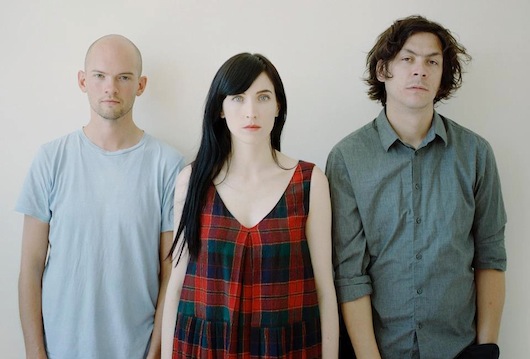
Under his Tuff Sherm alias, Australian producer Dro Carey has remixed “New Peaks,” the latest single from electronic pop outfit Eaux (pictured above). Once a strain of chilled-out and romantic new wave, Eaux’s new song is completely trampled by Tuff Sherm, leaving only scraps of the original production in his wake. Placing the stifled grind of a house beat in its center, the remix slowly winds on its synth-laden path, taking exasperated breaths along the way. Eventually, the beat starts swinging around, knocking about the stereo field until Tuff Sherm’s track gives way to Eaux vocalist Ahern’s crystalline falsetto and an especially propulsive climax. Furthermore, Eaux is about to hit the road in the UK and Europe, the dates of which can be found after the jump.
19/09 – Paris, FR – La Trabendo w/ Fuck Buttons 20/09 – Tilburg, NL – Incubate Festival 29/09 – London, UK – Dummy AGM @ London Fields Brewery w/ oOoOO & Patten 28/10 – London, UK – Hoxton Bar and Kitchen w/ Lightning Dust 29/11 – Camber Sands, UK – ATP End of and Era part 2 30/11 – Belguim, BE – Autumn Falls Festival
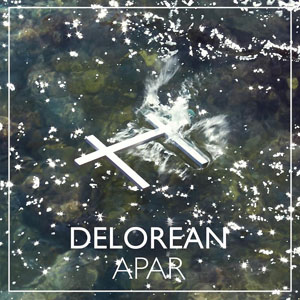
A little less than three years ago, XLR8R deemed Delorean‘s Subiza LP to be our favorite release of 2010. Apar—the Spanish outfit’s first recorded material to surface since then—finds the quartet only carefully tweaking the Balearic-tinged, indie-friendly, dance-pop formula which yielded its standout album and certainly contains a number of breezy, fun, and ultimately worthwhile jams, but it lacks the consistency of its predecessor.
Apar is a noticeably less energetic album than Subiza. The club and rave influences which were integral to the previous record’s signature sound have been reigned in, percussive and rhythmic momentum no longer pushes at the forefront, and more straightforward—and, at times, predictable—arrangements are utilized. While still very much crafting sun-kissed, tropical-soaked dance-pop hybrids, Delorean sounds less concerned with fun in its new form. The exuberant elation which made songs like “Real Love” and “Stay Close” instantly infectious is not completely stripped away though, but rather fitted into a more even-keeled approach, which is perhaps the sign of a band whose musical outlook has matured over the past three years.
Delorean has referred to Apar as the group’s “big production album,” which it seems not only refers to the overall sound of the record—a mix of ’80s-pop sheen with an extra dose of dreamy textures—but also to a shift in songwriting, which also appears to take a fair share of cues from the grander end of classic ’80s pop. What results is a record that is not primed for dance parties but instead for more traditional listening environments. To this end, Delorean does give listeners a number of songs that are enjoyable from beginning to end simply for the sake of, well, listening. Early on, “Destitute Time” and “Dominion” arrive as two of Apar’s most hook-laden efforts; the former combines the long-winded vocals of Cameron Mesirow (a.k.a. label mate Glasser) with an upbeat, guitar-led track which takes occasional instrumental breaks full of big tom rolls and swirling synth FX, while the latter wraps the blissful plucks of an almost Arabic-sounding guitar (a texture that finds its way onto many of the songs here) around a samba-like beat and includes Apar‘s most soaring chorus. Later on, “Walk High” is similarly successful, incorporating the vocals of Chairlift‘s Caroline Polachek into a Qunicy Jones-indebted slice of funky, yet introspective, dance pop. Interestingly enough, it is the album’s closing cut that may sound the most familiar to Subiza fanatics, with “Still You” presented as a slice of heavenly disco, one which graciously indulges in sparkling synth motifs and melodies rendered from repitched vocal “oohs.”
Along the spectrum of electronic pop, Delorean moves more towards pop with Apar, and as a result, those who found themselves helplessly sucked into the group’s brand of youthful, breezy tunes due to their reformatted club components may feel something is missing here. Still, the group’s warm allure and knack for melody have not been lost. Perhaps because they sound so closely related to the songs of Subiza, one can’t help but imagine songs like “Spirit,” “Destitute Time,” or the particularly sentimental “Your Face” infused with a bit more rush, exuberance, and dancefloor nods. If Subiza had faded from our memories, maybe we would not comprehend these songs as lacking in some way, but that is likely the price of making an album that is so sticky—those songs will rattle around in our heads for a long time. Until then, Apar is left to sound good but not great, worthwhile but not essential, Delorean but not quite.
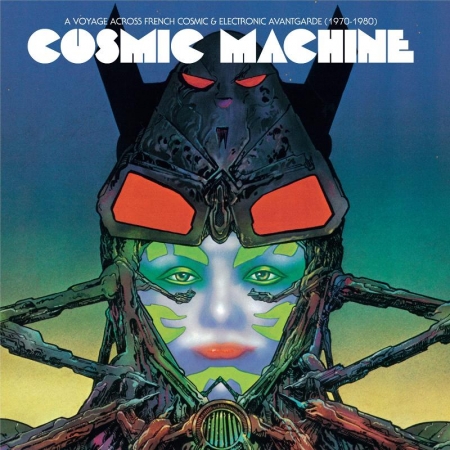
International label Because Music has established itself as a mainstay in the world of electronic music since its inception in 2005, having helped champion the likes of DJ Mehdi, Justice, and Erol Alkan. Now, the French-born music group plans to release a compilation of vintage electronic productions from its home country, exploring the eclectic narrative of “cosmic and electronic avant garde” sounds from across the ’70s. Called Cosmic Machine: A Voyage Across French Cosmic & Electronic Avantgarde (1970-1980), the release promises to be an extensive trip into a time when “the future wasn’t yet a retro notion.”
Olivier Carrié (who curated the Shaolin Soulseries) handpicked the 20 spacious synth-disco jams and ambient ruminations featured throughout Cosmic Machine—including Jean Michel Jarre, Serge Gainsbourg’s “Le Physique Et Le Figure,” Thomas Bangalter’s father Daniel Vangarde (a.k.a. DVWB), disco icon Marc Cerrone, and “Le Bracelet” by Alan Goraguer, whose Fantastic Planet soundtrack was sampled frequently for Madlib’s Quasimoto records. Exploring the more emotive and passionate side of French electronic music history, the forthcoming compilation is something of a love letter to innovative and experimental composers who championed analog synthesizers and challenged the all-consuming American disco scene at its peak. Before Because Music’s Cosmic Machine is made available on October 14, its tracklist can be found below.
1. Patrick Juvet “Le Reve” 2. Didier Marouani “Temps X” 3. Droids “Shanti Dance Part 1 & Part 2” 4. Fraçois de Roubaix “Survol” 5. Space “Magic Fly” 6. Universal Energy “Disco Energy (I)” 7. Pierre Bachelet “Motel Show” 8. Space Art “Love Machine” 9. The Atomic Crocus “Ombilic Contact” 10. Jean Michel Jarre “Blackbird” 11. Bernard Fevre “That Is To Be” 12. Cerrone “Generique (Debut)” 13. Frederic Mercier “Spirit” 14. Quartz “Chaos” 15. Rene Roussel “Caramel” 16. Serge Gainsbourg “Le Physique Et Le Figure” 17. DVWB “Acqua” 18. Alain Goraguer “Le Bracelet 19. Jean-Jacques Perrey “E.V.A.” 20. Rockets “Rocket Man (Instrumental)”
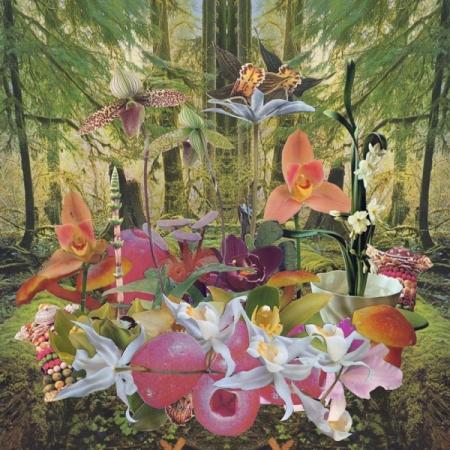
Los Angeles-based lo-fi beatsmith Monster Rally (a.k.a. Ted Feighan) is set to follow up last year’s well-received Beyond the Sea LP with his third full-length, Return to Paradise (out on October 29 via Gold Robot). The album is said to “translate the images of a half-century of National Geographic into 17 tracks,” and our first taste of this new record comes in the form of “Orchids.” The Return to Paradise opener features lush guitar playing and a lackadaisical beat, which forms a serene, nostalgia-soaked whole.
As its title suggests, Donato Dozzy‘s Plays Bee Mask is not a remix album as much as, let’s say, a techno adaptation of a covers album. The idea doesn’t map neatly since Bee Mask‘s original “Vaporware” is a sprawling, multi-part epic, a composition that’s all but impossible to replicate. But the scope and intentions of this album-length project are very different from a remix. Plays Bee Mask zooms in on individual shards of Bee Mask’s stained-glass original, meditating on select facets of “Vaporware” with a distinctly deferential tone. There’s none of the usual subconscious drama about putting one’s stamp on or even besting the source material that can come along with constructing a remix. Responding in kind to the labyrinthine “Vaporware” is a tall order, which is likely why Dozzy has wisely chosen to break the project down into manageable pieces, connecting the source material to his own sound organically.
Like Shifted did to TVO’s originals on Red Night Variations, Dozzy submerges his takes in a grainy haze that avoids going techno, but is too pointed to accurately be called ambient. “Vaporware 01” swirls around the the most recognizable lift—cascading, wayward arpeggios that are the closest Bee Mask comes to a riff in his fluid composition—but the action is set behind an extravagantly, well, wet field recording of a downpour. Evocative and hands-off is generally Dozzy’s approach here, curating snippets and packing them in ambience. Sometimes his curation is so microscopic that it obscures the original, as he does on “Vaporware 02,” which stares into a fogged-out void.
It’s somewhere in the neighborhood of “Vaporware 04” that Dozzy really starts to gain traction, finding a tangent that combines his and Bee Mask’s appeal in what feels like a comprehensive fashion. “Vaporware 04” avails itself of the lower frequencies of one of Bee Mask’s android arpeggios to create the murky thrust that characterizes Dozzy at his best. After establishing this throaty momentum, Dozzy allows choral pads to join the ratcheting frequencies that flit across the stereo field, hinting at the mincing propulsion of hi-hats rather than making it explicit just yet. He leaves this last part to the LP’s highlight, “Vaporware 05,” which sees him once again finding his footing by attenuating select frequencies in a very small loop, creating sense of movement within a basically static idea. This kind of virtuosic control of near-subliminal change is certainly what makes the Italian producer a revered name in the techno world, as he trusts the power of suggestion over the obvious. As many places as Bee Mask managed to go in the 13 minutes of his original, Dozzy finds something all his own by diving deep and letting the layers create strangely beautiful moiré patterns so subtle that they’re barely perceptible. Dozzy never has the poor taste to outshine the master, but in tracing the same lines, he arrives in a strange terrain all his own.
Over on The Creators Project, an intriguing new video has appeared, a mini-documentary which shines a spotlight on the past achievements, methods, and inspirations of inimitable UK artist Four Tet. But what largely makes director Dan Wilde‘s piece different from previous interviews with the artist born Kieran Hebden is that it’s entirely animated by Yorgo Alexopoulos, who added visual effects and design flourishes to a number of archived photos. The illuminating and even heart-warming Looking Backward, Moving Forward can be seen in the player below, and an interview with its director is available to read over here, courtesy of The Creators Project.
Coinciding with its Berlin pop-up radio station, the Red Bull Music Academy blog shared an English translation of a comprehensive article about the Communist-era electronic-music scene east of the Berlin Wall, as told by artists who were there. The original piece, penned by Florian Sievers for Groove, tracked down all of the musicians and producers featured on Permanent Vacation‘s Mandarinen Träume: Electronic Escapes from the Deutsche Demokraktische Republik 1981-1989 compilation, which sought to showcase electronic music made in East Germany before the fall of the Berlin Wall. What transpired is an illuminating discussion between a handful of former East German residents as they recall the difficulties of smuggling synthesizers and drum machines into the country and the struggles of making new music while in such a controlling state, all while mapping the trajectory of East Germany’s mostly unknown electronic music development. RBMA’s full translation of the illuminating article can be read here.
Due to a motorcycle accident involving Sascha Ring (a.k.a. Apparat) and his girlfriend—who are said to both be relatively fine, considering the circumstances—the Moderat trio (which also counts Gernot Bronsert and Sebastian “Charlie” Szary of Modeselektor in its ranks) has been forced to postpone its European tour. No extremely serious injuries were sustained in the accident, but Ring has been diagnosed with “a multiple and complicated leg fracture,” which will prevent him from being able to perform for the next few weeks or even months. Though all the European dates in support of the outfit’s recent and noteworthy II album have been postponed, Moderat plans to honor all obligations early next year, and have already begun rescheduling its performances. The list of so-far confirmed dates are included below.
JAN 26 Munich (DE), Kesselhaus JAN 27 Amsterdam (NL), Paradiso JAN 30 Cologne (DE), Live Music Hall JAN 31 Wiesbaden (DE), Schlachthof FEB 01 Erfurt (DE), Stadtgarten FEB 02 Warsaw (PL), Basen FEB 07 Bristol (GB), TBA FEB 08 Edinburgh (GB), Substance@Picture House FEB 09 Dublin (IE), Button Factory FEB 11 London (GB), Koko FEB 12 London (GB), Koko FEB 14 Aarhus (DK), Train FEB 15 Copenhagen (DK), Studie 1 FEB 17 Paris (FR), Trianon FEB 19 Fribourg (CH), Fri-Son FEB 20 Zurich (CH), Komplex457 FEB 21 Lyon (FR), Le Transbordeur FEB 22 Milan (IT), Magazzini Generali FEB 23 Stuttgart (DE), LKA FEB 24 Vienna (AT), Arena FEB 25 Berlin (DE), Columbiahalle