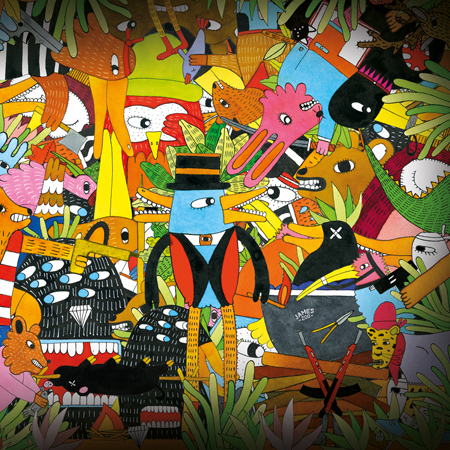
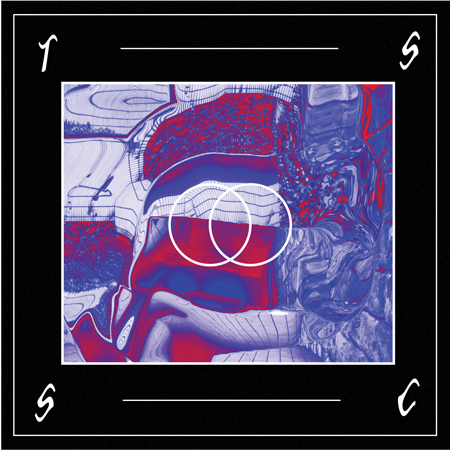
The latest offering from Dutch beatmaker Jameszoo is probably a “love it or hate it” kind of tune, but regardless of your position, there is no doubt that “Psitta Riddim” is completely off-the-wall. The wild production’s hodgepodge rhythm may not make for a head-nodding beat the whole way through, but the jumble of quirky, percussive noises could nonetheless manage to catch and hold your attention—toward the end, it winds up sounding a bit like TNGHT’s “Bugg’n.” “Psitta Riddim” comes from Faaveelaa, Jameszoo’s first release for the Amsterdam-based Rwina label. You can stream a preview of the oddly unique EP after the jump.
To up the anticipation before his forthcoming album, Until the Quiet Comes, drops on October 2 via Warp, Los Angeles beat maestro Flying Lotus has shared a track from that record, which features left-field soul songstress Erykah Badu. The jazzy vibes from FlyLo’s last full-length, Cosmogramma, are in full effect on “See Thru to U,” as hard-hitting tribal toms and cymbals roll and tumble underneath Badu’s signature raspy vocals. You can indulge in the lush soundscape below.
Back in February of this year, we ventured into the Brooklyn studio of experimental house duo Teengirl Fantasy to talk to producers Nick Weiss and Logan Takahashi about the kinds of synths, drum machines, and various effects processors that were used on their hitherto untitled second LP. We’ve since been enlightened to the particulars of that record, now called Tracer (out August 20 via R&S/True Panther), and have more recently indulged in its 10 tracks of wooshy dance and pop music. As it turns out, Weiss and Takahashi weren’t kidding when they explained how the ’90s-era Digital Revolution had a great effect on Tracer; you can hear it in the washes of crystalline synth pads, the terse and percussive drum programming, the vintage sound effects, and the liquid ambience inherent throughout. It’s influence is so strong, in fact, that we thought it necessary to get down to specifics, so we asked Teengirl Fantasy to send over five cuts from that time period that were reference points for the new album. Takahashi returned our request with a solid selection of tunes that any fan of early IDM and ’90s electronica would do well to peruse.
David Van Tiegem “Thunder Lizard”
I was listening to the album Safety in Numbers a lot during the spring before we started recording, and I was definitely thinking about it as a sonic reference point to some of the ideas I was coming up with. [David Van Tiegem] does a really good job of creating a specific sound world, one that is really digital sounding and clear and contained. There is also something kind of demented about his musical sensibility that I really like—it’s this kind of absurd quality that’s at [odds] with the otherwise peaceful, new age-y sounds he’s using. This music actually sounds really insane the more you listen to it.
Black Dog Productions “Merck”
This past year and a half, I’ve dug a lot deeper into a lot of early-90’s/Warp-era/early IDM artists like Black Dog Productions, B12, Aphex Twin, Autechre, etc. Right now, this is some of my favorite type of music. The digital-era melodicism and musical complexity of these types of artists were huge points of inspiration for me when making Tracer. To me, this sound is really relevant right now, and I’m surprised that not more current producers are reaching back to this period.
Art of Noise “Camilla”
When it comes to Art of Noise, “Moments in Love” gets the most shine, and deservedly so, since it is one of the most perfect tracks written, ever. “Camilla” is a slightly less-known track from them, but just as magical and beautiful. Anne Dudley’s synth work is so warm and simple yet full here, and is really complimented by Trevor Horn’s more tightly programmed drums. I like how Art of Noise kind of owns that Fairlight sound so well—it’s so recognizably theirs. They are the original masters of the choral pad.
Jan Hammer “Theater of Magic”
I’d actually been into this track way before I knew who it was. When I was a little kid, I would obsessively watch the Beyond the Mind’s Eye videos that this music was written for, and I guess it ended up having a lasting effect. Jan Hammer used a lot of digital rackmount synths, most famously the Wavestation. Last spring, Nick [Weiss] purchased a Wavestation SR, which is a digital FM Vector synthesizer. A couple months before that, I’d picked up a Yamaha TG-33 in Berlin, another digital vector synth. These two synths generated a lot of the sounds that we used on Tracer.
Ken Ishii “Flurry”
Ken Ishii was one of the original artists on R&S’s roster in the ’90s, and he is one of my favorites. There’s an iciness and moodiness to his synths that is indebted to Detroit, yet his harmonic and composerly choices really sound so Japanese to me. I think he was way ahead of his time with the way he presented all these avant garde ideas in the guise of more straightforward techno. There is so much information in his tracks that I always hear something new every time I listen to him.
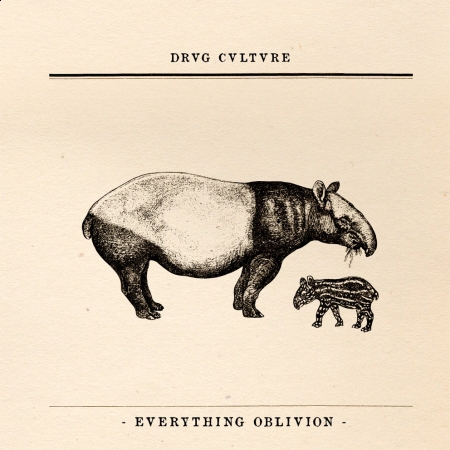
You may remember Netherlands producer Drvg Cvltvre from his remix of Burial & Four Tet’s “Nova,” which we posted a little while back. Now, he’s back with “Black and Rufous Elephant Shrew,” an out-there cut of playful beat work taken from his recently released Everything Oblivion album.
Before his debut long-player arrives later this year, Bambounou is offering up a brief, bass-centric dispatch in the form of the three-track Cobe EP. Here, more than ever before, the Parisian tunesmith strips back the slippery chords, woozy melodies, and extra bells and whistles which marked his previous work, favoring instead a more efficient sound that’s focused—above all else—on concocting massive rhythms.
There is little house-related material to be found on Cobe. On the contrary, the tracks here more resemble Untold circa “No One Likes a Smart Arse” or an even more machine-minded Pangea. This is tough bass music—singed at the edges with just a touch of overdriven crunch and defined as much by its negative sonic space as it is by the elements which fill it in. Alternating patterns of tuned percussion and monstrous low end create almost tribal rhythms, all of it anchored by a single hat which hits on the upbeats directly in between where the 4/4 kicks would normally be. Each of the EP’s tracks dresses up this formula in a slightly different manner. The opening “Chrome” leans heavy on a half-time snare, throwing space-age FX and shuffling hats on top, while the following “Mass” eventually locks tuned tambourines, thick kicks, and a stuttering vocal phrase into a chopped groove. The closing “Deepstaria” comes complete with the most adornments, lacing an almost electro-boogie beat with acid-tinged arps and a gurgling, bouncing bass that serves more of an essential purpose due to its melodic line than its low-end content.
As the EP runs its course, the exact sources of its sounds are almost impossible to detect. Each element is robust and vivid but still hints at being a bit untamed, as if they had emanated from pieces of unruly hardware. On the flipside though, the patterns are assembled with an immense intricacy, fitting together in such a way that the aid of a computer was most likely necessary. In truth, there is probably a hybrid at play, one which well serves Bambounou’s continued movement towards more efficient dancefloor weapons.
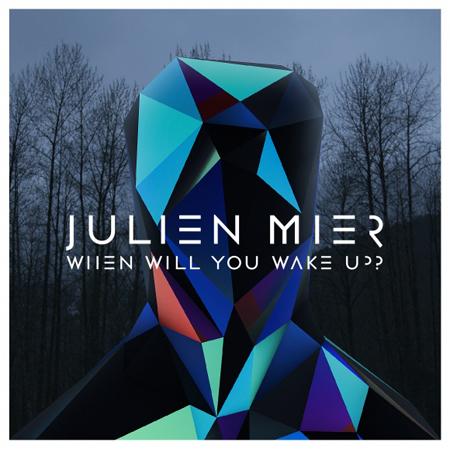
Dutch producer Julien Mier released his When Will You Wake Up? EP via Canadian label King Deluxe last week, and has offered one of its tracks for download. Despite the fact that the soft-hitting “Je t’écoute” is made up of many fragmented melodies, it manages to pull together a head-nodding rhythm out of its glitchy, stuttering beat. Mier’s EP also features “Watercolour Sky,” a tune that was recently treated to a video directed by Vancouver director Stuart Langfield. Like “Je t’écoute”—which uses vocal coos, clicking tongues, and various plinks and plonks as percussion—”Watercolour Sky” uses odd noises to craft its beat. You can check out the video for that track after the jump.
Shenoda is from London. He makes tunes. Beyond that, there aren’t a whole lot of stories floating around about the UK producer, despite the fact that he’s been quietly—and steadily—dropping releases since 2006. While his music has come out on a number of different imprints over the years, Shenoda does appear to have a solid relationship with Hypercolour, which put out his On & On EP a few months back. Now, he’s returned with another EP, A Homage, for Hypercolour’s self-described “little sister” label, Losing Suki.
Heavily steeped in the traditions of UK garage—the EP is titled A Homage, after all—the three-song effort kicks off with “Flex,” a subby number propelled by a skippy beat and a punchy bassline. Propulsive and relatively linear in structure (despite the rhythm’s steady swing), the song hints at ’90s speed garage with its rolling low end, filtered synth and vocal stabs, and upbeat vibe. “Flex” is an effective tune, but it’s quickly outshined by “Every Time I Say,” a choppy, vocal-led number full of infectious vocal bits and start-and-stop melodies. It’s the kind of track that will undeniably prompt grumpier dance-music aficionados to decry its pop inclinations and recycling of a well-worn formula, but while they may have a point, it doesn’t mean that “Every Time I Say” isn’t a wonderfully sticky little song.
Somewhere in between the poles of “Flex” and “Every Time I Say” lies the EP’s final offering, “Bubbles.” It’s another production stuffed with chopped-up elements, but the vocals have been sliced into much smaller—and largely unintelligible—pieces, allowing them to largely serve as just another rhythmic element. “Bubbles” certainly has plenty of bounce, but it’s also rather tracky, the sort of record that serves more effectively as a bridge than an exclamation point. Nonetheless, it’s a quality effort, the kind of thing that Shenoda seems remarkably capable of turning out on a regular basis. Much like his work, the producer doesn’t seem to have a lots of bells and whistles, but he is quite consistent, and perhaps that’s good enough.
London natives My Panda Shall Fly and Benjamin Jackson have just put out a video for “Data-Module,” one of the beatwise tracks featured on their collaborative EP, Let’s Vibrate Together (you can stream it in full here), which was released back in February via Five Easy Pieces. Directed by My Panda Shall Fly and Nic Wilson, the trippy and brash video takes viewers on a journey through a world of colorful visuals and 3-D models that can reasonably be compared to watching the screensaver on an old PC running Windows ’98 while on psychedelics. Floating, rotating arches, compact discs, splashes of color, and checkerboard walkways seem to materialize from the colorful aether, morphing and warping to the steady tempo and synth squelches. It drips with ’90s-CGI kitsch, but when paired with the soundtrack of futuristic synth lines and 808s, the all-out assault of color is oddly fitting.
The Minneapolis-based, Chicago-bred producer known as Triple Six Sound Club has released an EP of bass-centric tunes titled The War to Own the Internet. He’s also unleashed one of the record’s tunes, the hollowed-out burner “I Can See Your Pupils Vibrating,” as a free download. The production lies low in the deepest bowels of sub-bass, where only a few metallic notes rise to the surface amongst the ticking hi-hats. You can listen to the rest of Triple Six Sound Club’s new record after the jump.
Calling himself Baby Prince, Gadi Mizrahi (of New York party-starting DJ/production duo and label Wolf + Lamb) is preparing to release his debut solo EP on September 24 via somethinksounds. The five-track record, called Nobody, was co-produced by Soul Clap‘s Lonely C, showcases two original tracks, and enlists Lucky Paul and Miguel Campbell to remix the title track. To finish out the release, Baby Prince and Lonely C rework Lucky Paul’s “Demon Spawn.” You can check out the tracklist for Baby Prince’s Nobody EP below.
01 “Nobody (feat. Lonely C)” 02 “He Doesn’t Say It To Me” 03 “Nobody feat. Lonely C (Miguel Campbell Club Mix)” 04 “Nobody feat. Lonely C (Lucky Paul Remix)” 05 Lucky Paul “Demon Spawn (Lonely C & Baby Prince Remix)”