Twenty-year-old Simon Ho grew up in a musical household. Dad used to build guitars, his sister was an R&B fanatic, and Ho himself played drums in the school marching band. That love of percussion led his father to buy him a copy of Reason 2.5—which Ho still uses to make tunes—and when combined with his discovery of juke a few years back, Cedaa’s production style was born. Both his “Tiffany” b/w “Simba” single on Car Crash Set and Old Growth EP on Dave Quam’s Free Bass offer a melodic, synth-infused take on Windy City sounds.
XLR8R Couldn't find the embed function for type: "soundcloud" and source: "<embed allowscriptaccess="always" height="81" src="http://player.soundcloud.com/player.swf?url=http%3A%2F%2Fapi.soundcloud.com%2Ftracks%2F3328840&show_comments=false&auto_play=false&color=ff7700" type="application/x-shockwave-flash" width="530">".
This track—originally by UK chanteuse Marina & the Diamonds, remixed here by San Francisco bedroom tunesmith oOoOO (pictured above)—was once a catchy, piano-led chamber-pop diddy, likely meant to simultaneously invoke feelings of love, happiness, and a touch of bewilderment with its thoughtful lyricism and upbeat ivory tickling. But producer Christopher Greenspan has made his version of “Obsessions” an ominous, bass-driven lament, as he managed to turn snippets of the original’s upbeat piano melodies and vocal utterances into key elements of his brooding soundscape. As past oOoOO releases have already proven, Greenspan is deft with sampling the voices and sounds of soulful pop music for use in his own sad, spooky synth-pop compositions. It’s an effective method, and now, he’s just calling it a remix. (via Pitchfork)
Danish four-piece When Saints Go Machine (consisting of a vocalist, drummer, and two keyboardists) is the latest act to sign to Berlin’s !K7 imprint. “Fail Forever,” the title track from its forthcoming EP, is an uptempo adventure into the possibilities of combining orchestrated, melancholy pop with a dance music bed. Driving from beginning to end, the song features rhythmic keyboards pulsing rapidly along with a consistent four-on-the-floor disco beat. The melancholy comes courtesy of frontman Nikolaj Manuel Vonsild’s haunting, almost Arthur Russell-esque falsetto; layered with harmonies, it combines with the slow-moving bass and cellos to make for an incredibly lush track. Apparently When Saints Go Machine have been making some pretty big waves in Denmark, winning the Danish National Radio Talent Of The Year Award and opening the country’s Roskilde Festival earlier this year, but even without that knowledge we’d still be looking forward to their upcoming January EP and the band’s eventual LP expected later in 2011.
XLR8R Couldn't find the embed function for type: "brightcove" and source: "<embed src="http://c.brightcove.com/services/viewer/federated_f9?isVid=1" bgcolor="#FFFFFF" flashvars="videoId=684465804001&playerID=76307356001&playerKey=AQ~~,AAAAEbVM6uk~,vQUVoF2Cm-0Zv8FtEXT603HO0vXqtQ-o&domain=embed&dynamicStreaming=true" base="http://admin.brightcove.com" name="flashObj" width="530" height="449" seamlesstabbing="false" type="application/x-shockwave-flash" allowfullscreen="true" swliveconnect="true" allowscriptaccess="always" pluginspage="http://www.macromedia.com/shockwave/download/index.cgi?P1_Prod_Version=ShockwaveFlash">".
Donning his latest mask of choice, UK producer SBTRKT and his recurring voice contributor Sampha dropped the “Look at Stars” single earlier this year on the Step in Shadows EP, and now the two return on this video for the excellent track. The clip finds the pair milling about within a dark, cluttered room in some undisclosed location; SBTRKT fiddles with an old electronic device of sorts on a table riddled with lots of non-electronic trinkets, and Sampha (wearing a mask of his own, with his singing mouth projected on it) sits stoically in the corner. Not a whole lot really happens, but both the song and the beautifully shot imagery are captivating enough to make up for the lack compelling action. (via Resident Advisor)
Do people give iPhone apps away for Christmas? Maybe they do, we don’t know, but if so, we’ve got a pretty solid one here that you may want to give to your closest music-nerd buddy for the holidays. Our minimal man Richie Hawtin (a.k.a. Plastikman) has another nifty gadget in the works, which will be ready for you to fiddle with next month. Remiix: Plastikman Replikants is a brand-new iPhone and iPad app developed by Hawtin and the fine folks over at Liine. As the press release states, “Remiix is part of this natural progression of immersing the audience further into the spectacle, an opportunity for music fans to interact with, manipulate, and remix both classic Plastikman material and newer reinterpretations.” With spliced elements of Hawtin’s music (much of which is likely to also be heard on his forthcoming Arkives box set) and a slew of EQ settings and special effects, iPhone and iPad owners can tweak their favorite Plastikman tracks however and whenever they please. Expect more artists to be featured in the Remiix app in the future, as well.
Barcelona producer John Talabot (pictured above) only has a handful of productions to his name, but it’s hard to think of another artist who’s making better slow-motion house music right now. (That’s why we featured him in our Bubblin’ series earlier this month.) Granted, when we say slow motion, it’s not to imply that his tracks can’t get a dancefloor moving, and Talabot certainly has nothing to do with the current screwed-music craze; it’s just that his productions are nothing if not deliberate, slowly building from just a few bits of percussion to a euphoric, melody-filled release. The formula works to perfection on this new, nearly eight-minute-long remix of french outfit Tahiti 80. “Darlin” is the band’s latest single and the original will appear on the upcoming The Past, The Present & The Possible album, set for release next February.
If there’s one thing that will probably never vacate the world of electronic music, it’s the scores of imitators ready at a moment’s notice to ape the latest forward-thinking concept and blow it out and water it down until it becomes a limp, played-out, unfunny punchline. Frankly, we’re sick of ’em. Which is why, for this music technology edition, we’ve decided to assemble a few of electronic music’s trailblazers to tell us about what goes into creating a truly iconic sound. From dubstep stalwart Mala’s punishing low-end to Cocteau Twins’ heavenly guitar processing, we got the straight dope on how these innovators crafted their unique sonic signatures—and how they continue to move forward.
Since he began releasing music via the Warp and Rephlex labels in the mid-’90s, Squarepusher (a.k.a. Tom Jenkinson) has become inextricably linked to a large number of genres—like drum & bass, IDM, electronic-jazz fusion, and gabber, just for starters. Responsible for some of electronic music’s canonical records—Hard Normal Daddy, Music is Rotted One Note, and Go Plastic among them—the UK-based musician/producer/auteur gradually carved a signature sound for himself, only to rethink it with his recent d’Demonstrator LP, a jazz-centric collaboration with “a bunch of kids” (his words, not ours) under the moniker Shobaleader One. We called up Jenkinson to see what else has changed.
XLR8R: You’ve said that Shobaleader One is the realization of a fantasy group hinted at on your Just a Souvenir album. How does the songwriting process work as a band since the whole thing stems from your ideas? Tom Jenkinson: I wouldn’t say it’s markedly different. I’m basically making a rough outline of what I want to record prior to anyone arriving, and then playing it to people and seeing what they make of the parts and if they’ve got suggestions. It’s sort of an extension of what I’ve always done in the past, but instead of me being the sole person that experiments with the parts and tries to modify the way they fit with other parts, I’m actually getting input from other people. The point is that I’m definitely not interested in using musicians as just an extension of a sequencer, where I tell them what to do and they produce a result. I don’t really see much point in that because, with a certain amount of effort, you can program a sequencer to sound reasonably like a human being. Sadly or otherwise, you don’t necessarily need people on board to convey the impression of music which is made by a human being. So what I’m keen to get from these people is a sense of their own take on the ideas, and hopefully, bit by bit, them bringing their ideas to the table.
What was some of the gear used on the d’Demonstrator album, as opposed to your recent solo records? The main difference is the [mixing] console. It’s the first time I’ve used something that [could be described as a] “professional” console. Until recently, I was using the Mackie 24-8 bus, which is a perfectly usable console. I’m now using the Euphonix CS3000 console. It seems to sound a bit clearer. If anyone thinks this record sounds quite a lot clearer than my older work, that might be a reason. As far as instruments, they’re not necessarily instruments that I’ve not used on recordings before, but I’ve tried to develop new ways of processing them. Even though a sound is originally coming from an electric guitar, there’s quite a lot of processing in between the guitar and the recording equipment, so you don’t necessarily hear it as a guitar.
“Cryptic Motion”
Let’s talk a little bit about early Squarepusher. Even the complexities of Go Plastic were attributed to using solely hardware. How did those machines help shape your sound? Well, each machine determines, to an extent, what’s done with it. Each machine that I was using in those days—as much as I would try to use it in an open-minded fashion, and try to keep reassessing and developing the way I used it—had a specific mode of operation. There’s no way of getting away from that. Regarding Go Plastic, for example, the sequencing was done on a [Boss] DR-660 drum machine and a Yamaha QY700 sequencer. These things have their specific idiosyncrasies. Certain options are ruled out by using those, and other options are promoted. Certain things are harder to do than they would be on other machines, so you get guided away from some things and towards other options. In any case, you have the result of what happened. That, in a way, is the best articulation of how those different machines were making me operate as a composer, at the time.
You’ve been quoted as saying, “In order to prevent myself from being fully incorporated into any musical ghetto, I have to incorporate every musical ghetto into myself.” How does that apply to Squarepusher today? I must admit, hearing you say that now, that just sounds really pretentious. I think I had a point, but I think I might have been trying to phrase it in a way to just deliberately annoy people. Nowadays, I would say what I was trying to convey was something along the lines of ‘[I’m] trying to just keep mobile.’ One of the problems of working in the music industry is that it’s best for the companies you work for to market you in a quite simplistic fashion. What I’ve always tried to do is to keep those attributes fluid, which makes me quite an awkward proposition in terms of the marketing process. But that’s exactly what I want to do. I want to stay relevant. I want to make things which people actually buy, but I don’t want to be a slave to all of those processes. The one-dimensionality, which I perceive as being a convenient thing to people marketing music, I think is very damaging. So, I’ve gone on to try to be inexplicable. To try to incorporate so much into what I’m doing that it can’t be summarized sensibly—that there is no way of getting down on paper exactly what Squarepusher is. And even if you’ve succeeded at one moment, next time, you’re going to have to think about it again.
Shobaleader One’s d’Demonstrator is out now on Warp
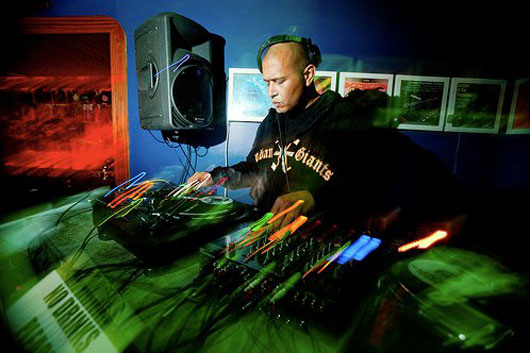
Featured on the forthcoming 12″ release for Primary 1‘s “Never Know” single, this remix by UK bass excavator Submerse (pictured above) is a poignant 2-stepper rife with forlorn string sections, heartwarming pads, distant-yet-piercing synth melodies, and a mess of lovelorn vocal samples. But those are just the parts tugging on your soul; it’s the all-encompassing bassline and skittering dance rhythms that carry those touching elements to the place where Submerse’s production belongs—your next club mix. Score this version of “Never Know” today, but look for more remixes of Primary 1’s track from The Shoes and Gucci Vump when his record drops on December 6 via Atlantic.
London native Danny Yorke (a.k.a. Altered Natives) is set to follow up his recent profile feature in XLR8R‘s pages with a DJ set in his city’s premiere nightclub, Fabric, on December 3. He’ll be joined that night by Shortstuff, Mosca, Girl Unit, and more in Room Three, while the likes of dBridge, Instra:mental, Cooly G, Joker, Plastician, and SBTRKT, among many others, take over the club’s other two rooms. To give you a better idea of what kinds of sounds Yorke will be taking along with him for his set, the mixmaster hooked up a great mix of soundsystem-ready dance music. In Altered Natives’ Fabriclive Promo Mix, you’ll find jams from T.Williams, Martyn, MA1, Roska, Yorke himself, and a handful of other choice producers. We’ve embedded the streaming player for you, along with the full tracklist, below.
Ratcatcher – Chlorophyll T. Williams feat. Terri Walker – Heartbeat – Local Action MdCL presents Sy Smith – Truth (Bertrand Dupart Mix) – Defected MA1 – Blade Runner GHP – Jimmy Go Boom – Loftworks Slackk – Theme From Slackk – Numbers Martyn – Left Hander – 3024 Roska – Untitled R1 Ryders – Pop Shit Off Grayz – The Real Deal Altered Natives – Welcome to Hell Altered Natives – Close Apart Altered Natives – Truth Hz
The elusive Jatoma trio (pictured above) released its self-titled debut full-length of precious, intricately made ambient house music earlier this month via Kompakt, and here, we’re treated to a remix of the album’s bubbling opener, “Little Houseboat,” from Copenhagen’s Kenton Slash Demon. The production duo remains true to the percolating vibe of Jatoma’s tune, as they leave the softly boiling synthscape to froth under the surface. However, Kenton Slash Demon opts for a more crisp dancefloor beat—and tosses in a bit of tasty percussion around the edges, too—rather than maintain the muffled pulse of the original, and it serves the track well. In fact, once things really get cooking past the three-minute mark, you might find yourself torn over which version of “Little Houseboat” ranks highest in your book.