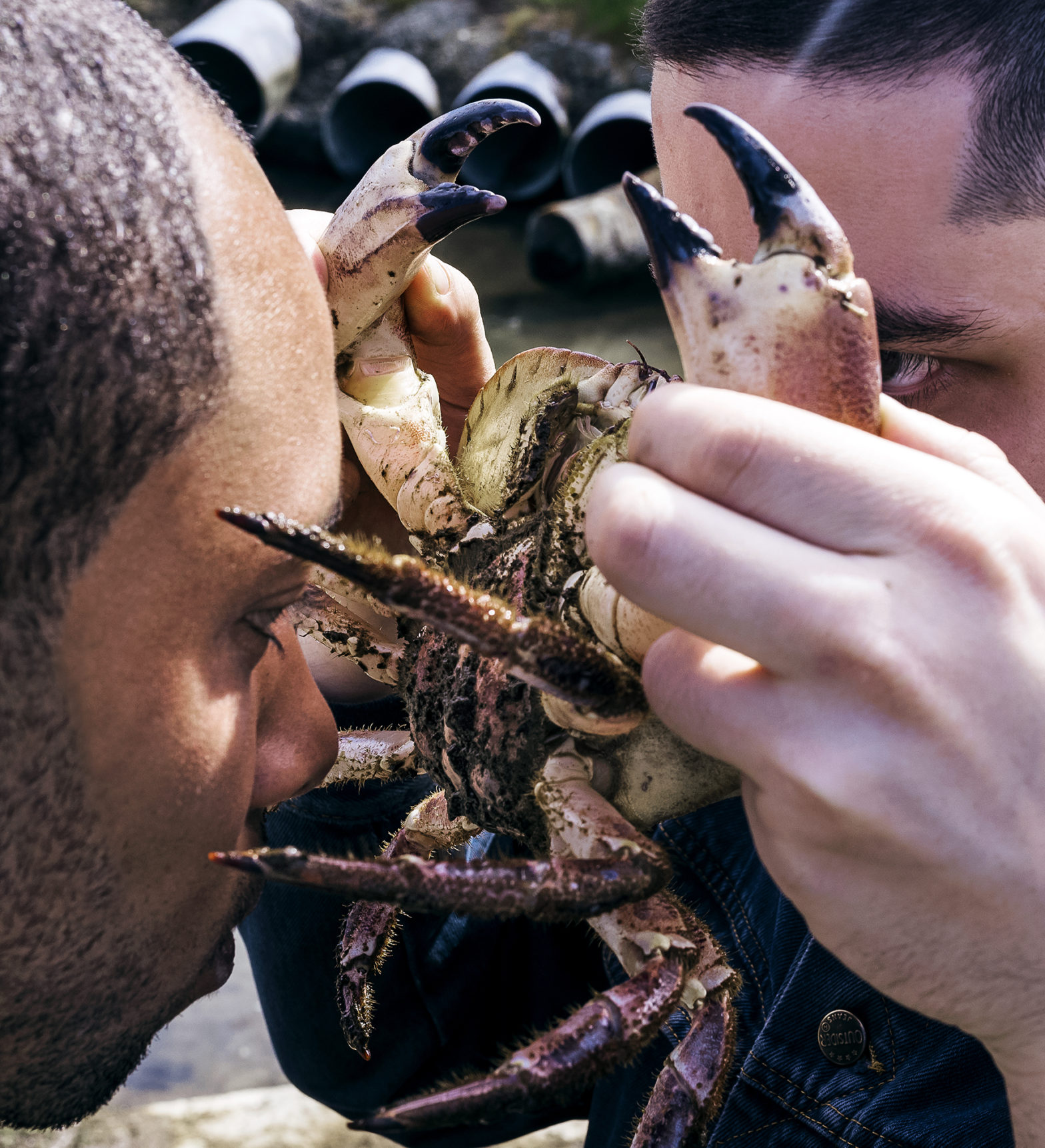
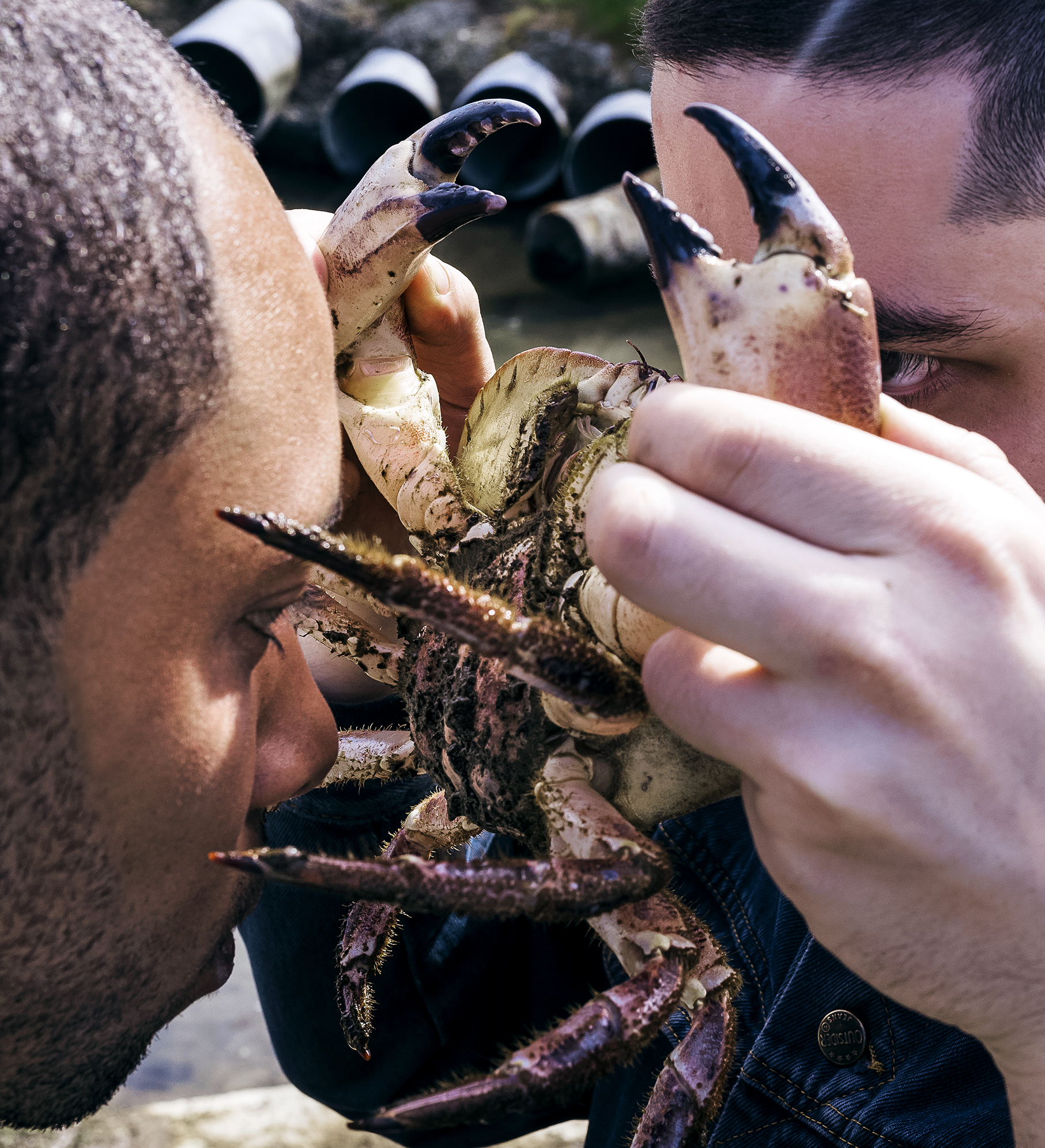
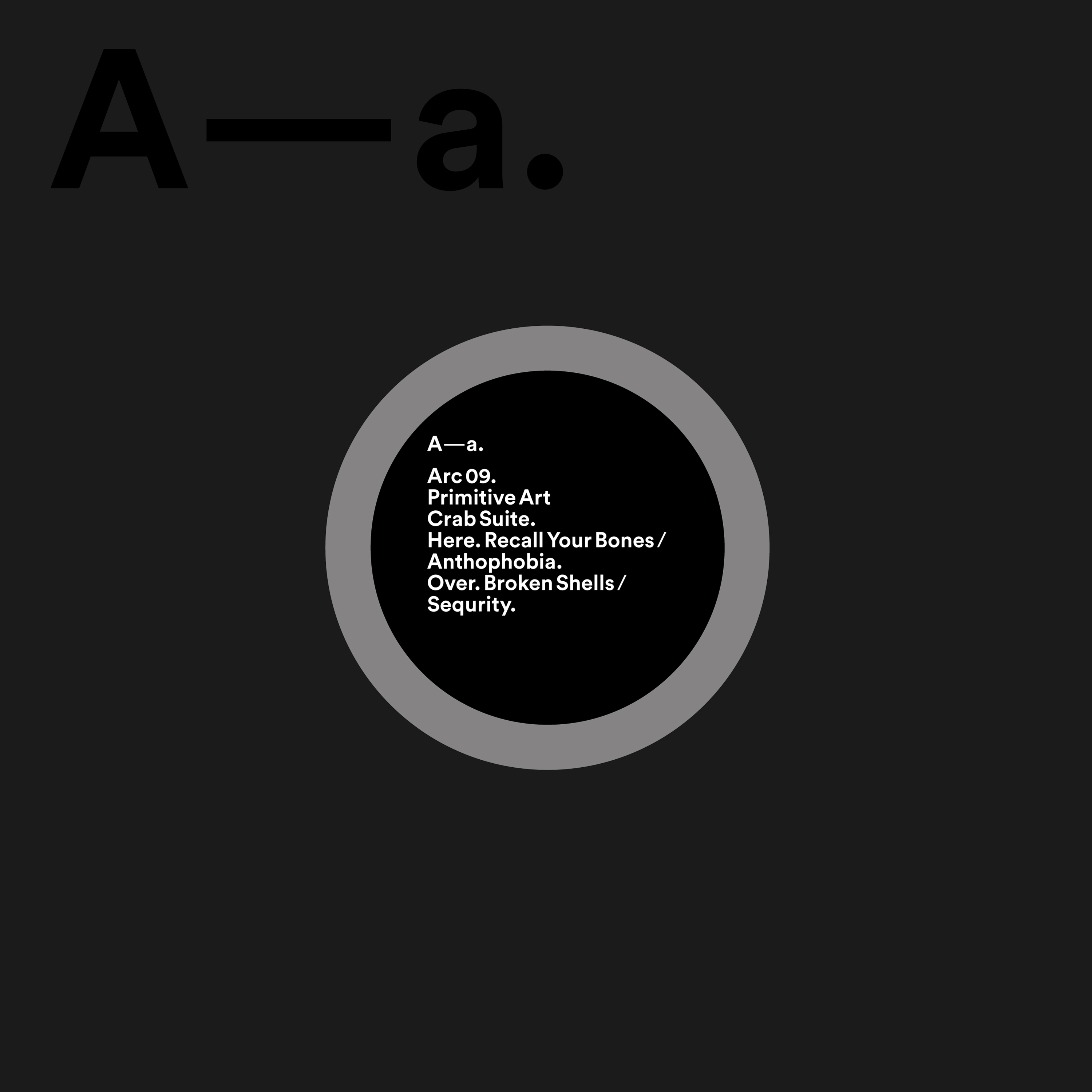
Warp’s Arcola sub-label will release Crab Suite from the Italian band Primitive Art.
Primitive Art is the project of Milano-based Matteo Pit and Jim C. Nedd. They formed the band in 2011 and in 2013 they released their first EP for Hundebiss, the label of STILL (a.k.a Simone Trabucchi). Pit handles the art direction of Club Adriatico, one of the most relevant Italian clubbing platforms; while Nedd recently co-directed “PICO Un Parlante De Africa En America,” a documentary about Colombian sound systems.
Crab Suite, recorded in 2015 and finalized in 2016, is Primitive Art’s follow up to their debut EP Problems. We’re told that it is a “darker take” on the Problems sound, and leads listeners into “stark territories.”
Tracklisting
A1 / 1. Recall Your Bones
A2 / 2. Anthophobia
B1/ 3. Broken Shells
B2 / 4. Sequrity
Crab Suite will land on June 22, with “Sequrity” available for full stream below.
Sophia Saze Georgia-born Brooklyn-based DJ, producer and label owner who specializes in deep dancefloor music—think techno, electro, and rolling house. Sophia kicked off her label, Dusk & Haze, last year with her own Solace EP, which also included remixes from Benjamin Damage & Umwelt. The label’s second release is on its way courtesy of SDX, with remixes from 138 and SC-164. Outside of her own label, Sophia also released a cut on Get Physical’s Words Don’t Come Easy compilation, showcasing a soulful downtempo side of her productions.
Following recent performances in New York alongside the likes of Young Male, and Regis, Sophia is set to play Interface – Scene, an official Movement after party featuring a huge list of techno’s best, including Vril, Kr!z, Cell Injection (a.k.a Drumcell and Truncate), DJ Hyperactive, I Murdered (a.k.a. Luis Flores and Janice), and more.
In support of the gig, Sophia has offered up “Silent” as today’s XLR8R download. The track, a dub-leaning atmospheric outing full of deeply woven textures, imposing synth lines, and hushed haunting vocal lines, can be grabbed via WeTransfer below.
The sinuous Caribbean pulse of reggaeton and the celestial atmospheres of ambient music might appear to have little in common, but in the hands of Brian Piñeyro (a.k.a DJ Python), these disparate genres sound like a natural combination. From his home in Queens, New York City, DJ Python concocts astral synth pieces, anchored by the “dem bow” rhythm—the beat adopted from Jamaican dancehall by Puerto Rican reggaeton producers and since exported around the Spanish-speaking world by megastars such as Daddy Yankee and Don Omar.
On 2017’s album Dulce Compañia for Anthony Naples’ Incienso label, Piñeyro explored this fusion of tropical rhythmic bustle and off-world electronics to captivating effect, creating an irresistible cloud surfing atmosphere, while drawing on elements of jungle and new age sounds. On album track “q.e.p.d,” he summons shimmering apparitions from his machines, while a moody, deep bassline and a locomotive percussion part provide the rhythm; while on “Todo Era Azul (Versión Afuera),” Piñeyro repurposes a breakbeat and presses it into a reggaeton groove, replete with warm, dubby synth chords.
Born and raised in New York to parents of Ecuadorian and Argentine heritage, Piñeyro moved to Miami while he was still in high school, and the Latin culture of the city, including the beat of reggaeton, made a big impression upon him. As an adult back in NYC, he began to make music seriously, releasing tracks under the pseudonyms DJ Wey, Deejay Xanax, and Luis. As DJ Wey, Piñeyro made “Nosebleed”: an oppressively intense minimal techno piece with zonked out bleeps and evil bass blurts, while as Deejay Xanax, he has created IDM-infused jungle, such as the metallic tasting “DJxana2.”
After experimenting with various genres, Piñeyro made a startling discovery. Haunted by a nostalgia for his Miami years, he made his first record as DJ Python, 2016’s ¡Estéreo Bomba! Vol. 1 EP, for Anthony Naples’ other label, Proibito—a very deliberate and novel fusion of his reggaeton past and ambient present. It was to send him in a new and highly original direction. With lots of new projects, plus his own label, in the pipeline, we called up Piñeyro at home in NYC to get an insight on how he hit upon his winning hybrid of styles, what genre means—if anything—in 2018, and where he goes next…
What was the first electronic music you liked?
Lots of Kompakt stuff. My brother went to France when he was 18, and I was 14. He brought me back a copy of Matthew Herbert’s Bodily Functions, and he also gave me Boards of Canada’s Music Has The Right To Children. Then I got into Aphex Twin, Rephlex, and Warp. It was cool having an older brother to show me that stuff.
So you were into this deeper stuff before encountering reggaeton in Miami?
Yeah, I first heard reggaeton when I was 15 I think, around 2000. It was on a bunch at parties, it was what everyone danced to. That and Miami Bass were what everyone played at parties when I was in high school.
When you moved to Miami, what kind of impression did the city make on you, beyond the music? Did you enjoy the Latin American aspect of it?
I moved to Miami when I was 14, and it was a time that was really peaceful and lonely for me. I didn’t have many friends for a while, as I moved during the summer and then making friends in school was tough. I got very close to my Mom at that time, as it was just her and I over there for a bit. I really enjoyed the Latin American aspect of it. The food, the way people talked to each other, the laidback aspect everyone seemed to project. I loved the culture of Cuban coffee shops, going and getting coffee and sitting around talking to friends and people around you. I loved how much people hung out outside too, of course. I was really happy to be by the ocean, that was swimmable all year round as well.
Did you feel an instant connection with reggaeton when you heard it? Were you able to identify with it in relation to your Latin roots?
Yeah, I did, because I found it to be new and exciting, and happening at a time that I felt like I was connecting more with my Latinx culture and heritage. It felt like another way to submerge myself in it.
Were you interested then in how the genres of reggaeton, and techno or ambient, might be alike?
I think at that age I was more a music listener. I made some music with an Electribe, but it was more for fun. I don’t think I ever really thought about that. When I first moved to Miami, it was when blogspots were allowed, so you could go on google.blogspot, and there would be a lot of blogs that would have ambient music. When I met Anthony Naples—he is from south Florida originally—we were talking about growing up there. I was like, “I want to make a reggaeton record for you since you’re from south Florida,” and that was how that whole thing started.
How did you first meet Anthony Naples?
I met Anthony for the first time, I believe, at Mutek festival in Montreal about four or five years ago give or take, and then at Bossa Nova Civic Center. I met him because I was friends with Huerco S and they were working together and good friends at that time. He told me to send him tracks.
Was mixing reggaeton with ambient and house deliberate?
Yeah, it was very deliberate. I knew I wanted to use reggaeton tropes as building blocks, and then do something different on top of it. It was something Anthony and I spoke about when talking about music. We thought it would be an interesting project for both of us to work on together. The house or ambient aspect I think may just be because that’s what I was feeling at the moment. I think right now there is so much interesting riddim-based stuff, be it dancehall or reggaeton happening in contemporary club music. I want to kind of expand on that, and lately I’ve been mixing it with more trance or progressive elements.
Why did you choose the name DJ Python?
I was listening to this mix from DJ Cobra a lot, and it actually kind of reinvigorated my interest in this type of music. I also thought it was a nice name too. I really like albino pythons too.
In making Dulce Compañia, was there a sense of nostalgia about remembering your time in Miami and experiencing reggaeton beats for the first time?
Yeah, for sure. I wanted to make something for kids growing up in Miami, growing up feeling weird. When you’re a teenager, it’s frustrating and stuff. I wanted to make an album for people in Miami to listen to, reminiscent of their surroundings but a little bit different. That was the whole idea.
What is it you like about the reggaeton beat?
Getting into reggaeton, it felt like it was an embrace, like, “Cool, reggaeton is a Latin American thing that is big in the States.” It felt connected to me culturally. That’s what drew me to it.
So was adding reggaeton to the electronic dance that you were creating was a way to express your Latin heritage through the music?
That was something I was thinking of. I have family from Ecuador and Argentina, and I like my family a lot, so it was an interesting way to communicate with them in a certain way, my cousins and my grandpa. It’s cool. It’s actually pretty interesting how everything is split up in club and dance scenes; it’s kind of sad. But I feel like I’ve been embraced more by Latin people through this.
There’s a hypnotic feel to the dem bow rhythm that seems to sit quite naturally with the ambient sounds you add on top on Dulce Compañia. How did you come upon this combination?
It’s weird. Me and Anthony Naples did the first record [¡Estéreo Bomba! Vol. 1] and said, “Let’s call it deep reggaeton,” kind of as a joke. And I was like, “I don’t know, is this new?” I don’t know if it’s a new thing. There are tons of broken beat records with ambient sounds and that’s essentially what it is, but then with a tag to it, it becomes something. It’s fun to make. Dem bow, the rhythm of it, is really smooth to me, which makes it subtle, and almost ambient in nature. It’s normally in your face in the way it’s treated most of the time, but I felt these beats are so smooth, they’re rhythms that should be more chill. I’m glad it worked.
When you made your first mixtures of reggaeton and house or ambient, did it take some work to get the combination to sit right?
Yeah definitely. I think at first, I was talking with Anthony about making a reggaeton record for Proibito. I was listening to lots of perreo and more hyphy, I guess club focused Latinx music. I was honestly trying to make something that sounded like that. At the time I was also listening to lots of downtempo and ambient, things like Mixmaster Morris and Kruder & Dorfmeister, and I was just really interested in this I guess “chill-out” room style of the ’90s and what not. Also that song “Sleeper” by MLO, things of that sort. So I think it was almost a kind of happy accident. I feel the DJ Python stuff is like taking this approach to what lots of techno and ambient techno, downtempo, chill-out, and trip-hop people were doing, but instead of using hip-hop and jungle breaks, just using more riddims and tropes and building blocks that are more common with reggaeton.
Did you consult with Anthony Naples while you were making the tracks, sending them back and forth, for example, to perfect the formula?
Anthony and I worked together more so on things like, “I don’t like this, let’s make this one a bit “bigger” sounding,” things like that, but I don’t think the sounds and feelings were really aimed to create a certain sound. More just like presenting ideas that were different than things we had heard.
Your earlier material under the names DJ Wey, Deejay Xanax, and Luis drew from house, electro, and jungle. Does that reflect the broadness of your tastes?
Definitely, I like all that stuff. It’s just what comes out sometimes. A lot of my friends buy records and they don’t really download music. People who buy records tend to play older house music or older techno or jungle, and people who download music play newer stuff. Scenes are so split up that there’s a contemporary thing, then a digging fetishism separate to that, with genre even.
Jungle seems to be a big influence on what you do in terms of the time stretching on “Cuál” and breakbeats on “Todo Era Azul (Versión Afuera),” is that right?
I like a lot of jungle, especially every time I hear it out. I was watching PLO Man DJ over the summer, and talking with my girlfriend. I was having the best time, and turned to her and said, “This is like God’s greatest gift of music, there’s no better music than this.” I actually feel that way. With reggaeton, it’s cool because they’re actually really similar, from the same building blocks. Different cultures, but both island cultures. That’s a cool thing to explore.
Are genre tags helpful?
I think in the end they’re pretty meaningless. The thing is with that record, it’s maybe a new idea, but for something to be a genre, there has to be a scene surrounding it. To a certain extent, I don’t think that’s the case, but I have talked to people like Riobamba and Debit—I feel like they do something similar which is ambient or more experimental, where they push reggaeton stuff forward. But a lot of the time it’s done in a darker environment and is more industrial leaning. If people want to tag it as something new that’s fine.
Do you think producers and DJs are experimenting with different styles more freely now?
People can push things more now, with the internet. I do feel that way with a lot of club music. Contemporary DJs do such crazy stuff. They play with the audience and it’s pretty interesting.
How does the environment of Queens, New York manifest in the DJ Python material?
New York is pretty grey. It’s a pretty ugly city in a dreary way, but I like it. I feel like it makes me want to make more relaxing music because it’s a stressful city to live in. It’s super inspiring. I love how many cultures there are. Queens is super duper diverse. It’s the most diverse borough.
What do you use to make your music?
I made that album on an Elektron Octatrack and a Virus Snow. The small table-top Virus. That’s it.
What do you play when you DJ?
When I play with Anthony, it’s mostly house and electro. But I’ve been really into ’92-’94 UK stuff lately, the hardcore, euphoric as fuck stuff. I used to think a lot of hardcore was cheesy ’cause of the sampling style, but actually I really like it right now for some reason.
Are your other monikers on-going?
Python is the thing that works the most at the moment, but I have a DJ Wey record coming out in a few months. I want to do another Luis record. The Xanax thing, I’m going to stop using that name, because people think I’m glorifying drug use. I still want to do another jungle or drum & bass record, but I’m going to change that name. Plus, Anthony and I are working on a guitar kind of record. I think I’m going to have more freedom this year to work on music.
You also have another release forthcoming on Trilogy Tapes, please tell me about that.
I’m working on a tape, yeah. I’m going to have a live set on one side as DJ Python, and on the other side I want to map out a few rhythms and show the different ways they go, so towards dancehall and towards reggaeton, towards jungle, and try to mix it all together.
What else have you got coming up?
I’m going to do a record on my own label, called Available.
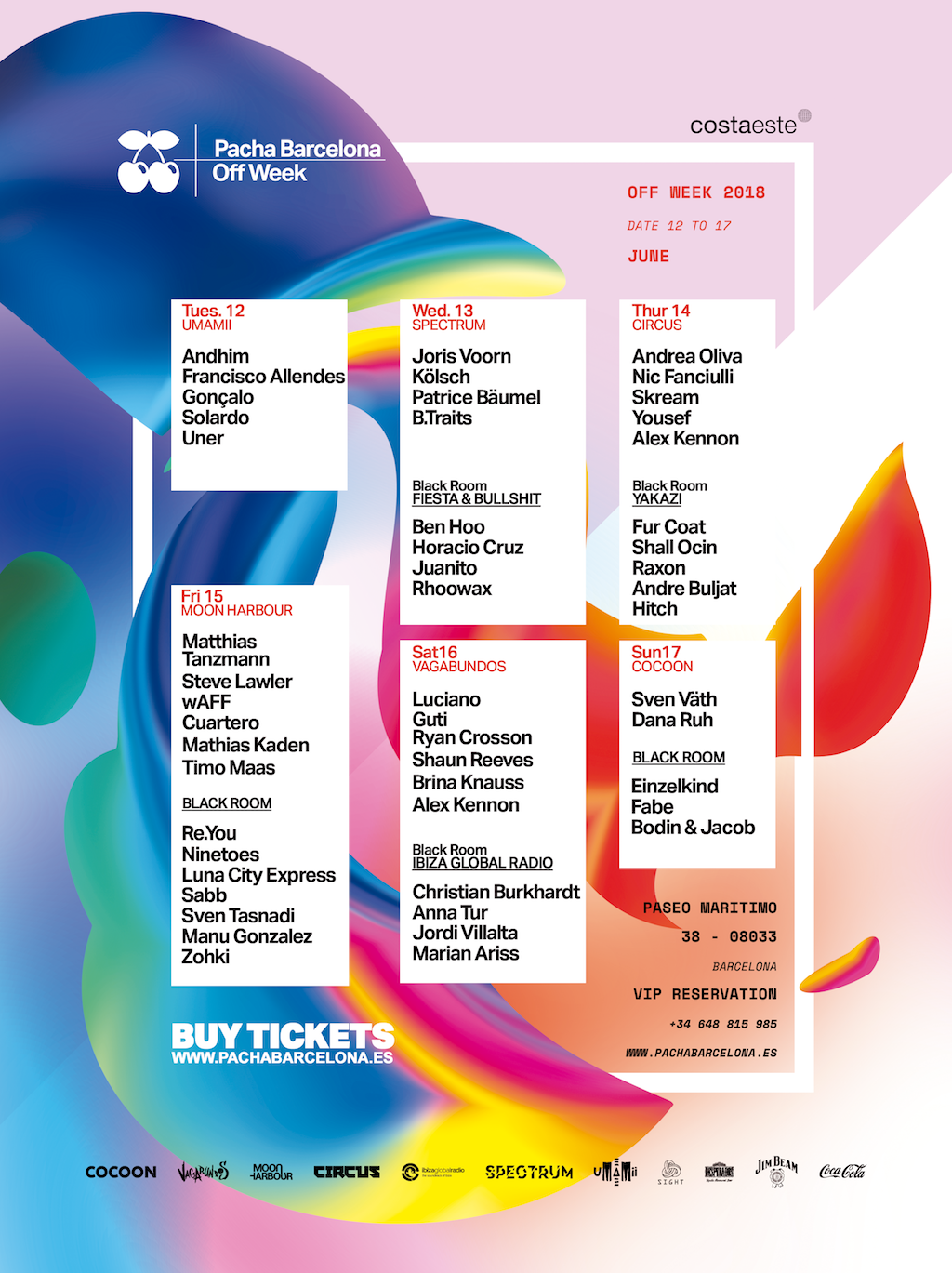
Pacha Barcelona has announced its Off Week schedule, taking place from June 12 to June 17.
The revered institution is once again back with a sprawling offering across the electronic dance spectrum, presenting six nights of some of the most respected club brands in the scene.
Pacha’s schedule will kick off with Umamii‘s Off Week debut, featuring a multi-sensorial concept by Uner and featuring Andhim, Francisco Allendes, Gonçalo, Solardo, and, of course, Uner himself.
Following that will be another debut in Spectrum, a concept by Joris Voorn sharing the name and ideals with the Dutch DJ’s radio show. Performances on the night will come from Kölsch, Patrice Bäumel, and B. Traits, all who will join Joris in Pacha’s main room. On the same night in Pacha’s Black Room will be a special showcase by Fiesta & Bullshit magazine, featuring the deep and melodic sounds of Ben Hoo, Horacio Cruz, Juanito, and Rhoowax.
June 14 will present yet another debut at Pacha Barcelona, this time Yousef’s Circus, which will be headed up by Andrea Oliva, Nic Fanciulli, Skream, and Yousef himself. In the Black Room, there will be a showcase by Barcelona record label Yakazi, owned by Hitch and Andre Buljat, both of which will be joined by Venezuelan duo Fur Coat, Shall Ocin, and Egyptian-born, Barcelona-based artist Raxon.
Friday night’s offering will be a Moon Harbour showcase, with label head Matthias Tanzmann joined by Steve Lawler, wAFF, Cuartero, Mathias Kaden, Timo Maas, Re.You, Ninetoes, Luna City Express, Sabb, Sven Tasnadi, Manu González, and Zohki.
Saturday, June 16 will see another Pacha Barcelona debut, arguably its biggest yet, with Vagabundos, Luciano’s renowned clubbing brand. With the man himself topping the bill, the night will also feature performances by Guti (Live), Ryan Crosson, Shaun Reeves, Brina Knauss, and Alex Kennon, with Anna Tur, Christian Burkhardt, Jordi Villalta, and Marian Ariss playing an Ibiza Global Radio showcase in the Black Room.
Closing a truly insane Off Week at Pacha on Sunday will be Sven Väth’s Cocoon, featuring an enticing selection of forward-thinking DJs in Dana Ruh, Einzelkind, Fabe, and Bodin & Jacob.
You can find more information and tickets for each specific event here.
Following his R&S debut, Afriqua (a.k.a Adam Longman Parker) will soon present Vice/Principle, his second release for the renowned Belgian label.
Recorded in the summer of 2017, Vice/Principle began as one of Afriqua’s seasonal music packs, a quarterly offering of original tracks shared privately with a small cohort of friends and collaborators. R&S quickly picked up the collection, which is said to “expand on the melodicism and textural depth” explored on his previous release for the label, Aleph. We’re told that the extended EP sees Parker veering into psychedelic territory, inspired by the cosmic departures of ‘70s krautrock and jazz.
The title, Vice/Principle, more a coy bit of humor than a philosophical statement, “reflects a wittiness that Parker often embeds into even the brawniest of his productions,” the label explains.
Parker currently resides in Berlin, Germany, where he works from his home studio in the city’s quiet Charlottenburg neighborhood. Born and raised in Hampton, Virginia, Parker developed his craft as a producer while studying classical piano and practicing hip-hop turntablism from a young age.
Tracklisting
01. Vign
02. Melamed
03. Noumenon
04. Cerch
05.Sway
06. Vermiform
Vice/Principle EP will land on June 22, with “Sway” streaming in full below.
Following his R&S debut, Afriqua (a.k.a Adam Longman Parker) will soon present Vice/Principle, his second release for the renowned Belgian label.
Recorded in the summer of 2017, Vice/Principle began as one of Afriqua’s seasonal music packs, a quarterly offering of original tracks shared privately with a small cohort of friends and collaborators. R&S quickly picked up the collection, which is said to “expand on the melodicism and textural depth” explored on his previous release for the label, Aleph. We’re told that the extended EP sees Parker veering into psychedelic territory, inspired by the cosmic departures of ‘70s krautrock and jazz.
The title, Vice/Principle, more a coy bit of humor than a philosophical statement, “reflects a wittiness that Parker often embeds into even the brawniest of his productions,” the label explains.
Parker currently resides in Berlin, Germany, where he works from his home studio in the city’s quiet Charlottenburg neighborhood. Born and raised in Hampton, Virginia, Parker developed his craft as a producer while studying classical piano and practicing hip-hop turntablism from a young age.
Tracklisting
01. Vign
02. Melamed
03. Noumenon
04. Cerch
05.Sway
06. Vermiform
Vice/Principle EP will land on June 22, with “Sway” streaming in full below.
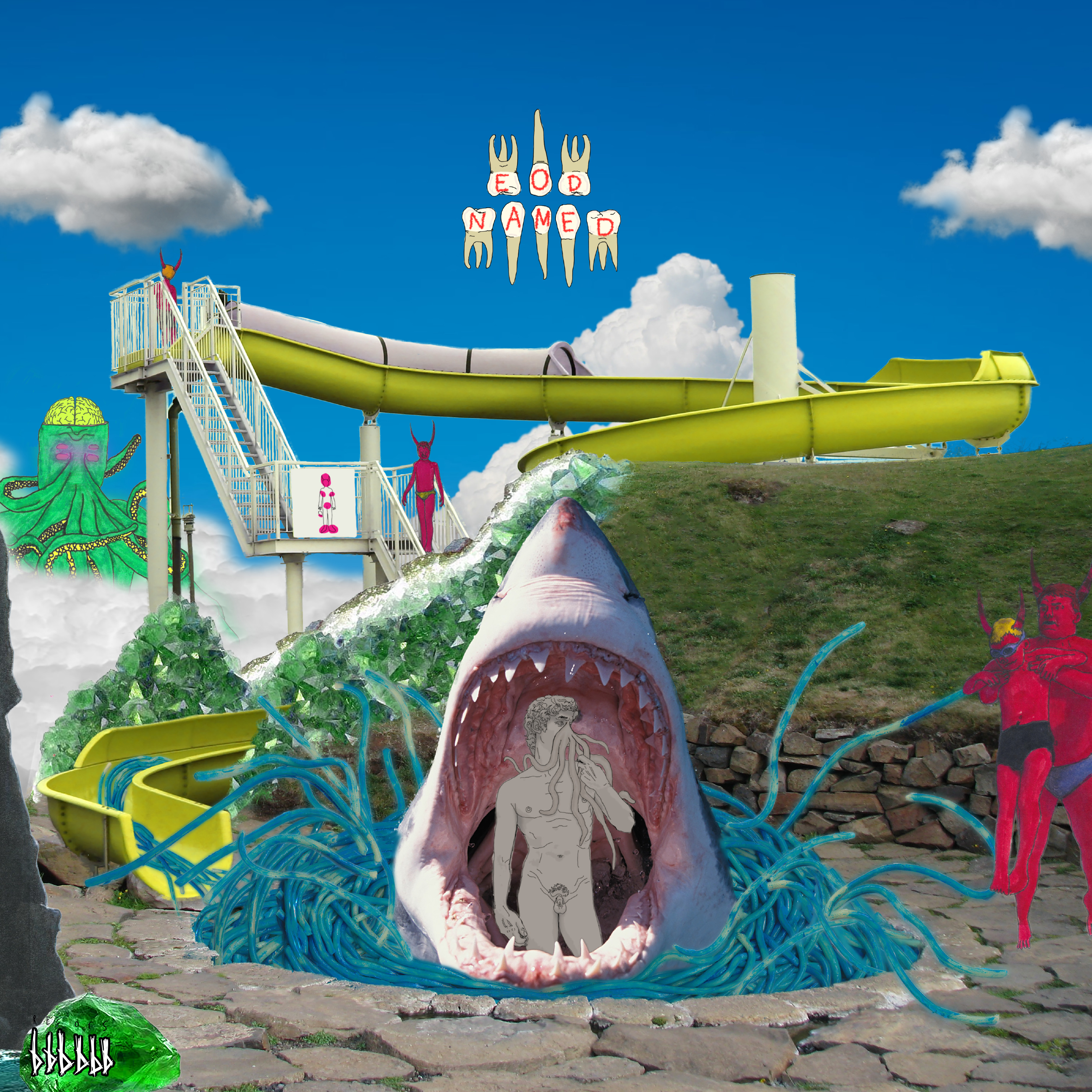
Rephlex producer EOD will drop a 15-track debut album on Bjarki’s bbbbbb this June.
Born in Trondheim, Norway, Stian Gjevik is a rarity amongst electronic music producers. His productions have landed on labels like WéMè Records, sleepers, cpu, 030303, and Aphex Twin’s Rephlex. Dropping on bbbbbb last year, his Swurlk EP sold out within a month and received support from Aphex Twin, Bicep, Bjarki, Nina Kraviz, and many more.
“It’s the album I’ve wanted to do since I started making music—feels like a dream come true. Inspired by what got me into electronic music in the first place; jungle and early ‘00s Warp/Rephlex “drill & bass”-type stuff, but shifted through my own EOD-style lens. Oh yeah and loads of lovecraft references because I love those.” — EOD
The album will be the Icelandic label’s 11th release.
Out-ER sub-label Pregnant Void will present the debut album of hi.mo, titled Urtìis. Landing on double vinyl in June 2018, it is an absorbing showcase of the Italian’s weird and wonderful fusion of various strains of sound from jazz to hip-hop to classical.
“The alteration of conventional musical patterns thrills me,” says hi.mo, who is classically trained in piano and uses that knowledge to play with rules, structures, and forms. Influenced by IDM, African drums, jazz and the interplay of chords, rhythm, and harmony, he infuses his electro-acoustic productions with found sound samples and analog and digital tools. We’re told to expect something in the same sonic aesthetic as Flying Lotus, Fela Kuti, Miles Davis, and Autechre. “The artist’s abilities to push the limits, overlap ideas, tease out new musical ground, and generally take you on a trip are all laid bare,” the label says.
Pregnant Void is dedicated to multidisciplinary cultural projects and electroacoustic music, and this album comes after label founder Simone Gatto’s own album and book, and the Mørk duo’s debut full length.
Tracklisting
A1. hi.mo “Aube”
A2. hi.mo “‘gnot”
A3. hi.mo “Dreams”
A4. hi.mo “Dance In Your Dreams”
B1. hi.mo “Jonaz”
B2. hi.mo “Maakohmustaa”
B3. hi.mo “Ode B”
B4. hi.mo “Pause”
B5. hi.mo “Retro Games”
C1. hi.mo “Sturm”
C2. hi.mo “Yellow”
D1. hi.mo “Parentheses”
D2. hi.mo “March”
Urtìis LP is out on June 8, with “Dreams” available for download in full via the button below.
The EP follows a run of outings from Barrow and Callosum and a sprawling VA featuring cuts from the aforementioned pair, as well as Galtier, Noire, Lew Boo, and more. Cuyo’s new EP is a musical embodiment of his deep connection to the Earth—a driving force for his musical vision—and looks to show an “infinite potential for the people of the world to shape the Earth into a colorful paradise without war, poverty, and prejudice.” As the label further states, the EP is a “response to the growing apathy of an admittedly depressed youth” and an invitation for “a discouraged youth to flamboyantly care more than ever in a world that needs all the love it can get.”
Musically, the release features three masterfully produced originals, from the tense and erratic grooves of “Care Con Flare” to the dembow rhythms of “RIA” and the expansive, bass-heavy wonderment of “τ (Tau).” Alongside the originals, Club Chai co-founder FOOZOOL twists “RIA” into a deep atmospheric ride through subterranean bass.
The prep of the new EP also runs alongside Cuyo’s initiative to help raise money to build a “hurricane-resistant, off-grid school for autonomous building and permaculture located in Aguada.” As Cuyo states: “I am here to crowd fund my participation in Phase 2 of the build (between June 20 – 30), and in continuation of my last fundraiser, help build water collection systems for groups to utilize in other schools and homes around the island.”
In support of the EP, Cuyo has offered up a full stream of “τ (Tau),” available via the player below.
You can pre-order the EP here, with Cuyo’s crowdfunding page here.
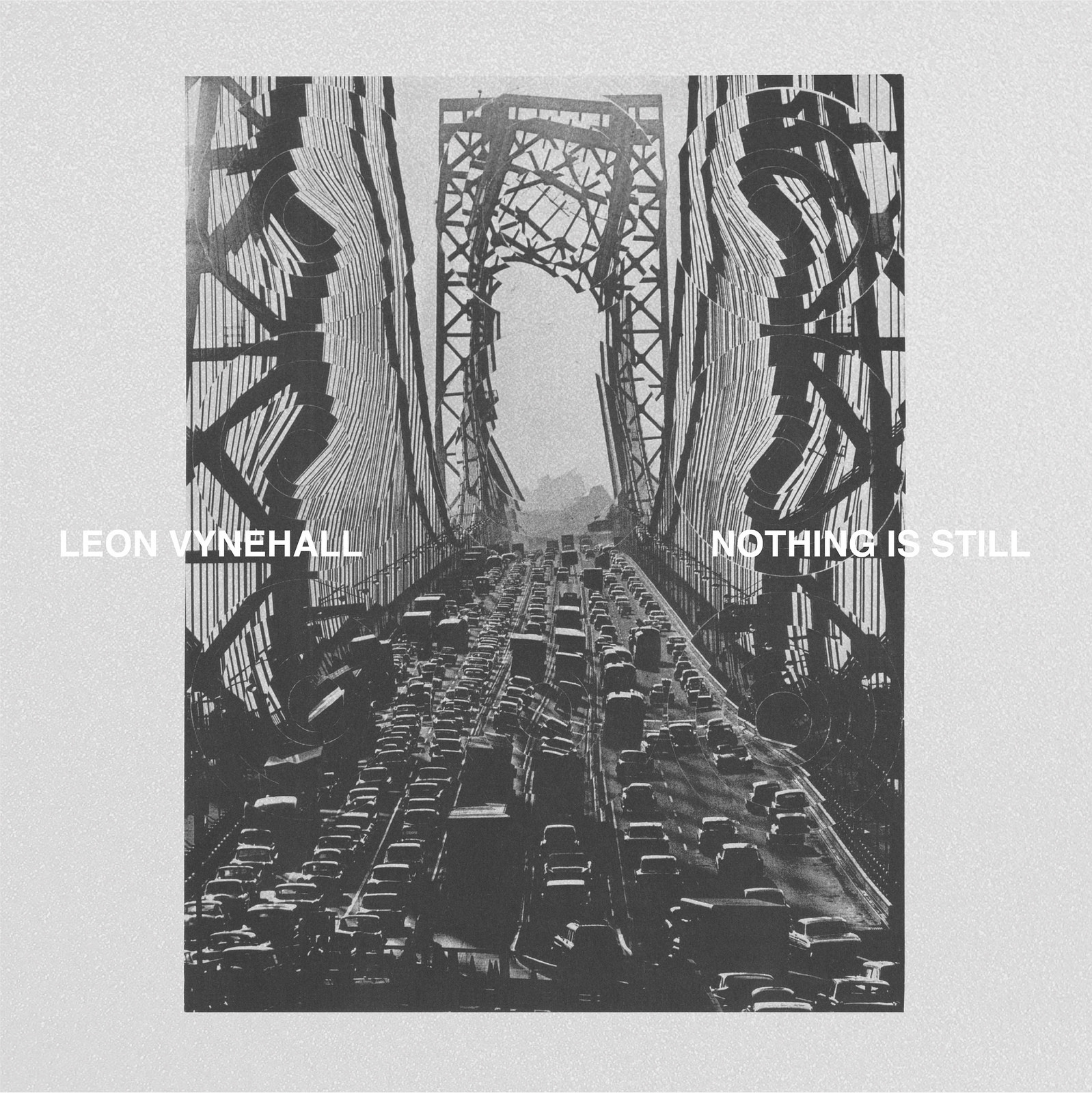
Leon Vynehall has shared “English Oak,” the latest single to be taken from his upcoming debut album Nothing Is Still.
Since the album announcement, Vynehall has shared “Envelopes (Chapter VI)” and “Movements (Chapter III)” as well as their accompanying videos (directed by Young Replicant) and novella chapters. Today he has followed up with ”English Oak,” a track with an infectious rhythm that nods towards Vynehall’s dancefloor prowess while flowing seamlessly into the structure of this grand, textural album. The track is based around a surreal dream that Vynehall’s grandmother had about falling from the top of the Chrysler Building during her time in New York. As well as the original, he has shared a Gerd Janson remix.
Nothing Is Still is, at its core, an album dedicated to Vynehall’s grandparents. Emigrating from a leafy south-east U.K. to New York City in the 1960s, their seven-day journey via boat from Southampton to Brooklyn, and the stories that followed, have only truly come to light upon the passing of his grandfather four years ago. What followed was a series of in-depth conversations with his Grandmother to find out as much as he could about this part of his family history that was seemingly hidden in plain sight.
Tracklisting
01. From The Sea/It Looms (Chapters I & II)
02. Movements (Chapter III)
03. Birds On The Tarmac (Footnote III)
04. Julia (Footnote IV)
05. Drinking It In Again (Chapter IV)
06. Trouble – Parts I, II, & III (Chapter V)
07. Envelopes (Chapter VI)
08. English Oak (Chapter VII)
09. Ice Cream (Chapter VIII)
10. It Breaks (Chapter IX)
Nothing Is Still LP will land on June 15 via Ninja Tune, with “English Oak (Chapter VII)” streaming in full below.