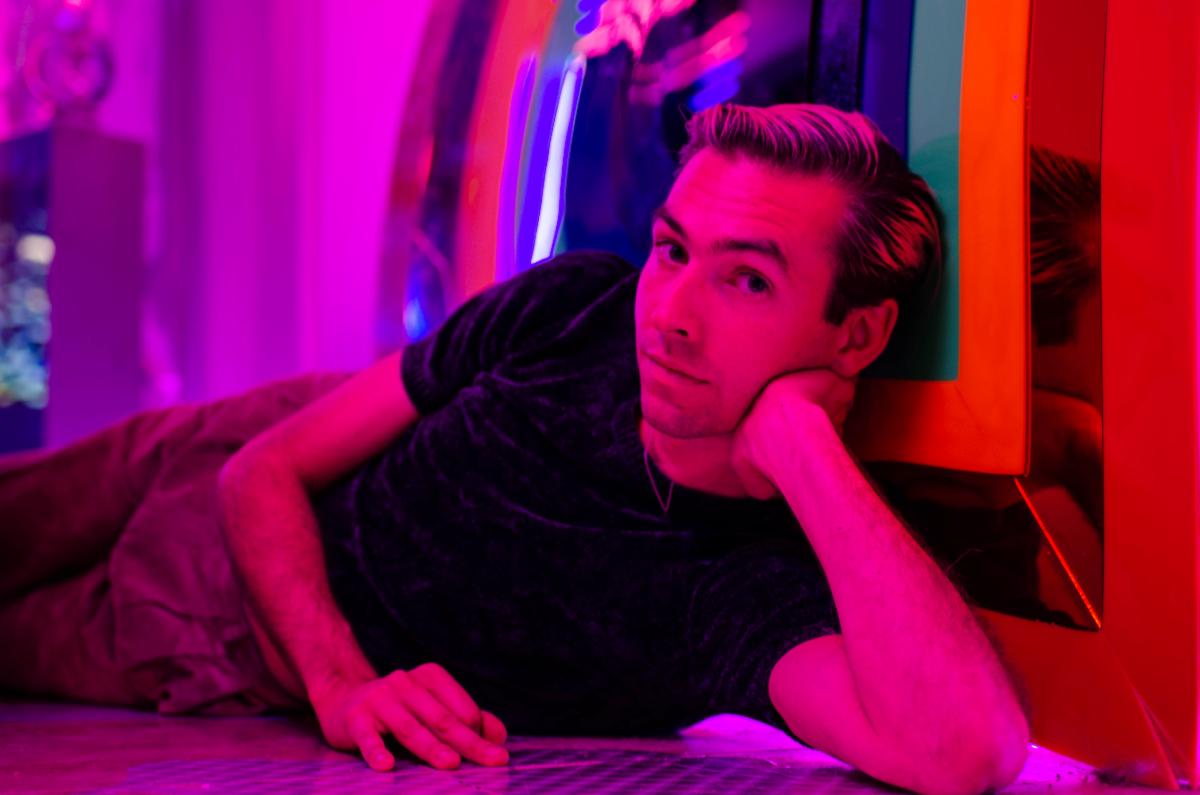
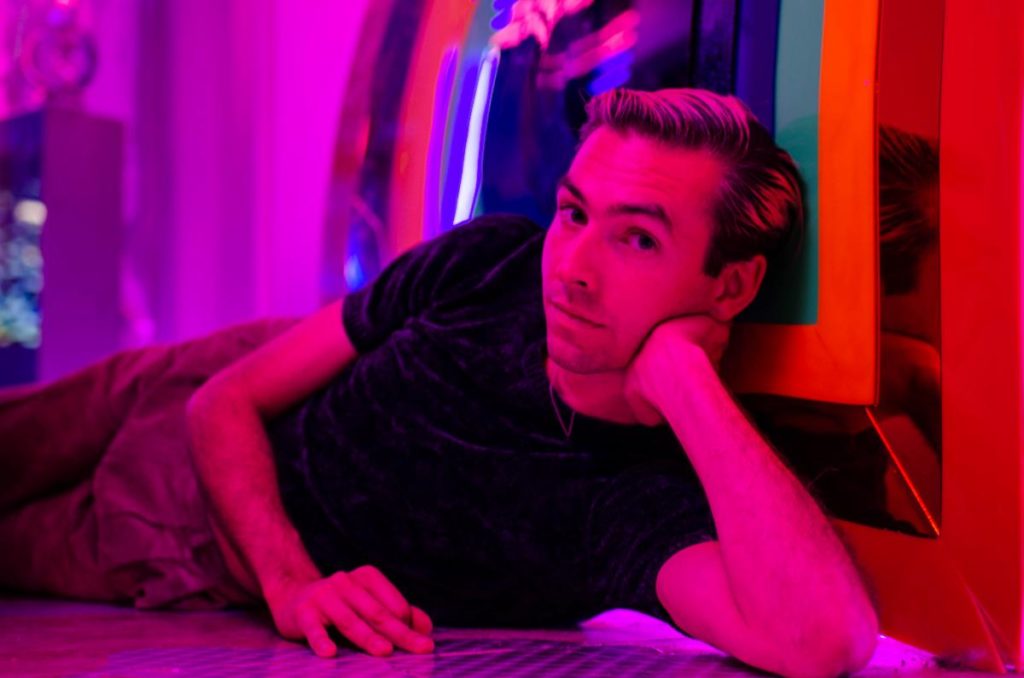
Shaytoon, available now via Dark Entries, is a milestone in Sepehr Alimagham’s young music career. Comprising eight tracks of left-of-center electro and sludgy psychedelia, it’s a debut album compatible with the dancefloor but cerebral in nature, paying homage to the 1970s Iranian albums that soundtracked Alimagham’s youth in San Jose, California. It follows Body Mechanics, Alimagham’s debut on the San Francisco label, in 2018.
The son of Persian immigrants, Alimagham discovered electronic music through psychedelic trance and hard house, but he developed his palette through high school when he’d travel to Berkeley and sneak into local club nights. He later became a regular at Compound, a San Francisco event that took him deep into the city’s historic music scene, driving him to relocate up the coast several years later. He now calls the city home, fitting in music around his work as a real estate agent.
DJing was the natural progression, firstly at local parties in San Francisco, and production came too. With time, his early “tech-house/booty-bass and wanna-be minimal hybrids” evolved into something resembling the sound he presents today, and the earliest incarnations appeared on Germany’s No Brainer Records in 2014. Through all his work, he finds himself drawing on the unalloyed joy of those early clubbing experiences.
He connected to Dark Entries at a time when a deepening affection for psychedelic acid techno was becoming more pronounced in his work. He sent a bunch of fresh tracks to label founder Josh Cheon, then on the lookout for contemporary dance music with a distinct nostalgia for San Francisco’s musical beginnings, and these become Body Mechanics, opening the door for Shaytoon.
Celebrating his debut album, Alimagham has compiled an XLR8R podcast that better resembles a live set rather than a DJ mix. At just over an hour in length, it kicks off with some low-slung beats before the pace picks up around the half-hour mark, and it’s sure to have you moving from there on in. What’s more is that the entire mix is made of unreleased Sepehr tracks, produced during lockdown and ranging from warped house and techno to heady electro, classic acid, and non-conformist atmospherics, unified by that Sepehr edge.
01. What have you been up to recently?
I’ve been trying to keep my mind off of the collapsing in real-time of society by making lots of new music, cooking, reading, and prepping my label imprint.
02. How has lockdown been for you?
The beginning of it was terrible, throwing away all the plans you had, etc., but it was a blessing in disguise for my creativity. I’ve been making more music than I ever have before. I’ve also been learning new skills like programming, design, and finally learned how to read and write Farsi. I really miss hanging out with all my mischievous friends. Also, there are people who deliver black market Micheladas in San Francisco, and I have been very much enjoying at least having those to look forward to.
03. Which artists, labels, or releases have you been listening to?
I have been listening to a lot of experimental/avant-garde/Musique concrète stuff and been really drawn to weird psychedelic and tribal music in general. As far as dance(ish) music, I’ve been really into labels like Ghost Zvuk, YOUTH, and a lot of late ’90s drum & bass.
04. You just released your new album. How are you feeling about it?
I am over the moon about it, and the feedback it has received. The concept I had been wanting to do for a long time now, and Dark Entries as a medium was a perfect harmony. It’s unfortunate that it came directly at a time where people can’t play the music out in clubs but I think it’ll stand the test of time. The album is a precursor for what is yet to come, and I am really excited to continue the name Shaytoon as a label of my own.
05. When and where did you record this mix?
I recorded this mix last month at my partner’s home in San Francisco.
06. These are all your own tracks: tell us about them?
I decided to go with one hundred percent unreleased originals since I have been having a creative renaissance lately and have so much unreleased material that I feel needs to be heard. The tracks are a really good snapshot into my musical mind as of late, mixing influences from all paths of my musical journey thus far. I’m excited about them.
07. How does it compare to what we would hear you play in a club?
I think it is a pretty good snapshot of the types of directions I would go in during a set at a club or an underground party. Parts that get slow and wonky move into some more accessible yet psychedelic dance music and then go into high bpm oblivion, if the mood is right and the drugs are strong.
08. What’s next on your agenda?
Try to weather this storm of the world as best I can, and take things day by day. I will be starting a label called Shaytoon in either late 2020 or early 2021. I’m really excited about it as it will be a vessel for all my unreleased music as well as a focus on Iranian/Middle Eastern artists in underground music.
XLR8R has now joined Mixcloud Select, meaning that to download the podcast you will need to subscribe to our Select channel. The move to Mixcloud Select will ensure that all the producers with music featured in our mixes get paid. You can read more about it here.
Alva Noto is back with the fourth instalment of his Xerrox series.
Xerrox is a five-piece series based on the concept of digital replication of source material. Using the process of copying as a basis, the series deals with the manipulation of data by means of endless reproduction, which allows everyday sounds to become so altered that they can be hardly associated with the source material. As a result, entirely new sounds are created; copies of originals become originals themselves.
The release follows Vol. 1 (2007), Vol. 2 (2009), and Vol. 3 (2015), and unlike its predecessors, whose starting point is a set of samples extracted from external sources and fragments of recordings, Vol. 4 “compounds under a unified cinematic soundscape, warm chords, thrumming digital ambiences, liquified electronics, drones, and noise sustained by floods of strings,” we’re told.
“This fourth volume shuns further from the conceptualism and orderliness of prior musical outputs, ranging from heart-warming elegies to mind-bending sci-fi projections in extrasolar territories,” Noton, the label, continues.
Xerrox Vol. 4 LP is available on vinyl, CD, and digitally on June 19. Meanwhile, you can stream “Xerrox Voyage” in full via the player below, and pre-order the album here.
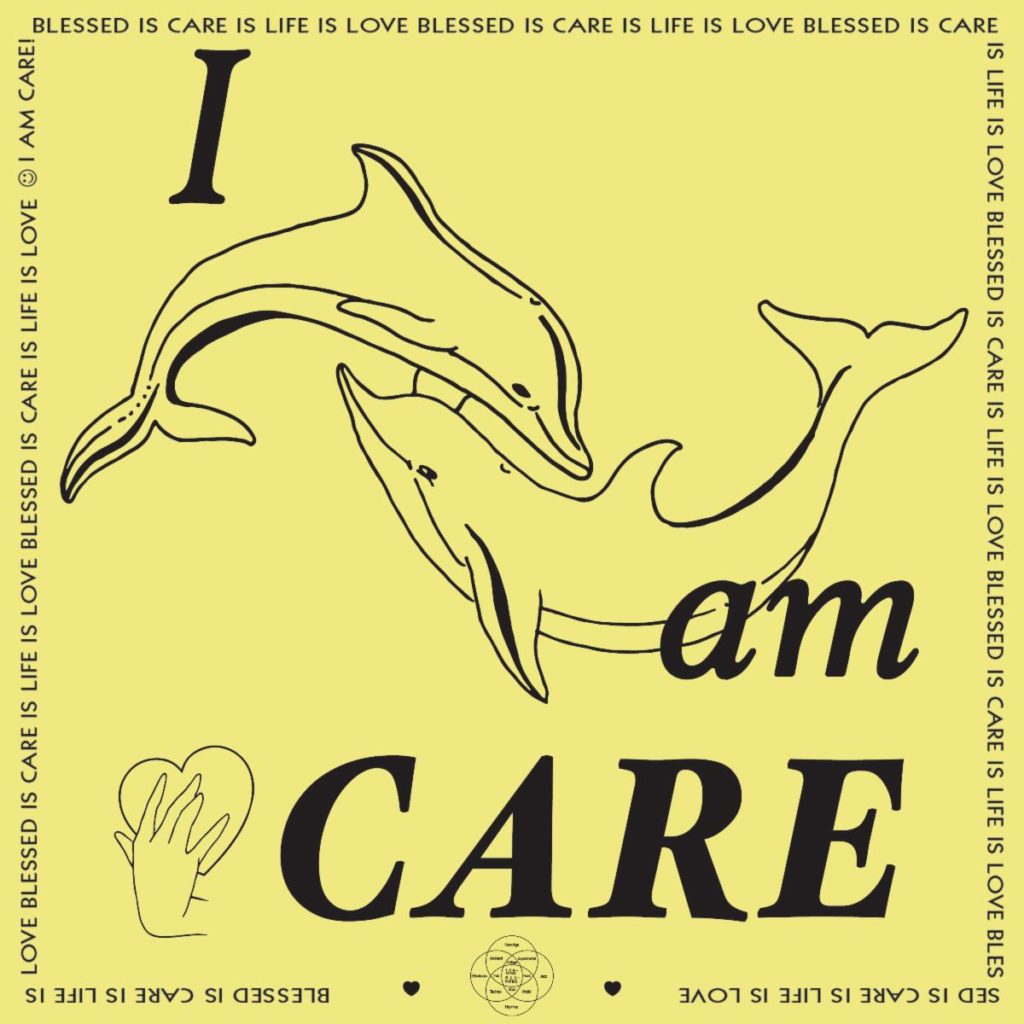
Beginning in 2015, Matthewdavid, real name Matthew David McQueen, has put out several EPs as Matthewdavid’s Mindflight, the last, Ophiuchus, coming in 2017, which he’s followed with a few singles. This particular outing comprises three long-form, constantly shifting Mindflight compositions inspired by the energy of care, which “maintains all life in its embrace,” Leaving explains.
The label continues: “We give thanks to the dust of stars that congealed into the body of this planet, our home, and that gives form and solidity to our bones and flesh. We honor the rocks and their long slow cycles. We give thanks to the living soil, and the billion creatures that haunt her caves and pores and chasms, to the belts and the ants and the termites, to the soil bacteria swimming in the slick of water that clings to her mineral archways, to the worms, wriggling, eating, coupling, and transforming within her.”
Besides the digital release, there’s a limited run a 300 cassette tapes.
Trackisting
01. Tract of Hidden Animalia 02. Tract of Gentle Healing 03. Tract of Bell & Flute Magic
Care Tracts EP is available now on Leaving Records. You can order the record here, and stream it below.
Once again, thank you for all the submissions, and all the great music you’ve sent to us. Another month has passed and we’ve been struck once again by the quality of the music we’ve received, spanning all sorts of genres and tempos. It means a lot to hear from you, and we’re grateful for your hard work and for supporting us. We’ve listened to every single submission more than once—and while we could have featured much more, these are the tracks and mixes that stood out. Please enjoy, and keep sending us your music.
You can find more about the submissions portal and how to submit your music here.
Editor’s note: once again, we’ve made a point of linking each artist’s Bandcamp page, or a place where you can buy their music, and we encourage our readers to support these independent artists by buying their music. Let’s keep independent culture alive.
For those unfamiliar, XLR8R+ is a member-supported music community and curated music experience. Every month, you will get three exclusive tracks—sometimes more—by a wealth of amazing artists that XLR8R has supported over the years, as well as access to the member’s area where you can submit tracks and DJ mixesto be showcased in this feature series and to the XLR8R+ community, as well as exclusive editorial content, mixes, FREE passes to music festivals and events, playlists, and more.You can find out more here.
kuprion “Plus Bus“
–
Since leaving university in 2015, Berlin-based artist Kuprion has dedicated himself to music production, influenced by artists Andreas Tilliander, Âme, Moderat, Sebastian San, Bicep, and Lake People, and by the labels Kann Records, Aus Music, and Whities. His dancefloor-driven music exists in the space between melancholia and euphoria. Under his former pseudonym, Annders, he has released a 12″ on Resopal, and an EP on L’enfant Terrible. Since September 2018, he’s also been working at Oye Records in Berlin. “Plus Bus,” a deep breaks-heavy roller in the vein of Calibre, is one of his latest tracks.
Walk Palmer is Anders, a 27-year-old producer living in Århus, Denmark. He’s been playing around with electronic music for 11 years but has really felt the urge to move his music forward recently. He’s inspired by playful percussion, melancholic and lo-fi synths, and big kicks. Here he presents one of his newest pieces, “Must’ve Been Wednesday,” which pairs subtle percussion with melancholic synth work and a head-nodding groove.
Piero Piccioni “Papà Funky” (Funclab Edit)
–
Funclab Records is an independent label born in 2018, based in Milan, Italy. The label heads have contributed a new edit to the recent compilation ROLLOVER MILANO & FRIENDS against CORONAVIRUS, which comprises 19 edits from the Rollover crew and friends—as you can see from the list on the artwork above, Rollover has pulled in some heavy hitters. All proceeds will go towards the fight against Covid-19. The Funclab Edit of Piero Piccioni’s “Papà Funky” is irresistibly funky, as you’d expect, with Funclab refitting the original with a swinging club framework. Check out the full release here for more.
Yulio released the Earth LP in March 2019, reflecting on climate change, and he’s now re-sharing some of the tracks as part of a compilation that can be downloaded for free from his Soundcloud. The release also compiles tracks from albums Contact Interstellar (2015) and Future Elqui (2013), and serves as a demonstration of the Chilean producer’s great skill in creating experimental environments with harmonics, field recordings, noise, and penetrating rhythms. “Paihuano” is the one we come back to.
Atika Altar is an artist and DJ from Singapore. She presents her palette of sounds through her psychedelic and playful DJ sets, spanning techno, IDM, bass, trace, and tribal, but also electronica, ambient, experimental, and other obscurities. Her versatility has seen her warming up for Brainfeeder’s Lapalux and DJ Shhhhh. “Afloat Against Time” is one of her first public productions, and like her DJ sets, it’s a wonderous amalgamation of styles, balancing deft rhythms and synth lines with a low slung groove.
Neil Foster “This We Have Now” (Optmst Remix)
–
Optmst is the alias of Belfast, Ireland-based, Bangor, Wales-born artist Ryan Macfarlane, who has quietly built a reputation for his distinct take on breakbeat, liquid, and left-field techno. Inspired by primitive trance states, IDM, progressive sounds, and the breaks era, he blends energetic styles into deep and soulful rhythms.
Over the past few years, under various monikers and projects, he’s contributed to the culture in Belfast whilst developing his sound and releasing music from other artists on his label, Born Sleepy. With recent movements including this track out on R&S and more releases in the pipeline he’s one to keep an eye on. Here he’s presented a remix of Neil Foster’s piano-piece “This We Have Now.”
Smva is the solo project of Nikola Tosic, a trumpet player from Belgrade Serbia, now based in Vancouver, Canada. The project is an “experimental laboratory for sound and production,” he says, and the first release is influenced by Balkan brass music and a variety of electronic music genres. We’ve picked the head-spinning jazz cut “Estrelitas” to present here, but we suggest you listen to the whole record here.
Founded by Şafak Öz Kütle, Oceanvs Orientalis aims to “challenge the aesthetic perception in electronic music.” Despite being an electronic-based project due to practical reasons, it intends to transform into a dance orchestra where each instrument is played by its own instrumentalist. This is the first taste of what’s to come. “Oceanvs Orientalis, tunes are not in a hurry,” Kutle says, as you can hear in “LIFE ABOVE THE SKY,” a patient and soothing slice of dreamy electronics.
ke thu are a live act and producer duo based in Detroit. The two have been making music together for the last decade, and conceived the alias ke thu in 2018. Their sound is “an earnest exploration of techno and everything it is capable of,” founded upon an intrigue in the soft, brooding vibes of dub techno, the vast soundscapes of ambient music, and rhythms that often shy away from the typical four-to-the-floor music.” They last released on Symbiostic in 2019, and “Every Aspect” is their latest cut, presenting a masterful take on broken beat, complete with swirling synths and side-stepping rhythms.
A music lover and synth fanatic, Darse began DJing at the age of 13 and began playing out in Insomnia, one of Italy’s most celebrated clubs. It was only then that he found himself drawn to making music. So he left DJing behind and began working in his studio, building a working process founded upon effects pedals and modular. He first released in 2015 on BeFree, showcasing the cinematic atmospheres and dark pads that have come to underpin his work. The next offering from Darse will be a more dancefloor-orientated track on the Afterlife’s Realm Of Consciousness Pt.II compilation, but he’s chosen to share a track from his upcoming album on Obseqvivm Records.
Wolf Light is an electronic music project by London-based artist and producer Jason Wolfe. Wolf Light is heavily influenced by Hyperdub, the Seattle darkwave scene, European ambient techno, and UK dubstep.
For “Cut My Body Down,” he had the instrumental pretty much complete and had started talking to John Nolan, a vocalist in New York, who sent him a rough video of him performing a song of his, recorded on his iPhone. “I ripped the audio and used the vocals in this song,” Wolfe explains. “I sent it to him the next morning and he loved it as much as I do, and we decided it was worth releasing!”
PTMS is from Helsinki, Finland, and a lover of electro. Of the tracks they presented, it was “Continuous Time,” a chunky slice of machine-funk, that we picked up the most, but check here for more. The entire EP is killer and available here, and we couldn’t recommend it more.
Heroarky is a Tokyo-born, Sydney-based music producer and audio-visual artist. His music is characterized by the intricate and textured sounds that surround listeners with an otherworldly atmosphere, summed up beautifully here with “Taiyo to Yama.” His approach to music is often conceptual, evoking thoughts and ideas. “Taiyo to Yama” is an unreleased track stemming from self-isolation.
Bostock was raised in the countryside but moved to London, tempted into electronic music by his mother, an ex-raver, and father, a nightclub owner. He’s played at parties across the UK capital, often presenting his own work that he’s now beginning to release. “Neverland” is the among the first music he’s shared and is an inventive dub groover that begs to be played on a big soundsystem.
Kevin Reed is a producer based in Indianapolis, United States. Little is known about him, but “Dredging Voices” is a deeply moving slice of cerebral techno that we keep coming back to. Check out his Soundcloud for more tracks like this.
Dan Kanvis “With My Bare Hands”
–
Dan Kanvis is a Los Angeles-based artist and designer that flew onto our radar with “With My Bare Hands,” the second single from his upcoming album. This song is a “confrontation” that combines Dan’s influences and the music he was exposed to as a kid into a heady and emotive mixture of hip-hop, bass, and pop-punk.
Fu Dog is an artist based in Cape Town, South Africa, blending jazz, house, acid, electronica, and techno. This is an all-original mix, recorded during the lockdown. Across nearly 20 minutes, Fu Dog showcases his wares, flowing from deeper-than-deep house to swirling dub techno, broken beat, and smooth downtempo, marking him as an artist to watch this year.
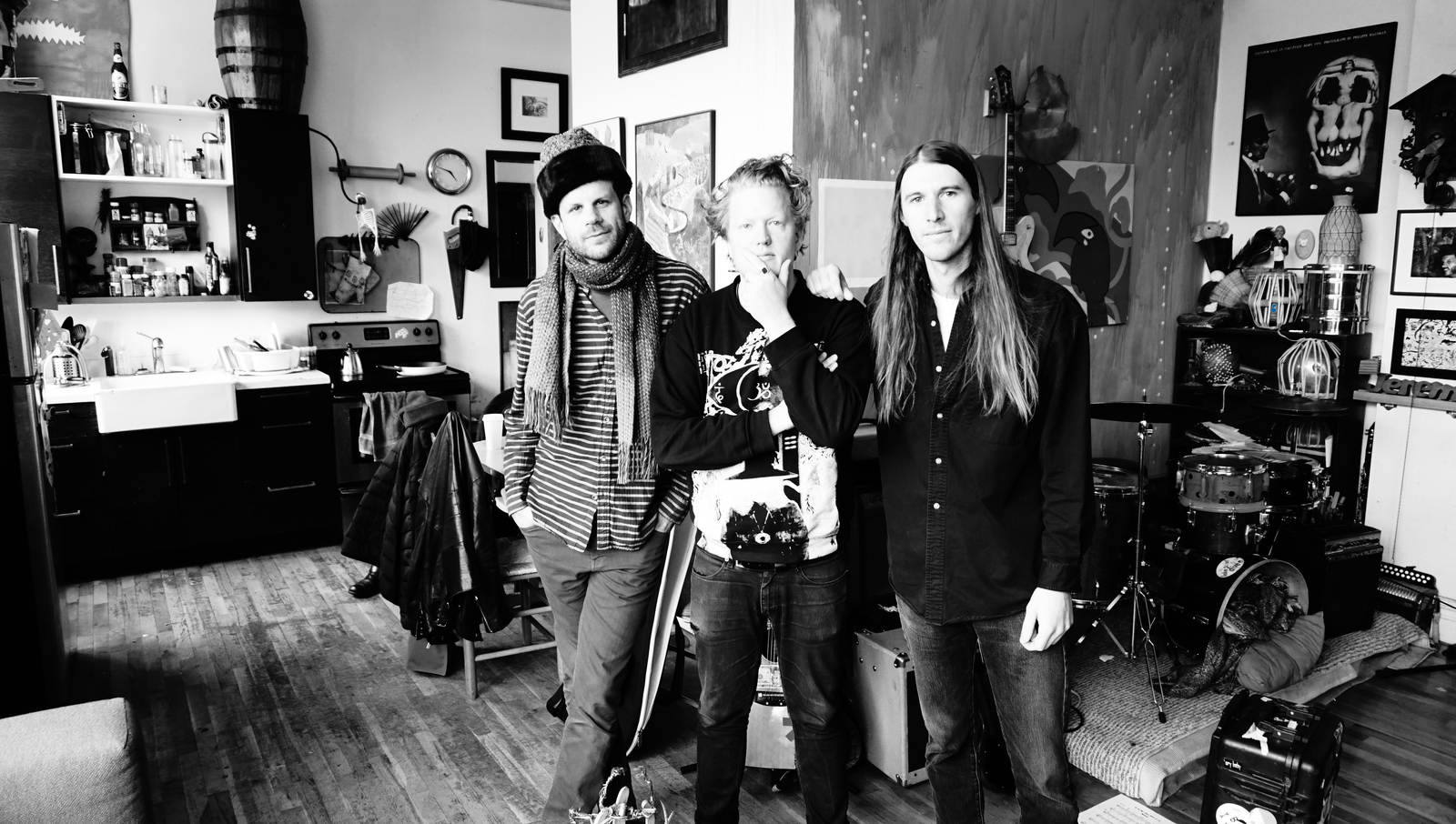
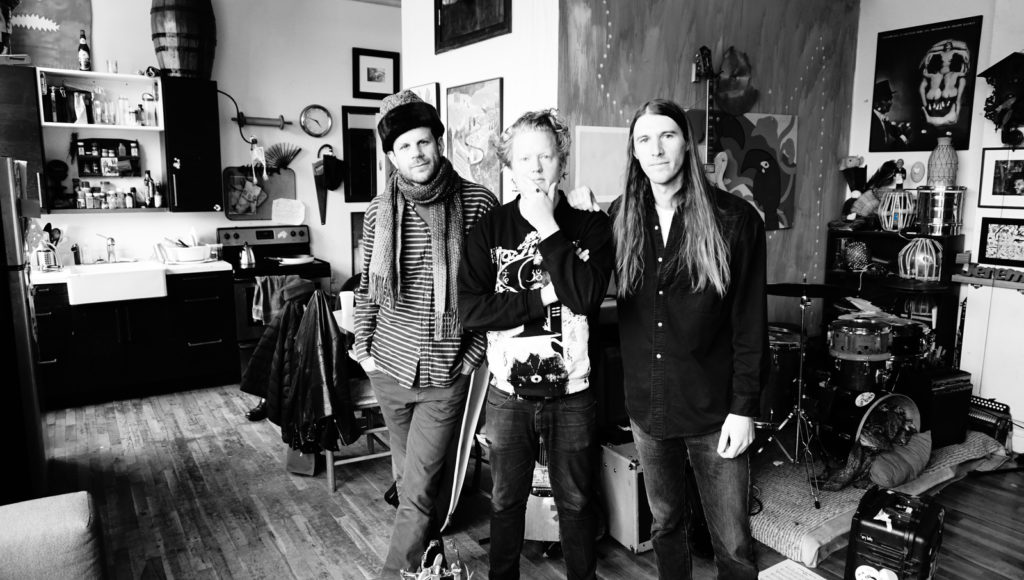
Harrington, Gustin, and Zahn have been friends for years, and found themselves planning a recording. An impromptu debut as a trio in Melbourne, Australia inspired Gustin to start booking gigs for the trio, including at Lunático, a Brooklyn bar that became “not only our little incubator, a place for undirected research, but also a good excuse to hang out and play, and see friends,” they recall. This eventually led them to the house of Jesse Harris, a friend of Gustin’s, where they recorded the album one “lost weekend” last summer.
“We wanted to make music that spoke to the sociality and looseness that permeated our Lunático sets, but was also considered, honed, and welcoming to the listener; something good for quiet headphones and also to just put on while you’re puttering around the house,” the trio explain. “It’s the sound of the three of us being ourselves with each other: talking, thinking, laughing.”
The album is co-produced produced by Harris. “His deep understanding of the jazz vocabulary that we are always circling but never quite speaking, musically at least, was invaluable,” the trio explain. “But most important was his sense of restraint, and comfort with, simplicity and space—he’s the master of a good song.”
Harrington, on electric guitar, acoustic guitar, and electronics, grew up as a jazz bassist. Stints followed in psychedelic, indie, and noise bands, eventually leading to the 2011 debut of his Darkside project with Nicolas Jaar. Harrington has since focused on his solo output, releasing two LPs with his Dave Harrington Group.
Gustin is a drummer who has toured and recorded with many artists all over the world, while Zahn is a multi-instrumentalist and performer originally from Massachusetts. He released his first album under his own name, People of the Dawn, in 2018.
Tracklisting
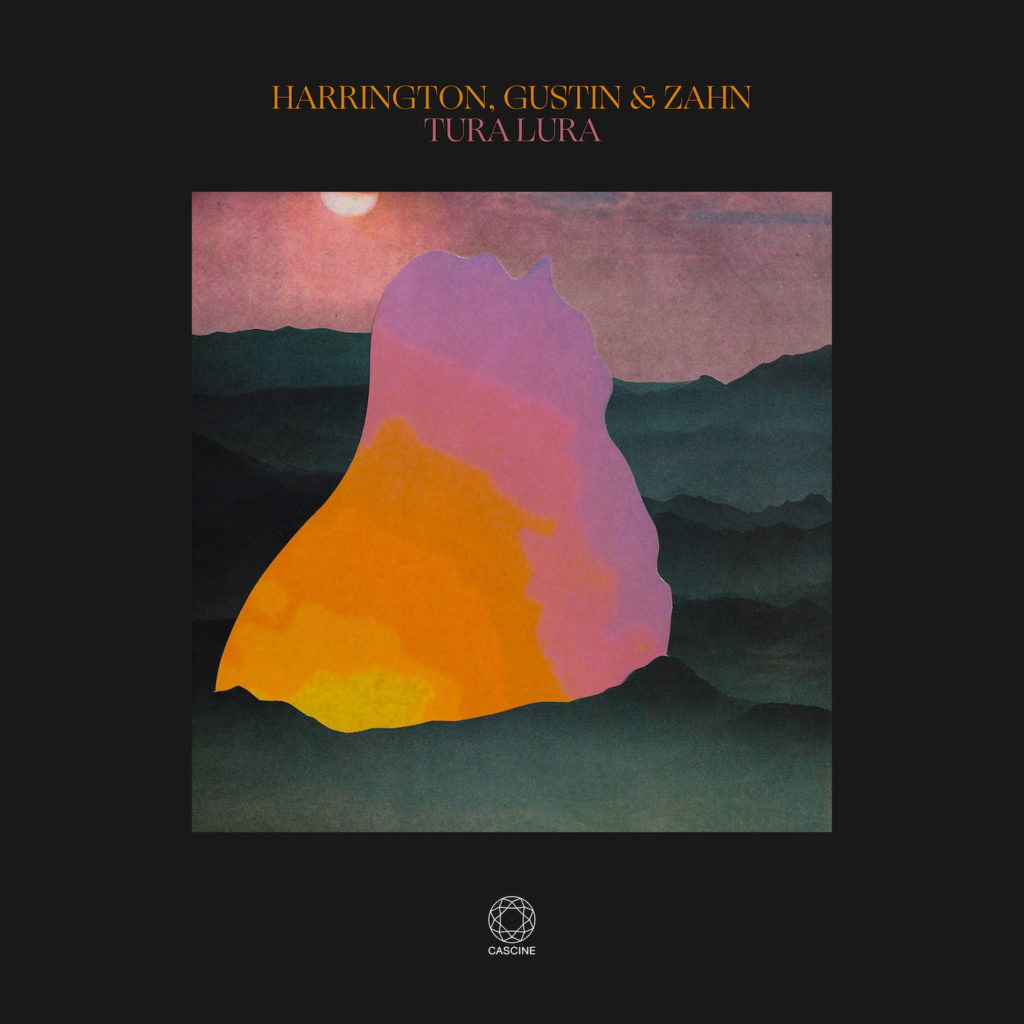
01. All I Can Do 02. Break Light 03. Dynaco 04. Cuyahoga 05. Iasos 06. Deep Breath 07. I Shall Tempo 08. Western Lands 09. Lullaby
Tura Lura LP is available now digitally on Cascine. You can stream a video of a Lunático set below, alongside the full album.
Rafael Anton Irisarri’s new album, Peripeteia, is on its way via Dais Records. The eight-track effort sees the American composer incorporating the metal and classical components of his youth into an ambient palette he’s dedicated more than a decade of his life to. “My previous works internalize any exterior forces or circumstances, while trying to make sense of the world,” he says. “Peripeteia reverses that approach, focusing on the personal in order to tell a wider human story.”
Irisarri was born in the Caribbean, specifically the island of Puerto Rico, and grew up between Florida, New York, and San Juan. He began his music career in Seattle during the 2000s, first making music as The Sight Below before having enough confidence to switch to his birth name. Whatever the alias, he uses music as a means of “coping with the fact that I didn’t seem to belong anywhere,” he says. “To this day, I still feel like this sometimes.”
After Daydreaming, a haunting debut full-length of atmospheric piano (supposed to be released on the now-defunct Mille Plateaux), he’s put out most of his music on Lawrence English’s Room40 and Mexico City’s Umor Rex. His recordings lean on field recordings, bowed guitars, strings, and electronics to create dense clouds of blurry, hypnotic sound, often doused in distortion and with a melancholic edge.
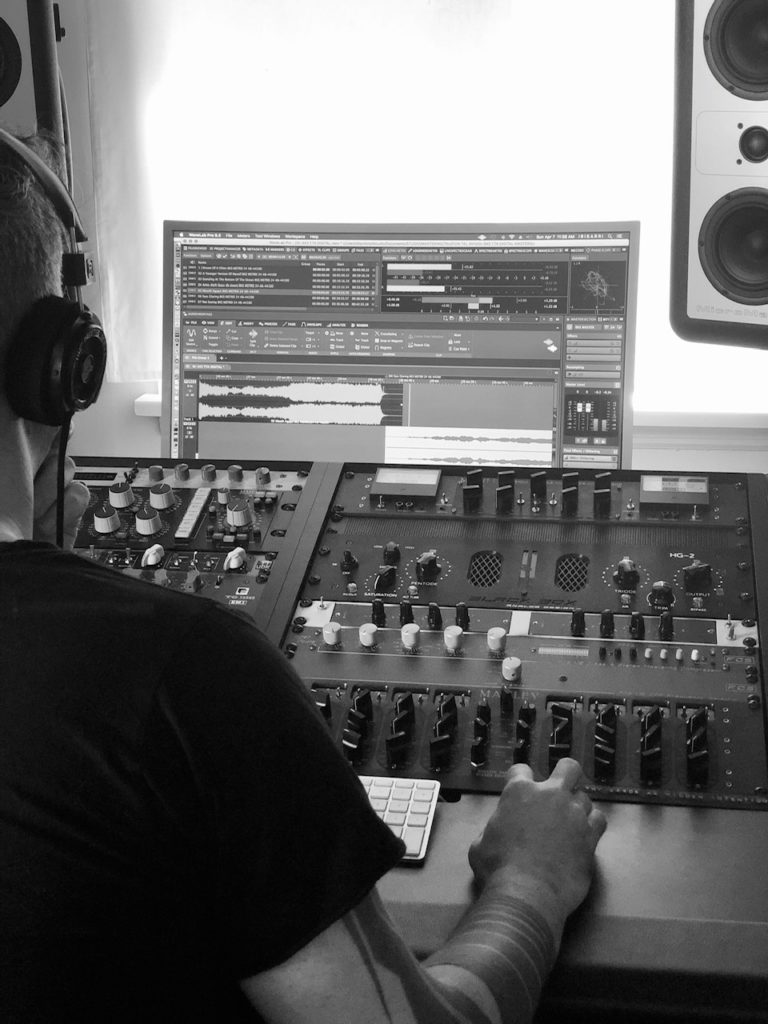
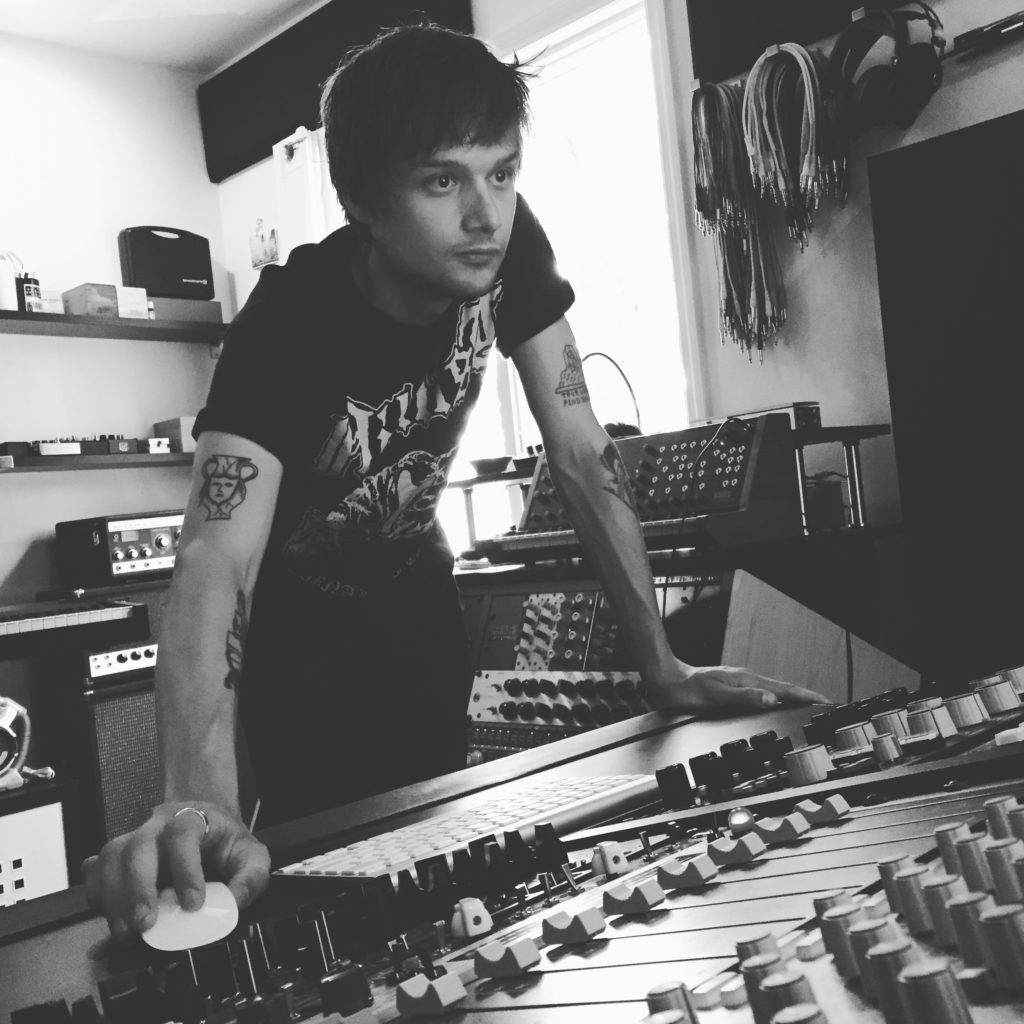
As he prepares for the Peripeteia‘s release, Irisarri explored the core principles of his ambient production techniques. He spoke to XLR8R from his studio in New York, from where he also runs Black Knoll, a sound studio specializing in analog mastering for digital and vinyl. His tips cover the mistakes often made by aspiring ambient musicians, the tools you can use, and important realizations if you are to make what he deems “memorable” ambient records.
Foreword: General Thoughts on Ambient Music
Ambient is a deceptively simple style of music. On the surface, it seems like anyone can do it at home. This is true to a certain extent (it’s not hard to do at all from certain technical perspectives) but making memorable ambient is much trickier than it sounds. It’s not so much about the individual elements—the sound quality of the recording, the performance of the musician, or the musicality of the piece itself—but rather the sum of all those parts working in tandem with the concept behind the piece of music. That’s why something like The Disintegration Loops by William Basinski is a masterpiece and the YouTube 800%-percent-slowed-down-videos-wasteland total rubbish. This characteristic makes ambient an easy genre to dismiss as either amateurish or pedantic.
Making ambient music requires an entire different set of listening skills—deep listening, as coined by the late great Pauline Oliveros. It’s about focusing on areas most people don’t, and bringing those areas to the forefront, and the recording process (tracking, mixing, mastering) itself is as important as the musical notes or sounds in the composition.
If we use the aforementioned album by Basinski as an example, the process of the tapes disintegrating on the reels when he created the music almost two decades ago is integral to the arrangement and the feeling of the piece. In 2011, the Wordless Music Orchestra performed “Dlp1.1” live at the Metropolitan Museum of Art and they even adapted the “disintegration” process into a musical score/notation. In the recording of the live performance, you can hear the musicians’ instruments disappearing as the piece progresses.
I liken the process of ambient music to stand-up comedy: it’s one thing to tell jokes to a couple of drunken friends at a party and another to build an entire routine that works with a crowd at a comedy club. With ambient, it takes a lot of time to find your own sound and learn to communicate complex ideas in a musical language that is minimalistic and shy by nature.
Also, none of my advice here should be taken as a “this is the way to always do things.” While the road you take might influence the musical result, ultimately, the questions to ask yourself are: does the track sounds interesting, beautiful, or innovative? Am I satisfied with it?” There’s more than one way to cook an egg, and I hope these ideas can facilitate this process.
Before You Break the Rules, You Must Learn Them
As artists, we must aspire to break the norm. We want to create something different from what came before us, and sometimes that requires us to go about things in a way that is contrary to how it has always been done. But it’s also important to know the rules that you’re breaking, or are going to break.
It’s easy to think that knowing and following the rules will make you sound like everyone else, but that’s not true. There is always the individual touch of the artist, musician, and producer. You can even have the exact same equipment and set up as “X” artist and play the exact same notes through the same rig, and it will still sound different to the way they recorded it. You can think of the fundamentals as a scaffold to hang everything else off, but the good stuff will come when you’ve left it all behind and do your own thing. We are all using the same 12 tones in western music, it’s all about how you combine, or don’t combine, them in interesting ways.
I’m not a trained musician, but I’ve developed a lot of knowledge of music theory in my time in music, although its limited compared to my peers who went to college, at great music schools like Berklee College of Music in Boston or otherwise. I am one hundred percent self-taught and have spent a considerable number of years on my own learning music theory and harmonic principles. When I started playing music, I actually relied on friends to pass along musical knowledge (in lieu of “real” musical school training). Then in my teens, I’d spend hours reading songbooks I’d buy at Sam Goody, watching guitar videos from ’80s rock & rollers on VHS, and playing along to records. Eventually, I got a hold of different music theory books at the library (my mum was a librarian, so she would order books for me that were taught in college) and would spend hours reading and learning.
Knowing things like the circle of fifths helped me when improvising with other musicians, and it also helped me when I started to play around with samples, as I started making electronic music in the ’90s in my bedroom. It taught me things like: “Oh this cool bassline I’m sampling is in a C major scale, and this awesome guitar sample is in C minor scale, so if I transpose the pitch of the guitar sample by 400 cents up to make the sample E minor, it will fit really nicely with the C major scale on the bass and sound musically coherent and in tune.”
Nowadays, you can find tutorials online on YouTube—and the subjects range from music theory to music technology, and it’s a wonderful thing having access to all this information for free. You can also find your favorite musicians doing online workshops and even doing tips or full-on masterclasses on social media like Instagram. (Just today, I watched my buddy Telefon Tel Aviv do an entire workshop on designing drum sounds!)
Knowledge is incredibly important, because we live in an era in which ignorance is praised and facts are discredited. Musical knowledge should be celebrated, not frowned upon. The great late Mark Hollis once said: “Before you play two notes, learn how to play one note, y’know. And that, it’s as simple as that really. And don’t play one note unless you’ve got a reason to play it.”
Learning music theory will not only expand your vocabulary but it will also help you understand why some of the music you love works in the way it does and hits you in a certain way. It will help you understand at a deeper level what makes that song you love so great. In no uncertain terms, it’s a valuable use of your time.
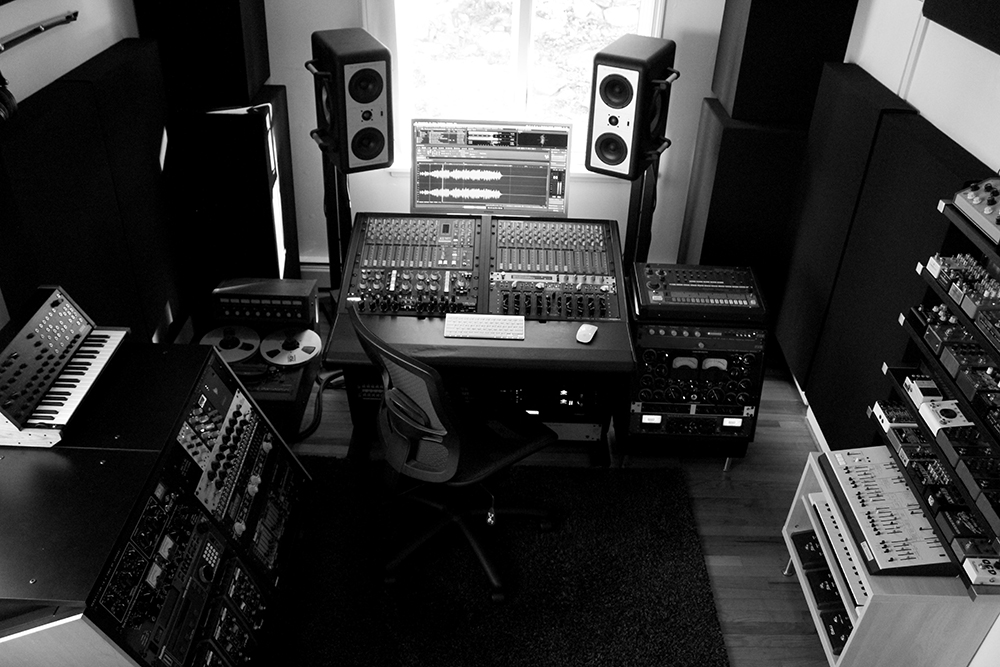
Black Knoll Studio, New York
The Studio is the Ambient Musician’s Instrument
Ambient music is predominantly created in the studio. Unlike, for example, a punk rock band, where the musicians will get together at a rehearsal space and write a song using their respective instruments (or perhaps even write a song during a soundcheck while on tour), ambient is written and developed inside a studio, where an individual(s) has an array of different tools at their disposal to create sounds.
What I mean to say is that when I’m working on music, it is never about the particular instrument I’m playing, but how the instruments, effects, mixer, etc. become the source for the various sounds I’d improvise with and use as the basis for a composition.
One of the most effective ways to work, I find, is to build all your sound sources first—whether individual sounds, samples, or short or long loops. Create the building blocks to which you’ll start your workflow, much in the way an architect does their craft. I have amassed many hours of field recordings, for example, hydrophone recordings of water, many forest walks, birds, things like that. I can use those as the foundation of some ideas.
Keeping processes organized, and compartmentalized, helps my focus, much better than trying to think of a melodic line, for example, whilst simultaneously programming a synthesizer to develop the sound for the particular line. The technical processes, like creating a sound from scratch, are better addressed separately. Of course, there are times when you build a cool sound on a synth and immediately come up with a musical idea because of it. When this happens, I just go with the flow. Ultimately, inspiration is more important than the X or Y method of writing.
One little trick I love to do whenever I’m writing is to take a field recording and map the sounds’ transients to MIDI notes in Ableton Live and experiment with the naturally-occurring rhythmic patterns of a field recording, utilizing those as the rhythmic foundation. Another thing I do is find a field recording with a tonal element (for instance, the drone created in the bathroom of a train cart) and load that into a sampler, utilizing it as the sound source, then running it through different elements like filters and effect units. A lot of the time in the studio my job is spent just managing the results of hours of improvisation.
Tracking Guitars for ‘Peripeteia.’
Document Everything
There is nothing more frustrating than arriving at the most beautiful loop you’ve ever heard and realizing you’re not set up to record it, which means it’ll be lost forever. Make a habit of being prepared to record and hitting “record” before you start doing any improvisation. I feel that whenever I’m improvising, lots of unexpected things can happen; music leaves your brain and goes to certain places, and sometimes you just have to set up the machines and let the experiment run its course. Sometimes it is just a matter of sitting back and letting the sound unfold on its own.
Before I touch anything in the studio, I make sure everything is patched correctly so I can record the results of an improvisation. I check to make sure everything is turned on. I make sure the signal flow is working so the Digital Audio Workstation, tape machine, or portable recorder is capturing the sounds I will generate, and that the gain staging is adequate so that there is no clipping or unwanted distortions. The signal-to-noise ratio must also be adequate, because you don’t want to end with a recording that was captured so low that all you hear is the tape hiss or machine noise—unless that is what you are specifically rooting for!
Speaking of improvising: last year when I was working on Peripeteia, I was messing around with an instrument called Metaphysical Function on Native Instruments’ Reaktor. One of the cool things about Reaktor is it lets you record whatever you are doing directly to your hard drive. So I remember sitting with it for a few hours and capturing many cool moments. Some of it ended up in moments during the album, whilst other sections of the improvisation I saved as part of my own library. It came in really handy to have this, as I was recently working on a film and one moment in the improvisation matched this particular scene’s mood rather well, so I ended up using it in it. This is why it’s so important to document everything you do, because you never know when you can use it.
Embrace Limitations as Part of the Creative Process
I spent my childhood in a single-parent working-class home in San Juan, Puerto Rico (that Caribbean island “surrounded by water. Big water. Ocean water”). Growing up poor meant we had to get creative with different aspects of our daily routine—to figure out how to stretch out our money to make it last until the next pay-check. This experience wired me to think differently, to accept limitations as not a roadblock, but rather an opportunity for creative thinking.
Instead of thinking: “Oh, I could make this sound much better if I had X piece of gear,” the questions I’d ask myself were: “What can I make with the three pieces of gear I currently have?” Technically-speaking, I wasn’t a gifted instrumentalist—I could play enough guitar and bass to perform with a few punk and reggae bands when I was a teen, and I can barely play instruments with a proper technique now. But I’m able to identify and adapt to the situation, which is an important skill for any musician making improvisational music, like ambient.
Flexibility and being able to understand your own shortcomings will help you develop around those, and those limitations will eventually form part of your creative process.
When I first started playing guitar with a bow, it stemmed from the fact I couldn’t find a cello player at the time to add a line to a song I was working on. I didn’t want to use string samples from libraries, so I decided to try bowing on the guitar, just to hear what it’d sound like. I’ve never played a bowed instrument before that, so I had no idea how to even hold the bow. Thankfully, we had the internet, so a few YouTube tutorials later, and I learned the “bunny” position. It didn’t feel very comfortable on a guitar though, so I developed my own way of holding it, which in turn contributed to the way I worked; long sustained notes as opposed to rapid movements on the strings, only bowing on the top or bottom strings for single notes, and utilizing a looper to create chords.
It also made me choose the type of guitars I wanted to play and record with, as I found some models were easier to play with a bow than others, and thus it shaped the overall tone. I adapted the music to my lack of “proper” bowing technique. I didn’t try to play, for example, “Fratres” cello string crossings on a guitar, but rather things that were more manageable at my skill level and thus sounded good as a result.
Always question whether you really needX piece of equipment to make music. It’s not always easy because we live in an era in which we are constantly bombarded by gear advertisements that create artificial “needs.” “Gear acquisition syndrome” is something we’ve all struggled with at different points in our lives. Seeing others utilize a piece of equipment and thinking: “Oh, if I had that, maybe I could sound better,” or reading online X company telling you you need their latest VST plug for “warmth” or “3D image” etc. It is all capitalism-driven marketing and designed to play on your own insecurities to make you spend money on whatever product is being pushed. A few of my favorite artists have done entire records utilizing nothing more than GarageBand (and their native plugs) to record and mix. Sometimes you see people dissing “Ableton Ambient,” as if making a track using whichever DAW makes it more or less legitimate. It’s all silly gatekeeping. Making interesting music is never about the equipment but about the ideas and inspiration.
Telefon Tel Aviv, Mastering
Form and Function are Key
Don’t automatically throw an EQ, compressor, limiter, or an effect on every channel. Listen to the actual sounds and utilize different tools, like a frequency analyzer or stereometer, for example, to see what actually needs to be addressed. Be selective. Do you really need a high-pass or low-pass filter?
Before you make any decisions, listen and analyze what you are doing, and think about the function of each part. For example, is the part a rhythm with lots of transients? Does it provide a foundation for the song? Or does it function more like a layer? Is it a main melodic element or is it a textural thing that contributes to the totality of the mix when combined with other elements? You’ll find that by understanding form and function, and thinking about this more deeply, your mixes will improve significantly.
A few years ago, I was working on Steve Hauschildt’s first album for Ghostly at Black Knoll and we were utilizing an 808 drum machine. The original 808 has independent outputs for each section (like bass drum, snare drum, etc). So we’d record everything on different channels. One thing I’d notice is each independent channel would have certain frequencies you’d not normally hear in that sound’s range, for example the clap would have a bunch of low end that’s hardly audible but there.
Many producer’s first instincts would be to apply a high-pass filter and remove all that low-end information. But my approach is always to work as an ensemble. How does that low end in the clap interact with the low end of the kick drum? Does it help to shape the overall sound and tone of the drum machine? It sure did in that case, so a “typical” thing in the studio (like adding a high-pass filter) was unnecessary and detrimental to the overall sound we wanted to create.
One of the very first things I do when I’m starting to work on a mix, either for another artist or myself after creating stems, is to move faders and find a balance just using faders only, no other adjustments. I listen to my initial balance to hear which things stick out, which things clash, and what feels good. If some areas sound cluttered, sometimes it could be as simple as muting a channel or as complex as changing the arrangement of a part so that it works better musically, and thus will naturally fit better without touching a single EQ.
Of course, if you are mixing your own music, you may already be able to do this as you write the track. Even if you are writing/mixing your own, it’s a good exercise to hear how elements sound against each other before starting to make EQ, compressor, limiting decisions. So whenever you are working in the studio on a track, listen to it as a whole, as a group of sounds played together. Does it sound correct to you?
Acronym mixing at Black Knoll
Be Selective About Who You Work With, and What You Share
I run Black Knoll Studio, a mastering house in New York. We’ve had some really good projects come through our studio over the years, from Ghostly International acts like Telefon Tel Aviv and Galcher Lustwerk, to Kranky stalwarts like Loscil, Windy & Carl, and Benoit Pioulard.
These projects are all special, but are not necessarily the studio day-to-day. We get countless independent artists from all styles and genres, but many up-and-coming ambient musicians. My approach is always to try and help everyone produce and thus, sound better, but there is only so much that I can do. A master is only as good as the mix, a mix only as good as the recording, the recording only as good as the production, the production only as good as the arrangements, and the arrangements only as good as the composition.
I operate in the studio with blunt honesty, as I don’t want to waste a potential client’s time or money on something that mastering is not going to fix (for example, a lackluster production or uninspired sound design). It’d be extremely dishonest of me to “sell” someone on mastering as the solution to a problem that only they can solve. I’ve received many recordings where I’d tell the client, “Look, this is not there yet, perhaps you should look into X, Y, or Z areas and take your time addressing X problems I hear on your mixes.”
While it is important that as an up-and-coming artist you get your name out, it is equally important to polish your craft before you put yourself out there. There is an insane amount of content available on a multitude of platforms in this already saturated music market. Take your time to develop ideas before deciding to release into the world. It takes a certain degree of self-control: as humans, we all crave feedback from others. We do this all day long, whether spouting our opinions on social media or posting pictures of whatever we see to obtain validation online. We shouldn’t do this with music, too. There’s a certain degree of social responsibility into what we do as artists. Self-criticism and introspection is a relevant part of your growth as an artist. Again, take your time.
As an artist myself, I seldom master my own music. I relish having that extra pair of ears listen to my creations, opine, and give me some feedback. This always helps and sometimes the engineer spots something I didn’t. It’s a system of checks and balances. Separation from the work adds to this concept: stepping away from something you are working on and hearing how it sounds a day after, a week after, a month after. Does it still captivate your attention a month later or do you think what was I thinking?
On that note, I’m also careful about who works on my music, in particular the mastering engineer. An impressive array of expensive equipment—sometimes a piece of gear that costs as much as a luxury car—means nothing if the engineer doesn’t understand the content or the artist’s intention. I wouldn’t want, for example, the same engineer who worked on the latest EDM atrocity touching my music; it just wouldn’t be right for me. Thus, I have built close relationships with a few engineers that suit my aesthetic, understand the vision behind my music, and know how I intend it to sound. I’d suggest you do the same.
Varispeed is your best friend
Key is massively important to timbre. It changes the feel of a track even if you play it in the exact same tempo. Every musical combination of notes has been used a gazillion times in western music. This is why Aaron Copland’s “four elements” are important: rhythm, melody, harmony, and tone. Three musical elements plus tone. Tone is altered dramatically by the key and music can be infinitely unique and interesting whenever those four principal elements are harmonious. Whenever I work on a piece of music, I’ll move around things until I find the “right” key, which in essence to me is the one that gives me the nicest tone. I’ve gone as far as changing the key of a song in a live setting based on how the sub-bass is reacting in a particular room. With all that said: enter varispeed.
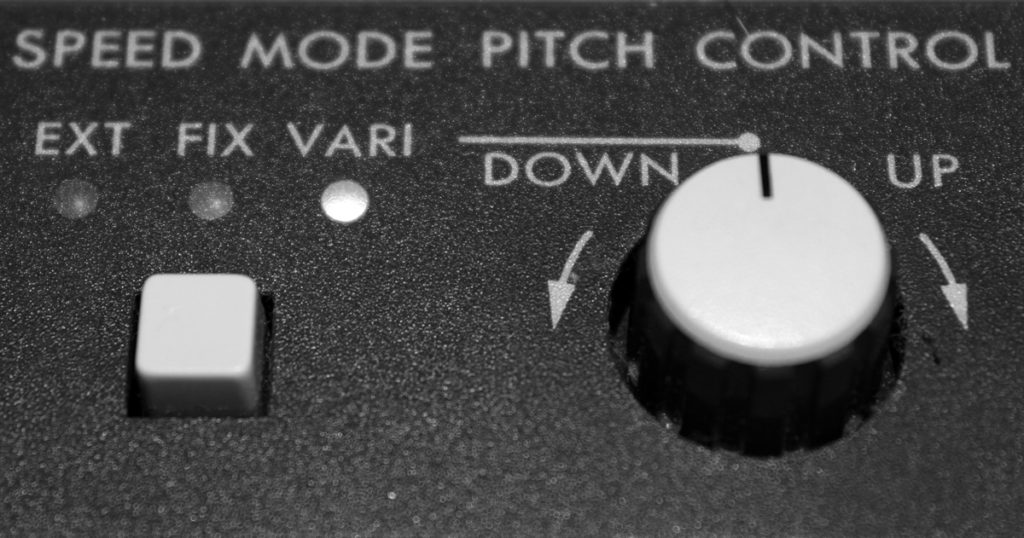
Varispeed is a feature of tape-based audio recorders that allows for both the tempo and pitch of a recording to be raised or lowered through the use of a pitch or speed control on the recorder. It is also emulated digitally in many DAWs. For example, Ableton Live allows for both tempo and pitch elements to be altered independently of each other. Many artists utilize varispeed to manipulate sounds in different ways. DJs, for example, can utilize varispeed to beatmatch tracks. It’s a great tool.
For ambient music, it is amazing how a little bit of pitch-shifting can make a sound or loop ten times more interesting. One of my favorite tricks in the studio when I’m working on ambient music is to make a loop in real-time with different effect pedals and hardware, record it, then varispeed down the entire recording by a few intervals. Everything feels so much sludgier and syrupy as a result.
Of course, this technique requires you to understand some basic music theory, as varispeeding will change the key of the loop. For example, if you varispeed (digitally) by -200 cents and your loop is in the key of D major, the resulting new loop will be in the key of C major, as you’ve dropped one whole step. It is important to understand basic harmony principles in order to not make a bloody tonal mess. Understanding and identifying the key signature of a loop is critical, particularly before you start processing it. Keeping track of it, as it morphs, is also really important.
Adding Reverb to a Track Ambient Does Not Make
A few years ago, I attended the AES conference in New York with a few engineer friends and ambient producers. There was a lecture put together by a respected audio publication on ambient music, so we thought, well, what the hell, we are already here, let’s check it out! To our surprise, one of the first things this lecturer said was: “To make ambient, just take a piano sound and add reverb to it” —and he proceeded to utilize a terrible sounding piano sample and throw some long reverb to it. We couldn’t believe what we were hearing; it’s possibly one of the worst pieces of advice I’ve heard in a long, long time!
Adding reverb to a track does not make it ambient. This is important to remember. I’ve done quite a few tracks with very little to no reverb on them. For example, “Vasastan” off Sirimiri, on Umor Rex.
Another example would be this collaboration with the lovely Julianna Barwick for the THESIS series. I remember producing this particular song with barely any reverb on the vocals. Julianna is known for singing through large reverbs, creating ethereal choir-like sacred hymns. I thought it’d be interesting to have some bare singing going through other effects (like loop pedals and delays) to achieve an ethereal vibe. As I worked with her, I discovered the etherealness of Julianna’s music comes a lot from the gossamer way she can sing. Her vocal placement is absolutely incredible, the way she is able to affect her voice and project it in a multitude of ways to change its tone is really inspiring.
Ambient is not about the actual effects used but about the atmosphere and feeling one can create with whatever tools at one’s disposal. Reverb is not a shortcut, even if it appears that way. Let’s not forget that.
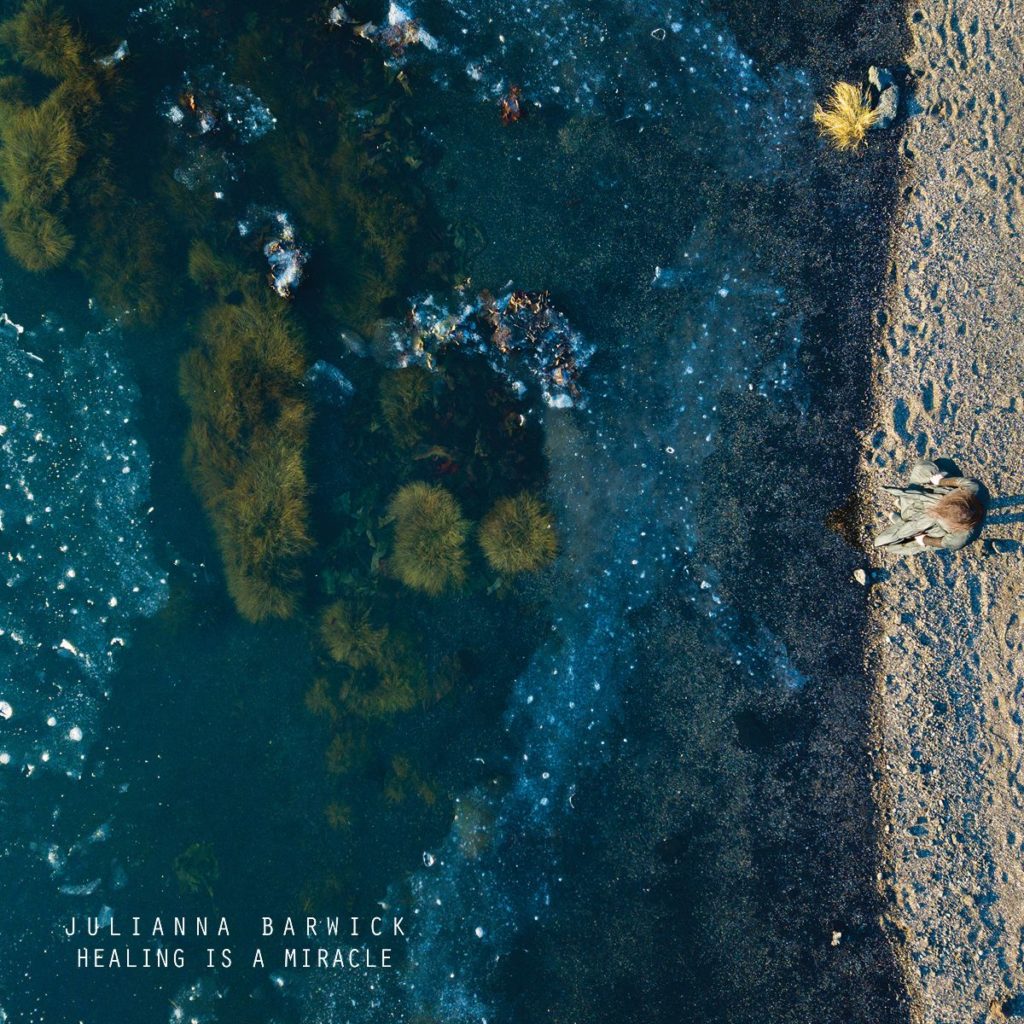
Julianna Barwick is back with Healing Is A Miracle, her new album, scheduled for July 10 release on Ninja Tune.
Healing Is A Miracle lands four years after the American musician’s last album, Will, on Dead Oceans. The record is built on improvisation and a close affinity to a couple of trusted items of gear, from which she spins “engrossing, expansive universes,” the label explains. Jónsi (Sigur Rós), Nosaj Thing, and Mary Lattimore all feature.
Barwick began working on the album in spring last year, when she sat down with her vocal looping setup and began sketching out some ideas for new solo material. “It had been so long since I had done that,” she recalls, “making something for myself, just for the love of it… it was emotional, because I was recording music that was just from the heart, that wasn’t for an ‘assignment’ or project… it brought me to tears a little.” She recorded it in the wake of a move from New York, where she had lived for 16 years, to Los Angeles, where she is now based.
The title of the record came to her after thinking about how the human body heals itself. “You cut your hand, it looks pretty bad, and two weeks later it looks like it never happened… That’s kind of amazing, you know?” From there, she conceived of the record’s simple statement title, ran it past a couple of friends, and it was settled.
The album’s artwork was shot in Iceland by Joel Kazuo Knoernschild and is taken from a series of aerial films shot by drone above the country’s coastline, which also make up the video for “Inspirit,” announced today alongside the single.
Tracklisting
01. Inspirit 02. Oh, Memory ft. Mary Lattimore 03. Healing Is A Miracle 04. In Light ft. Jónsi 05. Safe 06. Flowers 07. Wishing Well 08. Nod ft. Nosaj Thing
Healing Is A Miracle LP will be released physically and digitally on July 10 on Ninja Tune. Meanwhile, you can stream “Inspirit” below and pre-order the album here.
Pinch will release his first solo album 13 years, Reality Tunnel, via his own label, Tectonic.
The album takes its title and concept from the idea of a “reality tunnel,” a concept that was originally introduced by Robert Anton Wilson in his 1983 book “Prometheus Rising.” It relates to an idea on how we each create our own perspective—the subjective filter that we each apply to the world around us; the things we perceive and what our consciousness deems worthy of attention.
“Our beliefs, values, behaviours and so on, which we create and can therefore reshape, are the product of our individual reality tunnels,” Pinch, real name Rob Ellis, explains. “Every track on the album serves as its own reality tunnel and each tells a different part of my musical story.”
While floor-friendly bass pressure remains prominent across the album, it acts as a springboard for outré experiments in techno, grime, dub, jungle, dubstep, and other, more surprising styles.
The album began with “Back to Beyond,” which followed a “complicated experience with infinity,” Ellis explains. “I decided it was going to be the cornerstone of my second solo LP and set about making more music with that purpose in mind. There were to be no boundaries placed on the music; it would just be for me.”
“Each of these separate soundworlds travelled to by Pinch is explored and expressed with a distinct creative attitude and unified by an ‘anything goes’ free approach,” the label adds.
Reality Tunnels follows Pinch’s solo debut full-length, Underwater Dancehall, plus a collaborative LP with Shackleton, and two with Adrian Sherwood.
Tracklisting
01. Entangled Particles feat. Emika 02. All Man Got feat. Trim 02. Accelerated Culture 04. Returnity 05. Finding Space 06. Party’ feat. Killa P 07. Back to Beyond 08. Change Is A Must feat. Inezi 09. Non-Terrestrial Forms 10. The Last One’ feat. Nive Nielson & The Deer Children
Reality Tunnels LP is out on vinyl and digitally on June 26 via Tectonic Recordings. Meanwhile, you can stream “Accelerated Culture” and pre-order the album here.
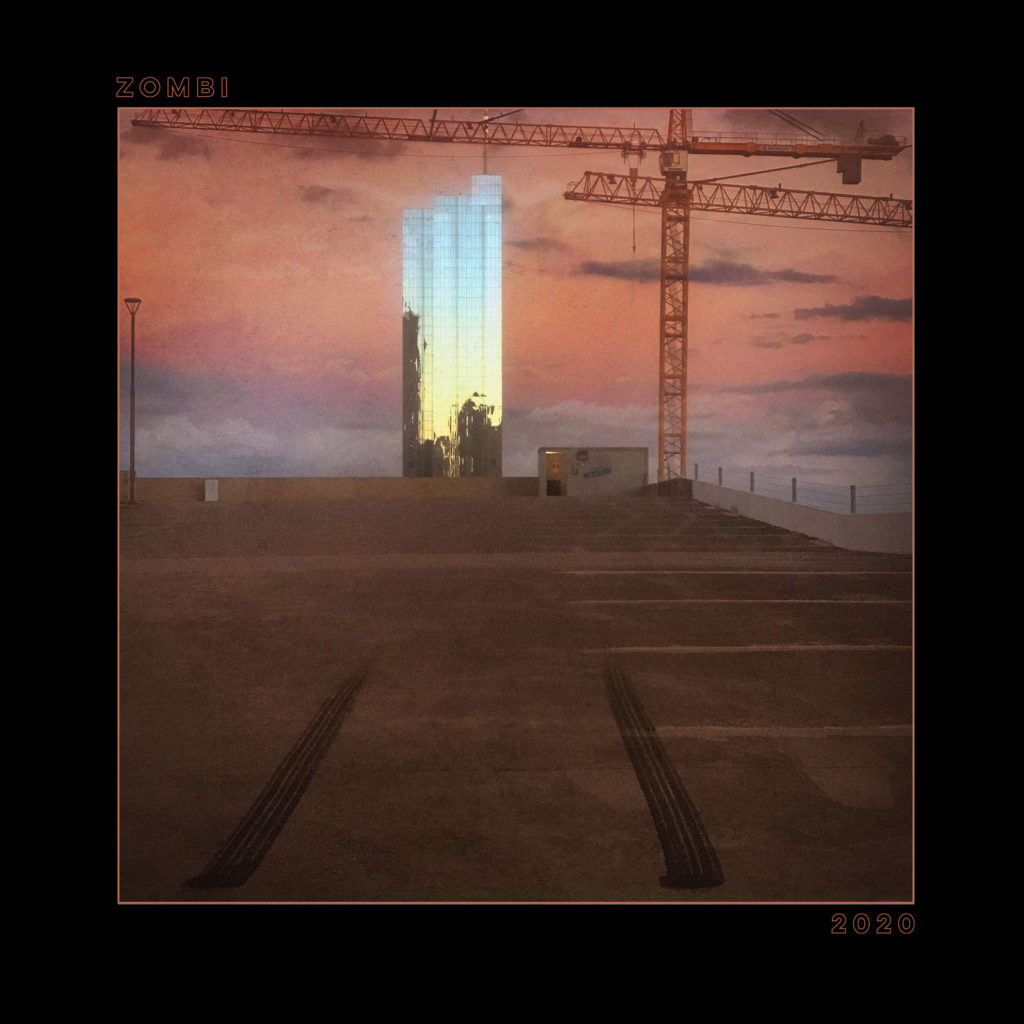
Steve Moore and AE Paterra will release 2020, their seventh studio album as Zombi.
2020 showcases the songwriting prowess that has pushed the duo of Moore (synthesizers, guitars, bass) and Paterra (drums) to evolve throughout their storied, 20 year career. While previous releases have seen the pair build upon and expand their sound, now they’re staying true to their ethos “more than ever.”
From the dramatic opener “Breakthrough & Conquer” to the melodic bass whirls found in “XYZT,” 2020 proves to be Zombi’s most “riff-intensive album,” Relapse Records, the label explains. What begins as “a soundtrack of driving musical euphoria,” 2020 takes a sharp turn into “uncharted waters,” where synthwave and neon crescendos are furloughed in favor of Blue Oyster Cult-inspired progressive epics.”
Zombi’s roots lie in Pittsburgh, United States in 2000. Their last album, was Shape Shift, came in 2015, also on Relapse.
Tracklisting
01. Breakthrough & Conquer 02. Earthscraper 03. No Damage 04. XYZT 05. Fifth Point Of The Pentangle 06. Family Man 07. Mountain Ranges 08. First Flower 09. Thoughtforms
2020 LP is out on vinyl and digitally on July 17. Meanwhile, you can stream “Breakthrough & Conquer” below, and pre-order here.
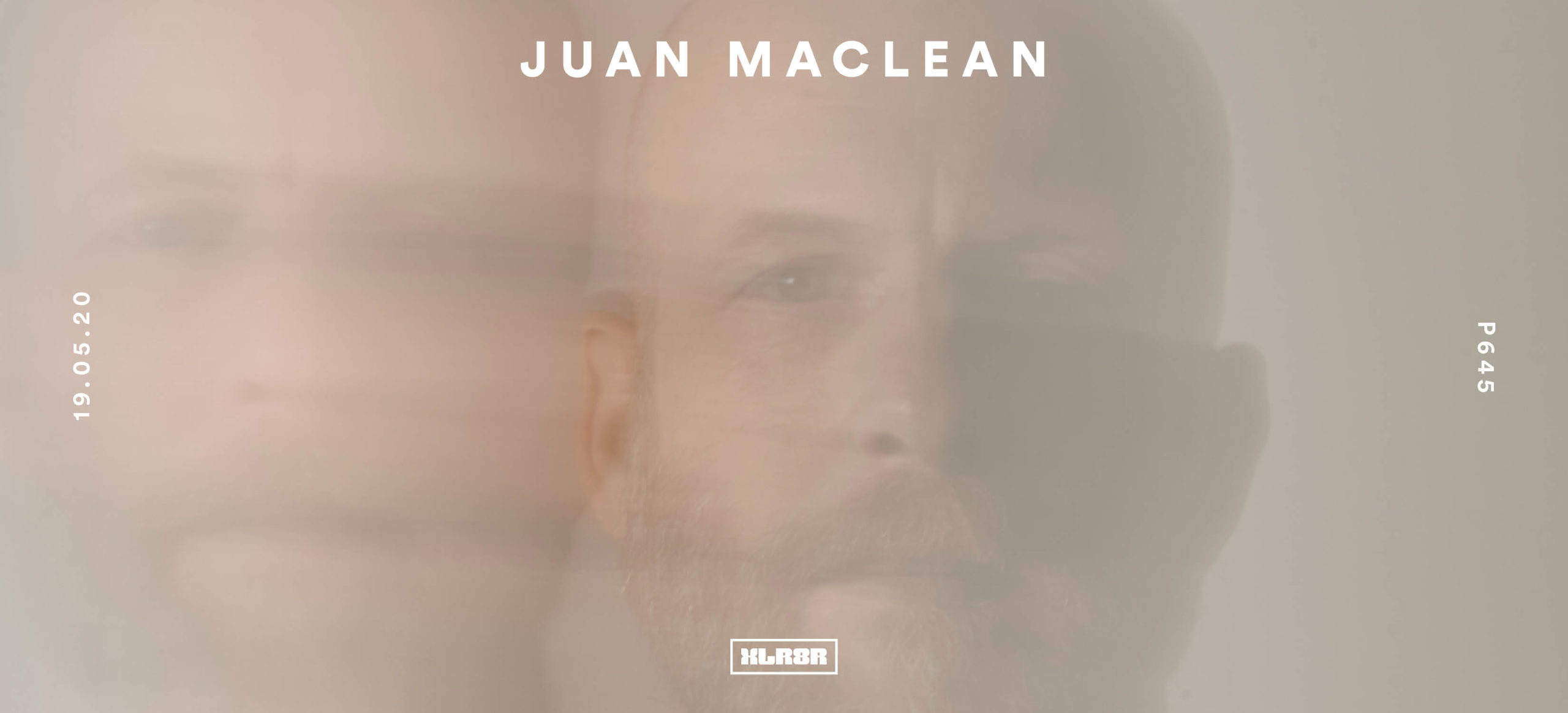
By his own admission, Juan MacLean is not an easy artist to pin down. His career in music dates back to the early ’90s, when he played guitar for post-punk group Six Finger Satellite and learned how to engineer, before dropping it all to pursue his studies in English. He came back to it in the ’00s, debuting as an electronic producer in 2002 on DFA Records, the label of LCD Soundsystem’s James Murphy. Last year, he released The Brighter The Light, his latest full-length on the label, once again in collaboration with LCD Soundsystem vocalist Nancy Whang.
MacLean has filled those 30 years with a vast number of releases and DJ and live band performances all over the world. Much of his recent music has been heady and slow burning, leaning on synth-heavy and Italo sounds, put out through labels like Motordiscs, Correspondant, and Aus. Running alongside these club-ready cuts are his songs through DFA, which allows him the freedom to go wherever his mood takes him.
Sculpted in various residencies across New York, MacLean’s DJ sets are also underpinned by freedom and adventurism. He can sometimes spend months preparing records for a set, and he’ll interlace his groove-driven sounds with unexpected curveballs and playful disco jams. He’s proven to be a master in building tension and then allowing crowds moments of utterly joyful relief.
As you expect, MacLean’s XLR8R podcast is not averse to the surprise. MacLean recorded it at his Brooklyn studio recently having spent many weeks picking out the records that he wanted to include. One afternoon, he dropped a little LSD and mixed them all together, leaving us with 80 intoxicating minutes of his favourite music old and new.
01. What have you been up to recently?
I had left for an extensive European tour on March 11, just before countries started to go into various modes of lockdown. I bounced around a bit as gigs got cancelled one by one, eventually ending up in London where I settled in for a few days to see if my gig there would be cancelled. It was a confusing time. There was a lot of conflicting information going around and it was impossible to predict how things would be looking outside of a couple of days into the future. At some point, the USA instituted the travel ban so I went home while that was still possible. It was enormously disappointing, I had been looking forward to and planning for these gigs for months!
I live in Brooklyn, and New York City has been one of the hardest hit places in the world by this pandemic. We’ve had a pretty strict lockdown in effect for over two months now. My daily routine is to walk (the subway is reserved for essential travel only) the three miles to my studio every day and spend the day in there while my partner works from home doing therapy via a video platform. I spend my days in the studio, and some days it’s great and some days I am in despair and just lie down on the couch and listen to music, allowing myself to sit with the difficult feelings. I have a new EP that just came out on Correspondant and it’s a release that I had really poured a lot of my soul into, so that has been very exciting and uplifting, finally having it out there and seeing the response.
I also did a live stream for and at my local venue that has been my home base for years, Good Room. That was enormously gratifying, to play music through a sound system again, even though I was alone in the space. The response was fantastic, and it really meant a lot to me that people reached out and had been very moved by it. I put a lot of planning into it, and basically treated it like a typical gig. I wanted to go back into that space and see if I could attain some degree of transcendence, of leaving behind the nightmare of this pandemic by providing something of a sonic journey, and hopefully be able to take people at home along with me, via a remote transmission.
02. Which labels/artists are impressing you right now?
I’ve always had a good connection with Mexico throughout the years, and lately a lot of my favorite music and artists have been from there. Zombies In Miami are good friends and one of my favorites, Theus Mago is awesome. Also transplants living in Mexico like Thomass Jackson and Rodion. Iñigo Vontier and the label he has with Thomass, Calypso Records. Duro Label is another Mexican favorite.
In Spain there is Javi Redondo and Darlyn Vlys, and Rotten City Records. I’ve also been super excited about a lot of stuff coming out of Tel Aviv, artists like Niv Ast and Omri Smadar. And of course Luca Venezia (a.k.a Curses) and his label Ombra International. I suppose the unifying aesthetic with a lot of this stuff is a more “live” and even rock feel to the music, and of course a strong dose of psychedelia. Most of these people are good friends. For me, this music is inextricably linked to relationships with people, either with the producers or local scenes. That connection is what gives me the energy to do this for so many years.
Someone who has been a real guiding light for me the last few years is Jennifer Cardini. She actually, unknowingly I’m sure, was a big influence on me with the track she sang on for Black Strobe, “Me and Madonna.” That track, and her vocal delivery, was huge for me. And since then, I will say she is one of my favorite DJs; her style is just right up my alley, and she nails it technically every time I’ve seen her. And we both have, not just a love, but an obsession with arpeggiators. Throw in Correspondant as one of my favorite labels and she ends up being my hero!
03. What’s been top of your quarantine playlist?
On my way to my studio, which is about an hour’s walk, I mainly listen to DJ set podcasts. It puts me in a bit of a trance, and sets me up nicely for the studio. Sean Johnston’s ALFOS set that he did at Phonox right after Andrew Weatherall died has been a favorite, and very emotional. Though I only knew him personally in passing, Weatherall was an absolute hero to me, more than anyone I’ve ever encountered.
Other than that, I’ve been listening to a lot of new age music from the ’70s and ’80s. I also made a six-hour playlist for a psilocybin mushroom ceremony I had at home, and I’ve been revisiting that a lot. It’s mostly contemporary minimalist composers like Steve Reich and Harold Budd, all ambient soundscape stuff.
04. Where and when did you record this mix?
I recorded this mix a week ago in my studio, which is in Bushwick, an area of Brooklyn, on two CDJs and a turntable.
05. How did you choose the tracks that you included?
I started with a general guiding idea of wanting to do a mix that was mostly new music that I was excited about. My aesthetic is generally what I would call “vibe-y” or heady music, and for me, it has been an exciting time for this kind of music. So I hit up producer friends whose music I love, and was able to include some unreleased tracks of theirs, to make it a bit special. I also included some older tracks that help to sort of connect the dots between past and present. Over the course of weeks, as I found tracks I wanted to use, I put them aside and started building a collection.
One day I had taken a bit of LSD and went to my studio, figuring I’d spend the day just making sounds in the studio. It occurred to me that the mix was due soon, so out of curiosity I checked my calendar and saw that I was meant to turn it in a couple of days before. I have really lost all sense of time during this quarantine. So, I set up the studio with the little disco ball going and some moody lights, lit some incense, and tried to make a nice atmosphere. Once I was all set up, I just hit record and went into it without thinking, just feeling my way through it. What you hear is the unedited take. When I listened back the next day I noticed there were a lot of guitars, which is unusual in dance music of course. This was not a conscious decision, but it’s what came through!
06. How does the mix compare to what we would hear you play in a club?
It’s actually quite similar to a set I might play in a club. I am prone to dramatic intros, and I have gotten worse (or better?) about this in the past few years, so in that sense this is pretty representative. I am a big fan of a long reset with no beat when I start my sets. This mix is a bit more one dimensional and focused than my DJ sets, which I prefer to be at least four hours.
07. What’s next on your agenda?
This is such a difficult question to answer right now. In a practical immediate sense, I just released an EP on Correspondant, I have an EP coming out on Aus in June, and a track on the next Motordisc compilation after that. But all of my gigs have been cancelled, of course. Many were rescheduled, but those dates seem improbable or at best uncertain. So for now I am just going to my studio every day and focusing on the moment, making music that is coming purely from the heart, devoid of any external influence or consideration, as those things don’t exist right now.
At some point I have to believe that clubs will open again on a small level. I am actually quite excited to be a local resident DJ again, playing for 50 people. The hope for this scenario is what keeps me going at this point. I have dedicated my life to music, and to playing music for people in that setting. It is what I am deeply programmed to do. Right now I am operating on the faith that I will be able to do that again soon, and when I do, it will be so glorious I think I will cry for hours in a DJ booth!
XLR8R has now joined Mixcloud Select, meaning that to download the podcast you will need to subscribe to our Select channel. The move to Mixcloud Select will ensure that all the producers with music featured in our mixes get paid. You can read more about it here.
–
Tracklisting
01. Daniel Emmanuel “Arabian Fantasy” (North Star Productions) 02. Hawkwind “10 Seconds To Forever” (United Artists Records) 03. Titin Moraga / Yellow Magnetic Star “Transandes Zone” (Music Productions) 04. Mufti feat. Vongold “Concepts” (Relish) 05. Niv Ast, Cornelius Doctor “Poisson d’Argent” (Correspondant) 05. Niv Ast, Adrien Albou “Beau Chien” (Zillas On Acid Remix) (Optimo Music) 06. Olta Karawane “Abattage” (Calypso) 07. Coil “Panic” (MI.RO Edit) (Rotten City Edits) 08. Juan MacLean “Bufomania” (Correspondant) 09. Omri Smadar “Dub Shell Dmaot” (Blue Shadow) 10. Javi Redondo “Rythmo” (Pablo Bozzi remix)’ (Correspondant) 11. SHMLSS “Taiko Dreams” (Calypso Records) 12. Zombies In Miami “Apache” (Creatures Of The Night) 13. Kincaid “Provisional Disturbance”(Futureboogie) 14. Pearson Sound “Glass Eye” (Hessle Audio) 15. Bouffant Bouffant “You Laughed” (unreleased) 16. Renato Cohen “Bismuth” (Jennifer Cardini remix) (Pets Recordings) 17. Juan MacLean “Yearning To High” (Good Room) 18. Ø “Atomit” (Pi Recordings)