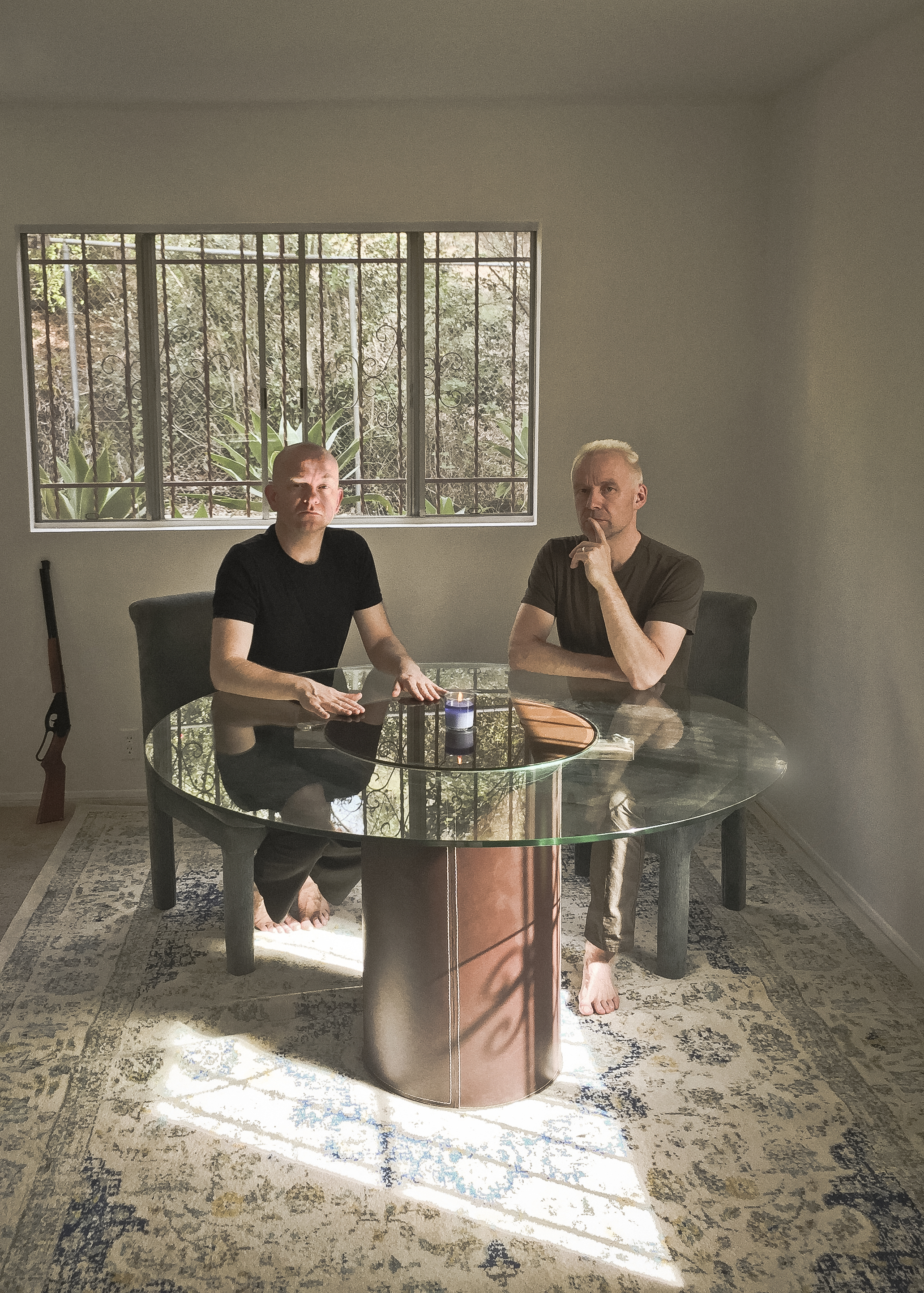
In an age that heralds DJs as the new rock stars, live performances of electronic music can often fall flat. Too frequently a repetition of stale ideas, it takes something really special to stand out—a magic quality that Uwe Schmidt (a.k.a. Atom™) and Tobias Freund possess in abundance.
Friends of about thirty years, they were brought together by a common passion for sound, a relationship that blossomed during the time they spent together in Frankfurt during the late ’80s. Independently of each other, they both went on to have many successes of their own. The driving force behind a shedload of very different projects, the Schmidt has done everything from trance to electro-Latino (a genre that he himself spawned as Señor Coconut)—and done it well. It is a level of skill that Tobias matches, partly attributable to his roots as a sound engineer—a role that he played for 18 years alongside other pursuits in performance and production, with releases on the likes of Ostgut Ton and his own Non Standard Productions.
Armed with that unparalleled expertise and years of experience, together they are a creative force to be reckoned with. Their live show at Mutek 2003 marked the end of collaborative hiatus of almost a decade; since then, they have been touring their improvised techno performance globally. More recently they have turned some of their attention to releasing music as well, a process that demands a lot of to-and-fro between their studios either side of the Atlantic. Many of these recent productions have honed in on a specific sound, defined by beefy, acid-driven techno, akin to what you might expect to hear at their shows. Yet their back catalog is proof of their affinity to experimentation, with releases like the Odd Machine record (a triumph of abstract house), or even the Grand Blue album, which publicized an impromptu piano jam from the lobby of a Japanese hotel.
Via a video link connecting their homes in Santiago and Berlin, we spoke to Uwe and Tobias in a rare interview together about their recent shows, the beauty of Japan’s Labyrinth Festival, and their formative years in Frankfurt.
Could you give us a brief run through of your current live-show setup?
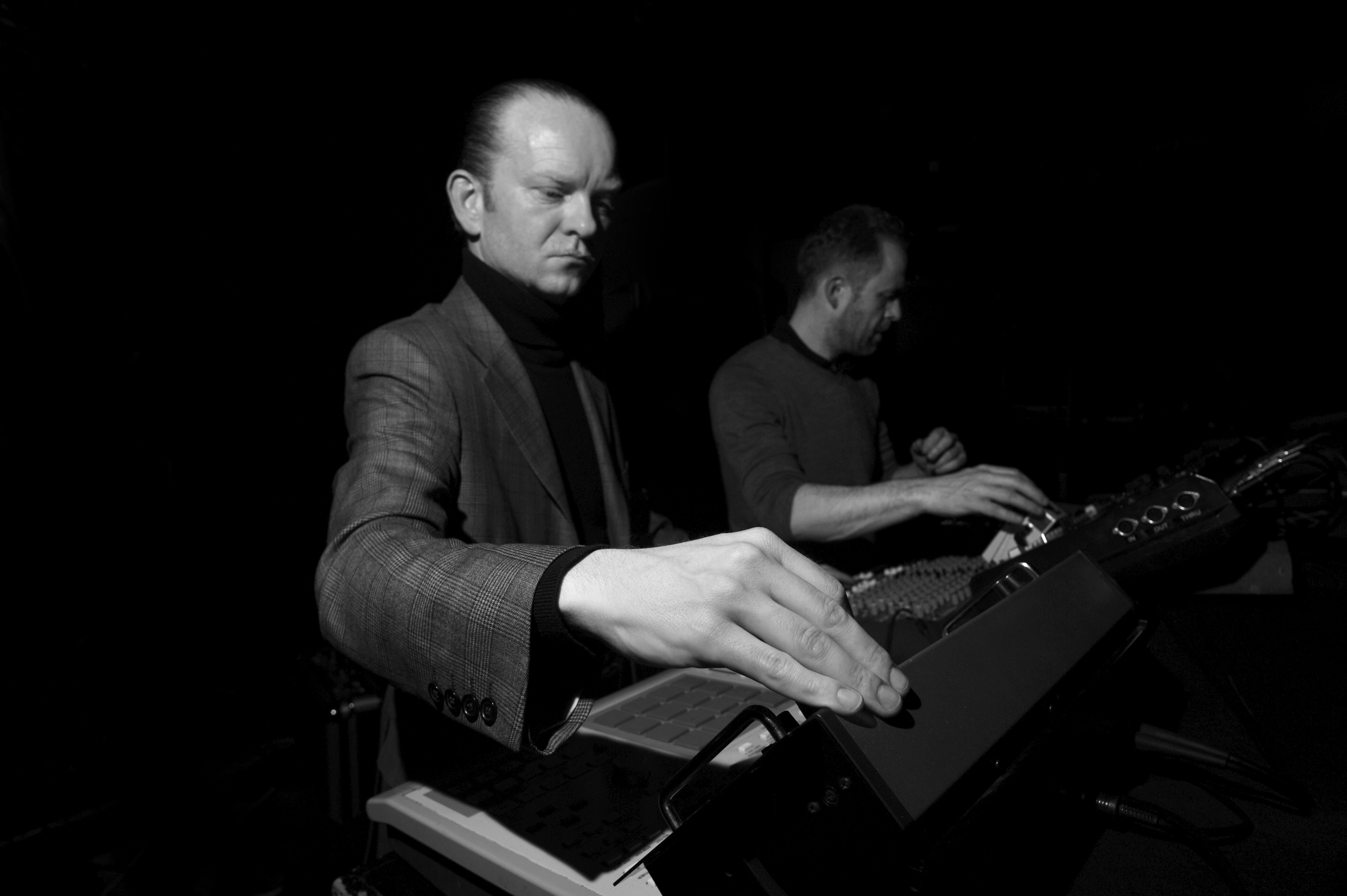
Atom™: Well, basically, Tobias and me use separate entities—we don’t touch each other’s gear, apart from the Roland TR-808. That’s the core element—and then my gear is a modified x0xb0x synthesizer, an MPC 1000, a computer, and a delay pedal.
Tobias: I have an old Pearl Syncussion, which is a two-channel drum synthesizer that is triggered by the 808. So, the programming comes from the 808, but the sound comes from the drum synth. I use the Roland MC-202, and then I use the computer with Ableton, which is like an instrument for me—I program sounds for my drum pads, and I play Ableton. I don’t play clips in rows, it’s more like a sampler. The TR-808 is the main thing, which we program during the sound check. During the concert, we can then decide whether one of us would reprogram it.
Atom™: Yeah—it’s so that we have something to start with. During the improvisation, if we feel like we need to change something, or that there is something missing, then either of us can reprogram it. We never talk about what is going to happen, it’s more about the moment itself.
The 808 is a key part of all of your music, Tobias?
Tobias: I’ve used it for every production that I’ve made, and it’s always different! You can add a different bass to the kick drum, and then it always sounds different to me. I’ve never got tired of that kick drum.
Atom™: I also have an 808, but it’s not such an important drum machine for me. I don’t generally use specific machines all the time, rather I get a special idea about a track, and then I look for the machine that fulfills that idea. Sometimes it might be the 808, but sometimes it isn’t. To me, it is a very specific sounding machine, which means that it has its pros and cons, but it always sounds like an 808. I’m always somewhere in between the Linn LM-1, the Linn 9000 and the TR-808—they are my three favorite for different reasons.
You’ve played in a lot of different settings across the world this year. Obviously the live show is improvised, but do you have any preprepared ideas going into a show of what you intend to play?
Tobias: Not really. I guess we just take the experience from the last gig, and try to continue from there.
Atom™: I’ve read a lot about something called the “frame of improvisation,” which is better explained with jazz music. If you ask a jazz musician what their music is about, they will tell you it is all about improvisation—but then you have to ask, why does it all sound the same? Why is it always jazz? That’s because there is a frame of improvisation. So, when we play with that certain type of equipment, in a club, or at a festival, we are improvising within a certain range of possibilities at that moment. We both know about that specific frame, and we know how far we want to take it. Generally, it is defined by the equipment that we use, and how we program and play it. When we play a longer set, that frame gets a lot wider, as there is the opportunity to do a lot of different things. Apart from that, we don’t talk about it—we just listen to each other to get a feeling for whether it is going the right way, and whether it is resonating with the audience. The sound system is very important—you are very limited by shitty ones, but we both know what works on them. Sometimes it doesn’t work, and there are certainly shows that we think were not very good.
What were the highlights from this past year?
Tobias: The Labyrinth—all the surroundings in Japan are always amazing, but the gig itself was really cool.
How did it compare to the last time you played there together in 2013?
Atom™: I wouldn’t say it was better or worse, it was just different. We have both changed a lot since then, and we have been trying new things. It’s a very special case—one of those festivals that actually gives you something back. Normally with a show, you deliver lots, and the crowd might enjoy it, but you aren’t getting anything back in terms of creative ideas and energy. Labyrinth is pretty unique, as you get to play on a really impressive sound system, and for the first time you can actually hear a proper sounding 808. With that experience, you start to think more about it, and what you can try. After the first Labyrinth, I started to put stuff in my set that I knew would only sound good there. Every now and then, I would try it in different places, but it just wouldn’t work. With that knowledge, when you go back to that PA, you try something else. It’s not better necessarily, it’s just different. The monitors they have are quite a big Funktion-One system—not quite the full thing, but close to it. It’s pretty obscene! It has got better over the last 15 years, but clubs don’t really tend to consider that you need a monitoring system as well as the PA. I think it is something that has to come from the artist, and not the promoters.
Tobias: I still want to work on the idea that we ought to play where the audience is. I really want to be able to play in the center of the dance floor—there should just be a little stage, with our equipment, in front of that huge sound system. That’s my dream!
Let’s talk about the Panorama Bar recording that you released—why did you decide to do that? Was it a particularly good one?
Atom™: I think it was a pretty good one, yes—a very consistent show. At some point, me and Tobias started recording all our gigs, and I ended up with so many of them that it became pointless to keep doing it, as we had no time to even listen to them. The first live show we did of that sort of length was four years ago, at Lunar Lodge. We played a long set there by accident actually, and it was a new experience. After that we became more aware of the possibility of doing it, but the Panorama Bar gig was the first long set that we recorded. With all the changes in the music business over the last few years, and new formats becoming available, I’ve become really interested in exploring the possibilities of digital music, and the fact that we have moved beyond it being a question. We don’t need to stick with vinyl or CDs, and we can do very short, or very long tracks.
Do you have a preference over the length of the shows?
Tobias: For me, I prefer longer sets—not five or six hours, because that’s really exhausting. To play at least two or three hours is more enjoyable. If I play one hour with my solo show, that’s nothing! You can’t allow yourself to fall into something creative.
Atom™: I think that every duration has it’s own quality, but one hour is a bit too short for most things, particularly if you are improvising. Anything between one and a half to three hours is great, but once you go beyond that it becomes very different. If you announce a set as being an all-night show, then the audience comes with a predisposition. If you go to a rave or club, and you know that you have to be there all night without any other DJs or acts, then that’s it for your evening. I find that very interesting. I realized when I edited the recording that six hours is a massive amount of time—it’s basically half a day that you have spent with a couple of people, in a room, making music. That’s a pretty intense experience, a very intimate time to spend with unknown people, and I really like that intense quality that it has. Looking at that timeline, you know that you can do pretty bizarre things in between, and play with some really abstract stuff. Even if you run through some boring patches, that won’t be the end of it. If you hit a boring patch in a two hour set, then it can be fatal, as that’s how the gig will be remembered.
Going back to when you first met, when you were in Frankfurt together, and you were Uwe’s sound engineer, Tobias.…
Atom™: [Laughs] It wasn’t like that! When I started making my first album, Tobias was already working as a sound engineer. I had no idea about sound at all—people just convinced me to make that album. I had no idea about engineering, or how to work a studio, so I needed help from people. I met Tobias through a couple of other friends. I asked him to help me record and mix bits and pieces—I don’t think you did the whole album, right?
Tobias: Yeah, most of the stuff was preprogrammed. For one of the songs, we did some drumming, but I’m not sure. The mixing we always did together.
How did you actually first come together? Was it just through mutual friends?
Tobias: Yeah—it’s nice to make friends who are on a similar wavelength. We shared a common interest in music, and it was just nice to find someone similar to me.
“Back at that time, it was before techno had even really happened. Nobody had any idea of how to perform techno music live—you couldn’t read about it, you had to just invent your performance.”
Atom™: When I started to produce, I met a group of people who were all interested in roughly the same sort of music. Some had already began making music, and others were just starting. It was a really interesting mix of people. Tobias had already made cassettes, and even vinyl at that time. Everyone was doing stuff together, collaborating, helping each other, and borrowing equipment. That’s how we met, but playing together came a while later. We both released on the same label in Frankfurt at some point, and they had asked Tobias to perform one of his releases live, in ’90 or ’91. Back at that time, it was before techno had even really happened. Nobody had any idea of how to perform techno music live—you couldn’t read about it, you had to just invent your performance. We played around with studio gear, and then hoped it would work in a live setting. Tobias wasn’t that comfortable on stage just by himself, so he asked if we could do it together.
Were you playing together a lot back then?
Tobias: No, we actually only did three shows.
And one of them produced the 1993 Elektroniikkaa EP?
Tobias: It came from two out of the three shows.
The idea of releasing a live techno recording was also very new. Why did you decide to do that?
Tobias: We did one show in Helsinki, either with Playhouse or Ongaku—a label done by Ata and Heiko MSO. Some of them traveled with us to the festival, and because we did it together, and they loved it so much, they came up with the idea to release it.
Atom™: Back then the equipment was very chunky, not like today, which you can fit in your luggage. It’s the same 808 though! The exact same one we use today. It’s pretty crazy to think about how much stuff we took with us, to get such a limited effect on stage. We didn’t really think about it—it’s not like today, where an artist might say that he has a record to promote, so he would record a set and put it on Soundcloud. Back then we just went to the show, played, and recorded it without knowing how it would turn out.
Tobias: We only did it because we wanted to share it with our friends who weren’t there.
You were both in Frankfurt for quite a few years. Do you think that was a particularly influential time for your music?
Tobias: I was never really a clubgoer, and I went to my first discotheque very late. I wasn’t very social at that time! Of course it helped that there were labels like Delirium, Ongaku and Playhouse, and the people around them who shared similar interests.
Atom™: It’s the same for me. What I find interesting about that time specifically is that nothing was really defined—it was a transitional period, between industrial, EBM, acid, and techno, which all happened at the same time, and mixed with each other pretty slowly. Frankfurt was a very important musical city up until the mid-’90s. There was an art school, and people around it were doing performances influenced by things like Laibach and that industrial stuff. Techno happened pretty slowly. There was a record shop, and lots of labels within Frankfurt—it was a very creative moment. It was very important to have met all those people though, and what I really liked about that time was that it was about experimenting and trying new things, rather than fulfilling existing genres and expectations. This went on until about ’94 or ’95, when everything became commercial. One reason I left the city was that people started making a business out of their activities, and it was totally boring for me to watch people change their creative energy into a business. Even if you look at other parts of the industry, like bookers, distribution, and that sort of stuff, none of it existed back then, so it all had to be invented. It was a big mix of people just improvising their lives—some wanted to DJ, some wanted to make music, and maybe others wanted to set up a record shop or label. I liked the creative energy from that time.
Living on different continents, do you ever get to spend much time together in the studio?
Tobias: We have only been together in the studio twice in the past ten years! It really doesn’t happen very much. If we are making a production, one of us prepares something, and then sends it over to the other to work on it, before sending it back. That’s how we work now.
Was that the same for the Odd Machine release?
Tobias: It was different, actually—we were in the studio in Berlin together, and I remember it because it seemed odd! I think the system we have now works very well for us, because of the distance. I can deal with both. With my label that we put the Odd Machine release out on, I really want to do noncommercial stuff. I just want to do stuff that we have fun with, and not listen to anybody else. I’ve got an idea now for the next one, as each is going to be me with a different producer.
“We are not really fixated on specific genres or anything. Music is about playing, and having fun with stuff.”
Atom™: We were both aware of what we could do, and what we wanted to hear. We are not really fixated on specific genres or anything. Music is about playing and having fun with stuff—if you are not enjoying making music at a certain point in your day, then there isn’t any point in carrying on. You have to find the right inspiration to make something, and it might lead to a piano album, or something techno. It all depends on inspiration.
Top photo:Seze Devres; www.sdphotography.net