Kizas do Ly is the first EP of DJ Lycox, but he is released an album on Príncipe in 2017. It comprises four tunes that “float above us,” celebrating the the popular style of kizomba. “So if actual proximity seems to be ill-advised this spring, let’s temporarily move to another realm and see what happens when mind does away with body,” the Lisbon label explains.
Príncipe has already released a digital version of the EP via Bandcamp, and a 12″ vinyl will follow when coronavirus has died down.
Tracklisting
A1. Jam A2. Red Lights B1. Babygirl B2. Hábitos
Kizas do Ly EP is available digitally via Bandcamp.
Danny Keane will release Roamin‘, his debut album, on July 24.
Drawing on a rich and and varied career, Roamin’ is a “thrilling coming together of a lifetime’s worth of ideas and influences,” MVKA, the label behind it, explains. Spanning nine tracks, it’s bursting with flavours of jazz, Indian folk traditions, African rhythms, European classical, and contemporary dance music, unified with Keane’s flavour as he pulls them all together into a unifying, dizzying whole.
The album represents the cutting edge of new, emergent urban music. Jazz is at its core, but it’s much more than that. It’s an unfolding genre, a joyous hubbub of musical storytelling, a thousand human conversations at once crackling with the energy of a North African souk or Dalston’s Ridley Road market.
Featuring on the album are names such as Mulatu Astatke, Pirashanna Thejaravah (Ravi Shankar, Anoushka Shankar), Tom Skinner, Richard Olatunde Baker, and Khadijatou, among others.
“One of the great pleasures of working with different artists belonging to different genres is the variety musicianship I get to share the stage with,” Keane says. “So often I would dream of getting these musicians in the same room and hitting record. Despite their varied traditions they all share a common goal—the pursuit of great art! I knew that one day I would do this”
Tracklisting
01. Olomouc 02. Twenty Tonnes Of Tension 03. Flight 19 04. Roaming 05. Addis 06. Igor 07. The Water Is Wide 08. Afro Cello 09. Ajoyo
Roamin‘ LP is out July 24 on vinyl and digitally on MVKA. Meanwhile, you can stream “Twenty Tonnes Of Tension” via the player below.
Editor note: a version of this feature was released in the zine to accompany the 19th edition of XLR8R+, a special Visionquest edition featuring tracks and content from Shaun Reeves, Ryan Crosson, Lee Curtiss, and Seth Troxler, plus this Studio Essentials with Visionquest artists Triptease. You can find more information on the package here.
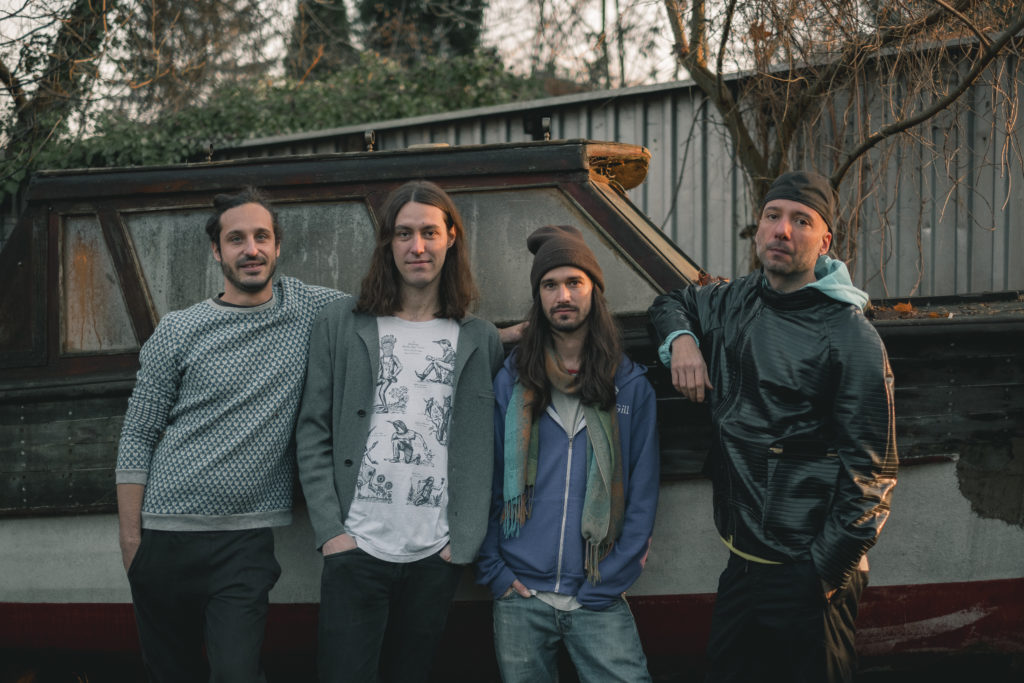
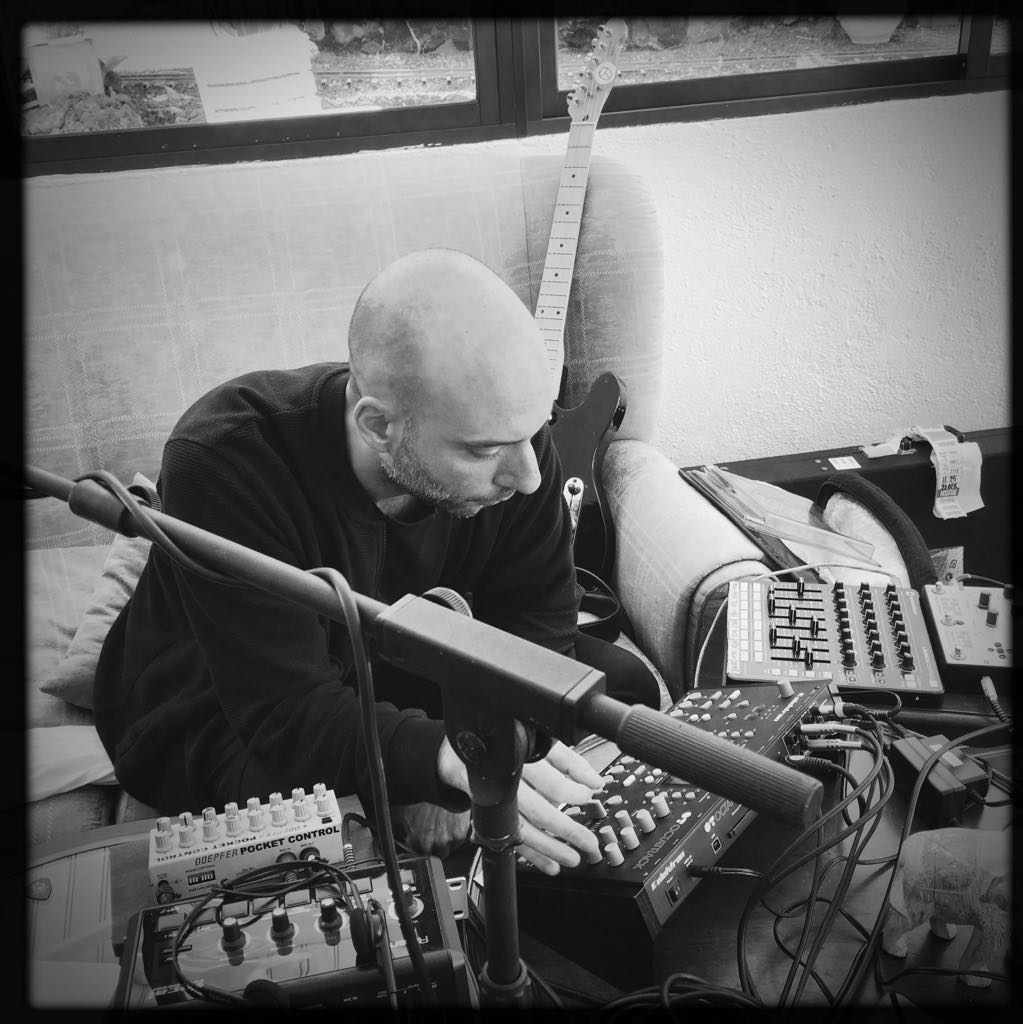
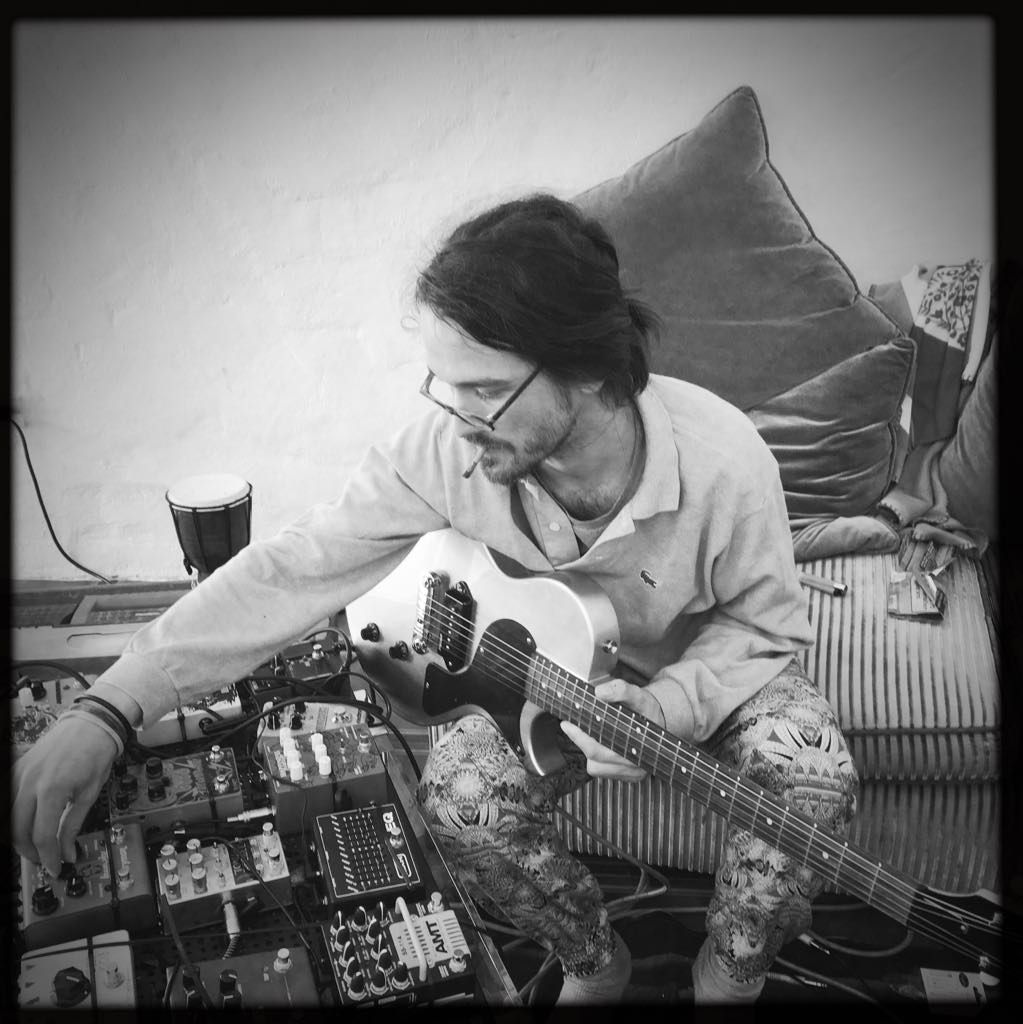
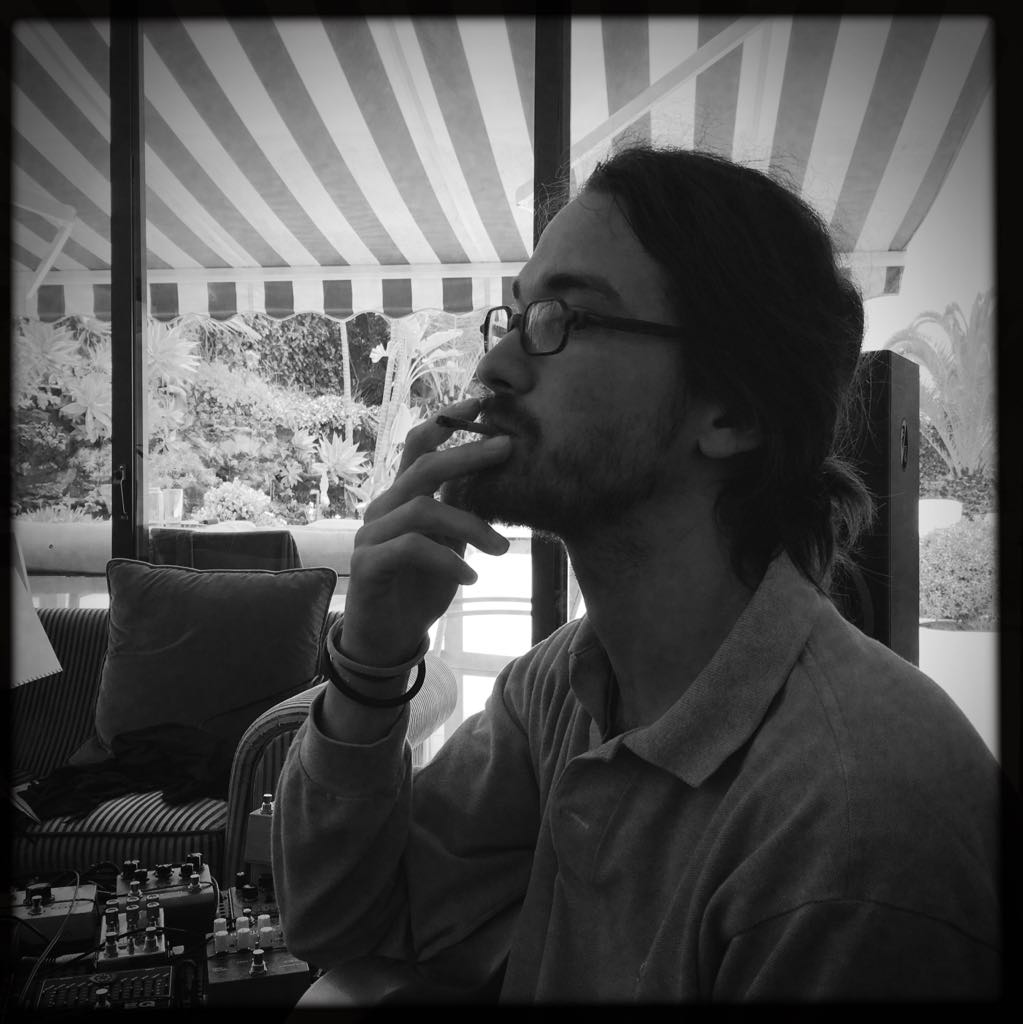
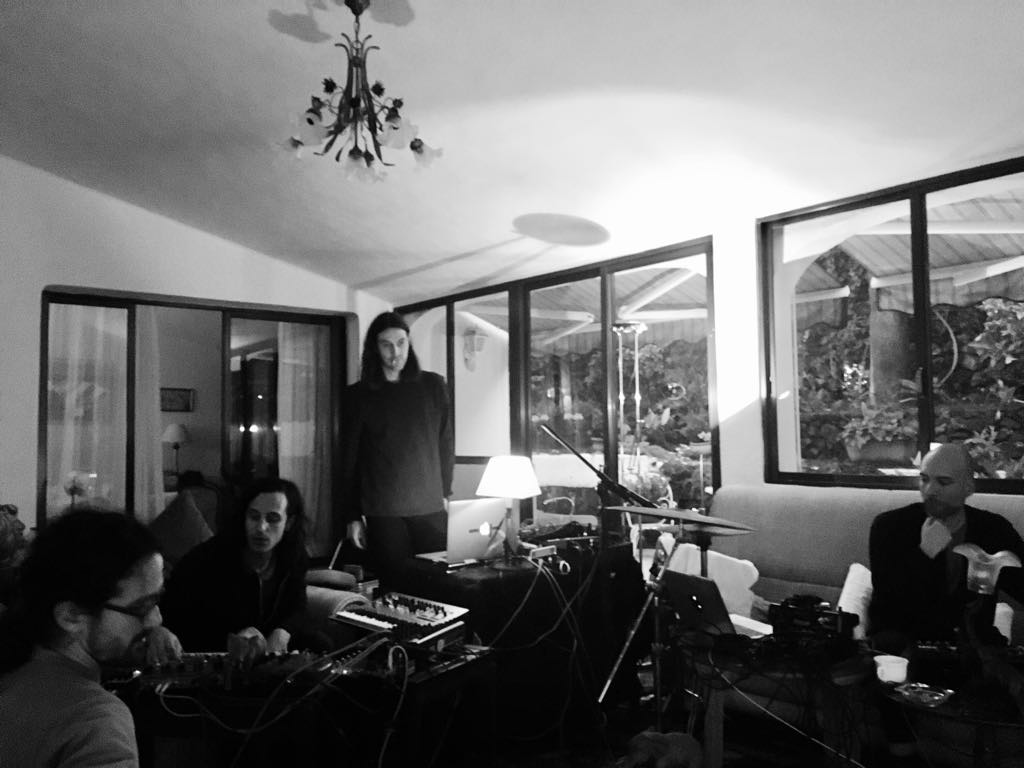
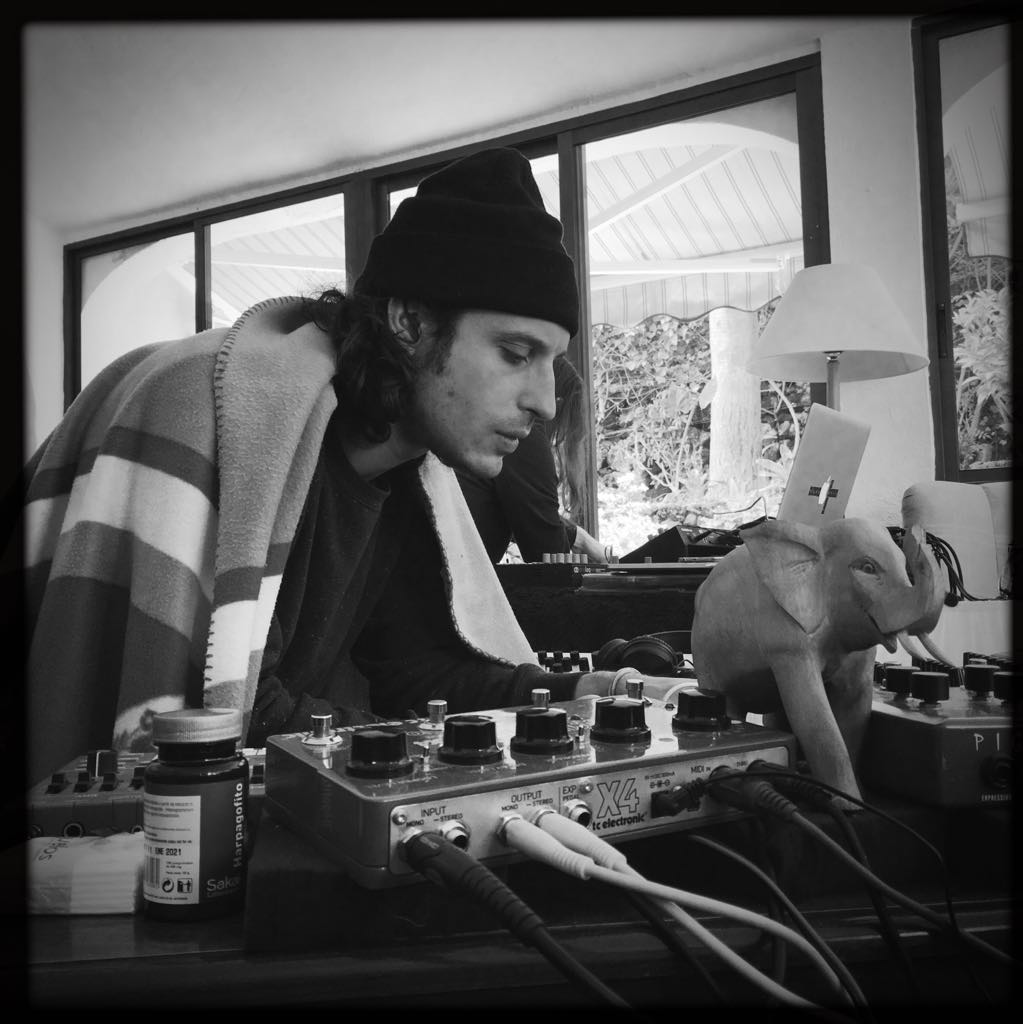
Triptease is an ongoing musical experiment performed by Topper, Jacopo, Francesco, and Hugo. Topper and Jacopo are lifelong friends who began the Triptease project back in 2012, and they were joined by Francesco, also a friend since kindergarten, some time later, after he picked up his guitar once again. They toured for a year or so as a trio until Hugo, a good friend and mentor since the band’s formative years in their hometown of Turin, Italy, formed the final piece of the puzzle. As a jazz-trained guitarist, he added the color and character to the beats that comprised the project’s earlier embodiment.
Each member has a precise role in the creative process. Topper is on modular synthesizer, samplers, and drum machines; Jacopo takes care of synthesizers, effects, and vocals; Francesco is on electric/MIDI guitar and pedals; and Hugo, also on electric/MIDI guitar, looks after samplers, vocoder, drums, and percussion. Together, they form Triptease, a shared platform through which they complement each other on musical and technical aspects, bringing different backgrounds and ideas all while sharing a view on what kind of music to produce. Their debut album, Mescaleros, is out on April 3 via Visionquest, recorded during a 10-day jamming session in Tenerife, off the coast of West Africa. To mark the occasion, they chatted to XLR8R about the setup behind it.
In April 2018, we found ourselves on a flight to Tenerife, loaded up with gear ready to enjoy 10 days off in the sun in the middle of the Atlantic ocean. A year earlier, Jacopo had been to the island to visit his sister and he came back bragging how cheap, warm, and inspiring it was. He said he’d love the four of us to go there to record some music, away from the usual routine of Berlin. Not long afterward, while randomly speaking to Gregor Kraemer, owner of Club der Visionaere and Hoppetosse, and probably our main supporter since day one, we found out that his parents used to live in Tenerife, and that he still had a house in the north of the island. He was immediately on board with our idea, and he invited us to go there with him a couple of months later.
And so we arrived at Villa Josefina, a five-bedroom villa in Santa Ursula. Unfortunately, the weather was terrible, 11 degrees and rainy most days, but we were there to record music, so it was actually bliss! We recorded a lot of material and some of it ended up forming the core of the ‘Mescaleros’ album. The setup was basically the same as the live show, but we added some extra mixers and a drum kit borrowed from a neighbor. We then worked on the tracks at our Pausenraum studio in Berlin, doing some overdubs and the usual editing and mixing.
We decided to split this feature into four sections, so each of us can tell you something about a couple of our favorite pieces of equipment, and how they were used in the making of ‘Mescaleros.‘
FRANCESCO
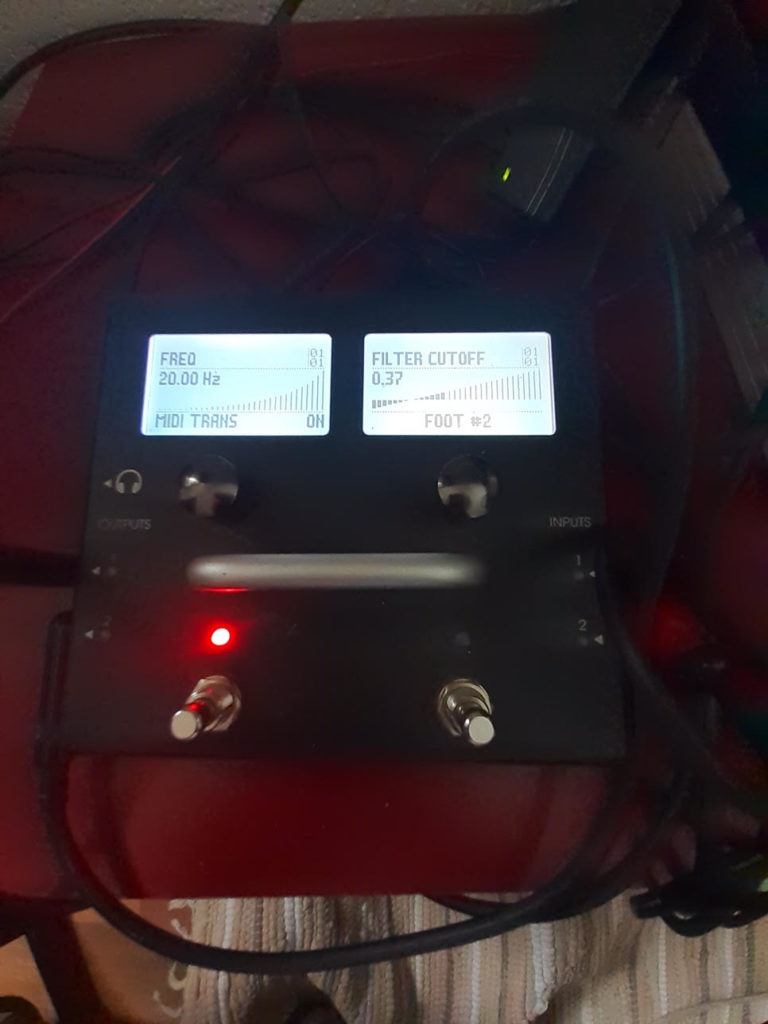
MOD Devices’ MOD Duo
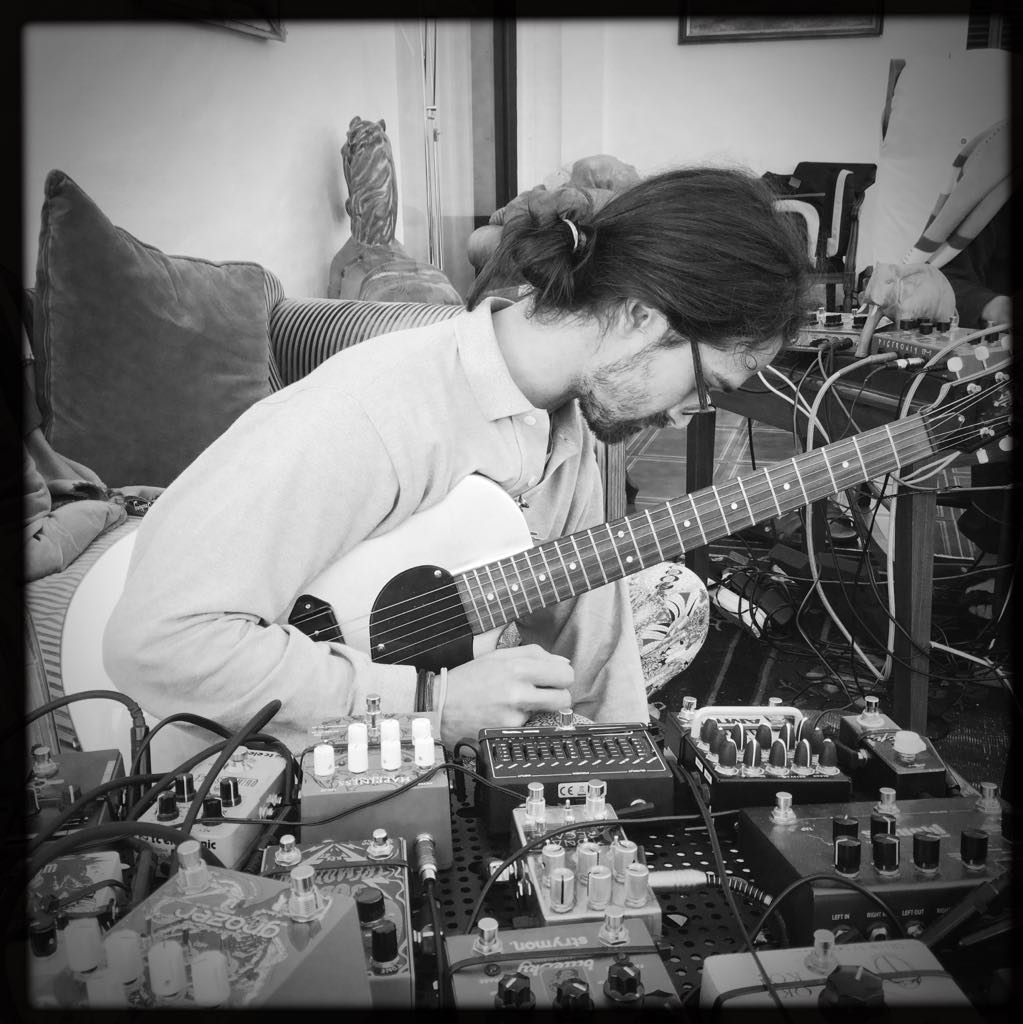
The first piece of gear I would like to introduce is the MOD Duo from MOD Devices here in Berlin. It’s a pedal that allows me to build virtual effects chains beyond my physical pedal board. It basically works around a patchable VST environment, and this allows me to leave the computer at home. The presets can be edited through a web interface, so I am able to do all my preparation at the studio, or even on my couch at home.
The layout is really intuitive and all the VSTs are open source. This machine allows me not only to shape my clean signal with compressors, filters, tube-screamers, saturators, and equalizers, but also to create psychedelic chains with lfo filters, chorus, delays, pitch shifters, phasers, etc., so that I can make drones inspired by synths and sitars, which are the sounds that I look for in the first place, and then I can run them through all the other pedals. You can hear the kind of sounds I like to create in the beginning of “Lo Siento.”
It also allows me to plug in my wireless MIDI pickup (Fishman TriplePlay) via USB and control a bunch of VST instruments, basically playing real synth sounds instead of just trying to emulate them with guitar tones and effects.
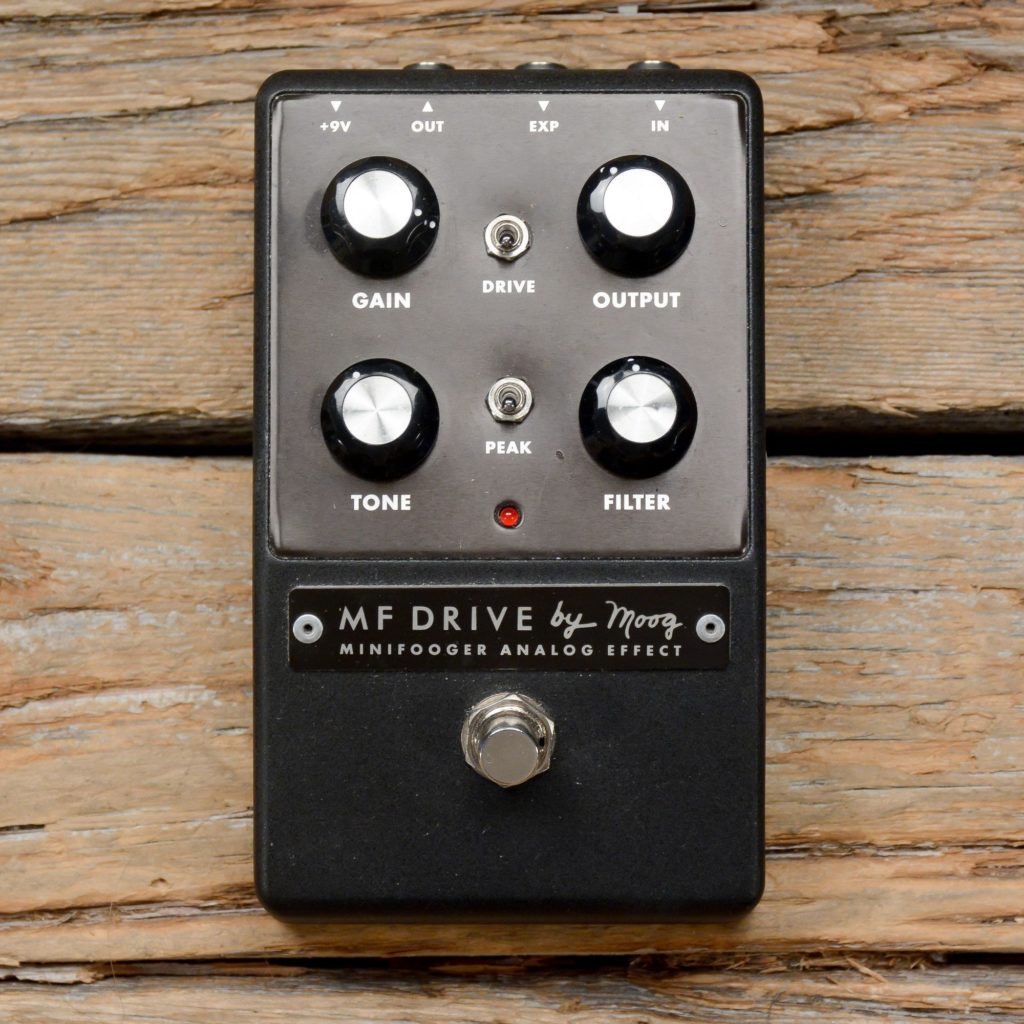
Moog MF Drive
The other piece of gear I want to talk about is my MF Drive from Moog. This small beast is a dynamic and highly reactive filter-based overdrive pedal that employs a Moog Ladder Filter, boutique FET amplifiers, and classic OTAs in its drive section—essentially it’s the overdrive circuit that comes built-in with many Moog effects and synths in pedal format. It’s the perfect tool for cutting through the mix with an electric guitar without using a real amplifier, and I don’t know how I could live without it.
For this purpose, I also use a SansAmp Paradriver, which is a booster and parametric equalizer, right after the guitar and before the MOD Duo, in order to shape, compress, and thicken the tone from the beginning.
Everything that comes out from my MOD Duo runs through the Moog before going to the Mixing Link from Eventide, creating the effect loop in my pedalboard. You can really hear how it fattens the bass guitar note from the arpeggio in “Song With No Name.”
I would also like to mention a couple more favorites from my pedalboard: the Stone Deaf Tremotron (tremolo) and Syncopy (delay) pedals, that provide me my main amplitude modulation and echo; the Red Panda Tensor, which adds a sprinkle of sympathetic intervals into the harmony, kind of how sitar strings mechanics work; and the Glou Glou Pralines, which is always on, even if the effect loop is bypassed, and gives the whole tone some modulation with the combination of four filters sweeping on the sustained signal.
All of these tools help me to enhance and maintain my tone through the chain with their analog signal path, which, as I said before, is the main problem when playing electric guitar without real amplifiers and speaker cabinets.
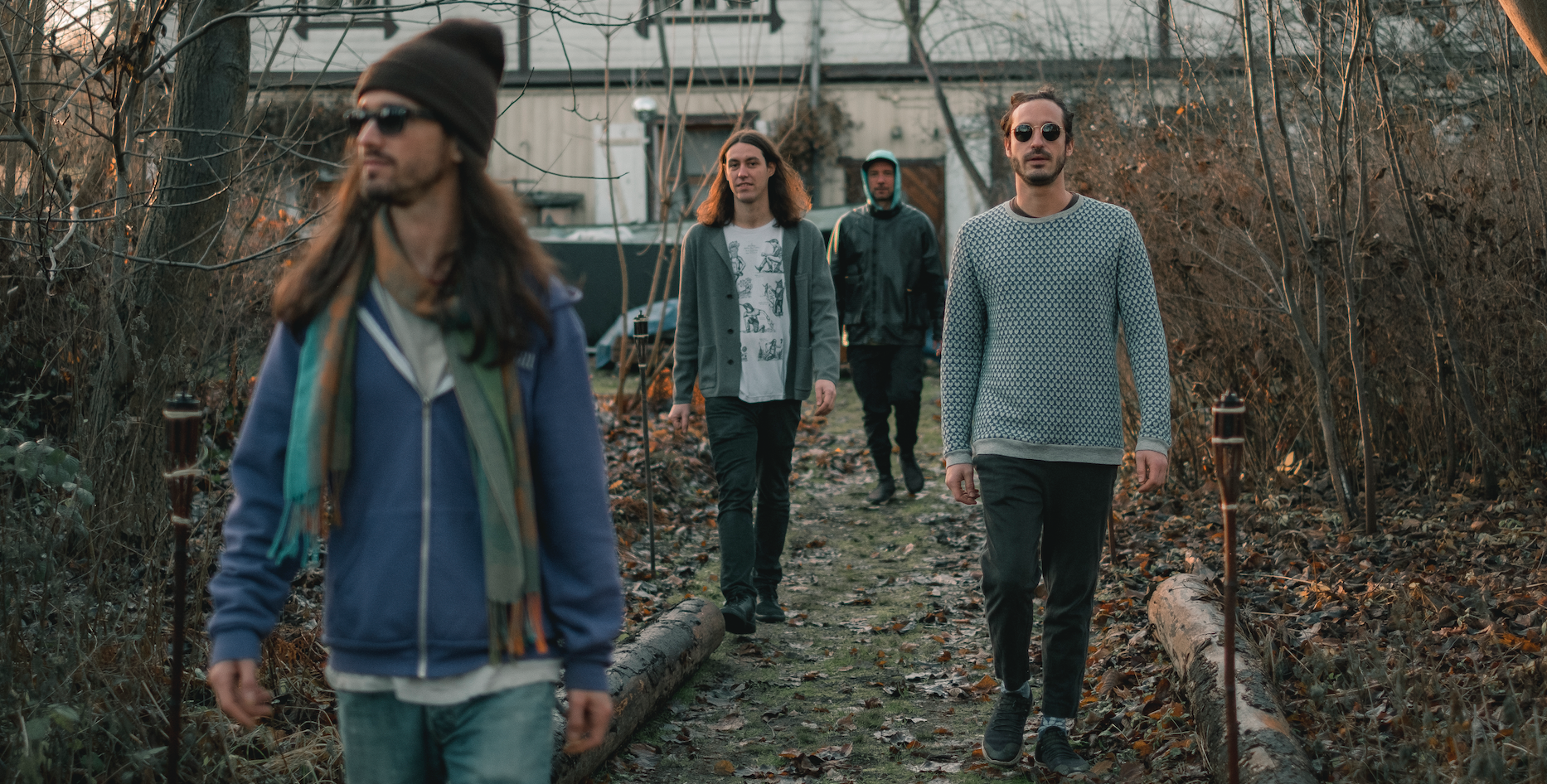
Left to right: Jacopo, Topper, Francesco, Hugo.
JACOPO
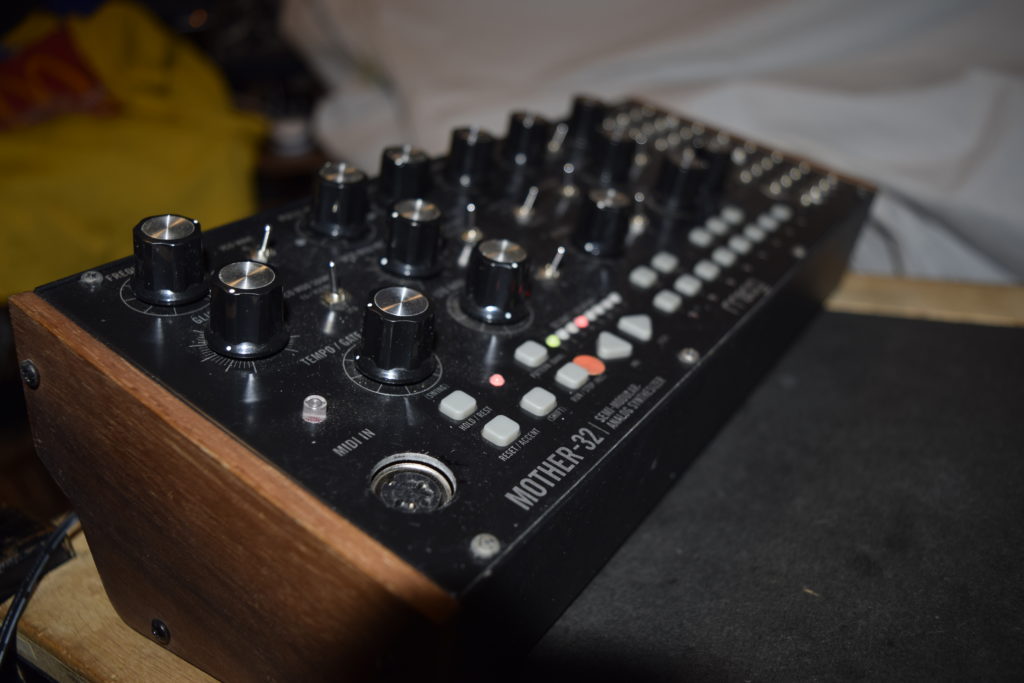
Moog Mother 32
I purchased the Mother 32 when I needed to upgrade my live setup. I was looking for a desktop Mono analog synthesizer so I went to JustMusic in Berlin to test a bunch, and Moog had just released it. What made up my mind was not only the sound, but the sequencer. The Mother has an old school approach with a modern touch, which is to say there is no screen and it’s also intuitive. Needless to say, it was a lot of fun playing it right away!
I use it mainly for bass and mid-range arpeggios, but it also works well for leads and drones. For me, it is a quick machine to use; for instance, I could go from a slow and long bassline to a fast-rhythmic percussive one in seconds thanks to the MIDI-synced tempo knob and the sustain switch.
To give an example, let’s imagine we are approaching a breakdown, and I have a subtle bassline playing without sustain and a short decay. When Topper brings back the kick, I’d hit the sustain switch and bring the bass up front.
Unfortunately, writing a sequence is not so quick because the machine lacks real-time recording, but once you’re used to the note/rest workflow, it’s quite fun and it can sometimes lead to surprising mistakes.
The killer features on the sequencer, at least for me, are the “hold” and “reset” buttons, especially when improvising and performing. By tapping the “hold” button, I can shift the timing of the bass, and by pressing it down I can repeat single notes, which achieves a cool sort of “fill” effect. It’s handy for breaks, randomizing notes, or solo-like phrasing, and if things get too messy, I just push the “reset” button and I’m back to the original bassline sequence!
I also love the transpose feature, which is perfect for when I have to adjust the bass to the same key as the rest of a track or for any real-time melodic changes in the sequence. I would say that if used in a certain way, the sequencer feels like a musical instrument of its own.
Sound-wise, the M-32 is very subby, and sometimes it’s too much and that’s why we have it going through a side-chain compressor, triggered by Topper’s kick drums, at all times. To me, it has a vintage Moog sound but it can also get modern-acid or FM-ish thanks to the patching capabilities.
I always have the M-32 assignable output set to a random sample & hold CV, and I usually use it to affect the LFO rate or the filter resonance to give it a subtle ever-changing feeling. If you go up the octaves, it cuts the mix well with the classic Moog sound.
Arpeggios in tracks like “Lo Siento” and “Drumses III” are made with the M32 which, going through a stereo delay, the Strymon DIG, becomes dreamy and cosmic.
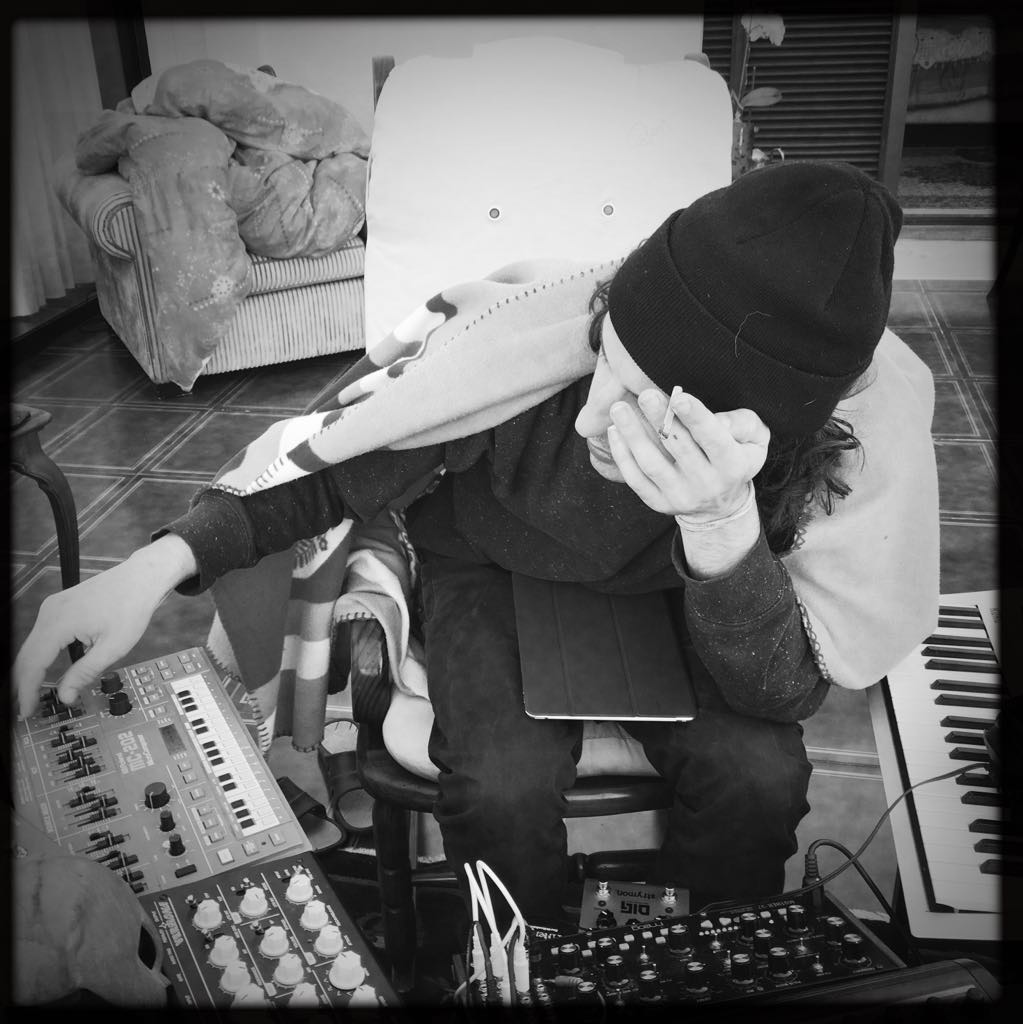
Finally, the Moog Mother works well when paired with the Roland MC-202, which is my other Mono synth of choice when playing live. They really compliment each other sonically. Having played on different sound systems, I’ve realized that if a club has more definition in the sub’s range, the M-32 will be my choice for the bass that night, and the 202 will be doing most of the arpeggios and leads, but if the sound system lacks subs then the 202 has a stronger mid-bass and will do a better job, whereas the Mother just disappears.
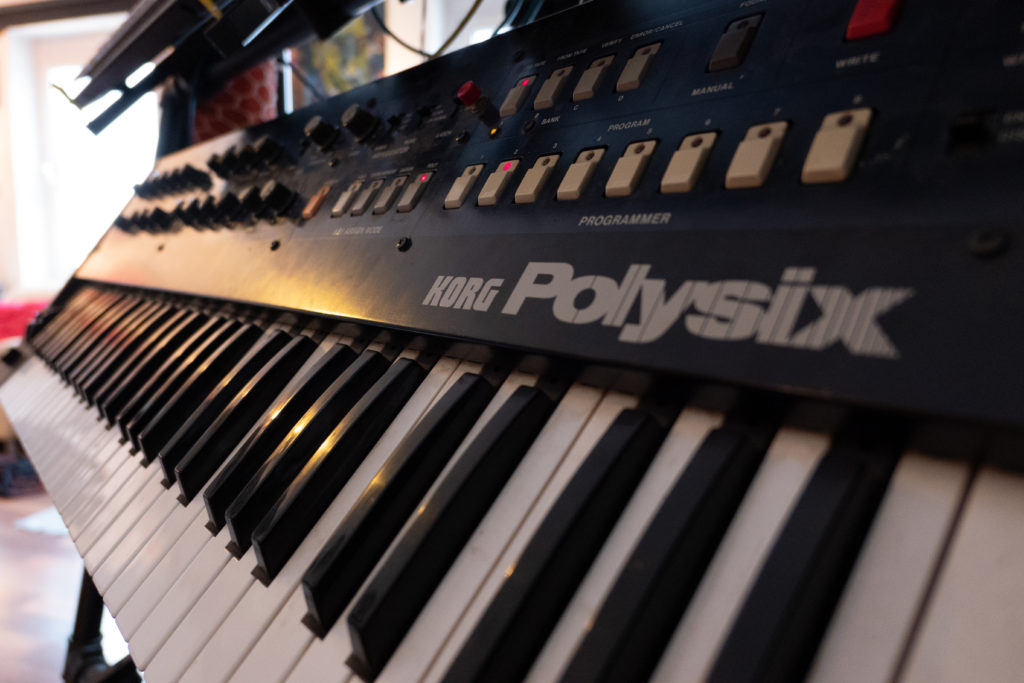
KORG Polysix
Topper and I found our Polysix while checking Kleinanzeigen, Germany’s best classified ads website, sometime in 2013. At that time, you could still find bargains if you were quick enough. I still think about the Jupiter 6 that we missed by just a couple of hours!
We bought the Polysix from a 60-something-year-old lady outside of the Berlin ring. It was listed as “not working” and so we bought it for a cheap price. The woman told us that she was the one who originally bought it, and it came with the original manual and the preset tape. She also said she had used it to learn how to play the piano, but it had been sitting unused on a desk for years, and so it was covered in dust. We tested it on the spot but no sound came out, so I fiddled with the volume knobs and suddenly I could hear a low detuned sound coming from my headphones. I looked at Topper and I whispered, “It works, mate..” We gave the lady her money, packed up the Polysix, and ran to the train to get back to the studio. After some contact spray and a bunch of fiddling with the volume knob, the beast was awakened. You can imagine how excited we were!
Later that week, we had it serviced by the trustworthy Phil-Synth, and the machine was in great condition and no battery leakage had happened, so he just recapped it and installed a newer leak-proof battery. We also did a modification that bypasses the synth’s effect circuit because it causes the signal to be super noisy; now we get a “purer” and more powerful signal taken straight after the master VCA. Phil also told us that the voices were slightly out of tune, a common problem apparently, but he also convinced us not to go through the expensive calibrating process, because that is what gives each Polysix his own character, and I have to say I couldn’t agree more!
The Polysix is a well known ‘80s synth so I’m not going to go through all the features here. But my favorites are the possibility to clock the arpeggiator with an external trigger like you can do with the Roland SH-101 sequencer, as it’s a really fun tool to come up with interesting melodies quickly, and the chord memory function for that instant Detroit vibe. But most of all I really just like the way it sounds!
You can hear this machine in chord mode in “Tony Little Something,” where Hugo did a wonderful job overdubbing those stabs, and the haunting unison bass-pad in “Pseudomartyrs.”
A gallery from Tenerife, April 2018
TOPPER
Eurorack Modular System
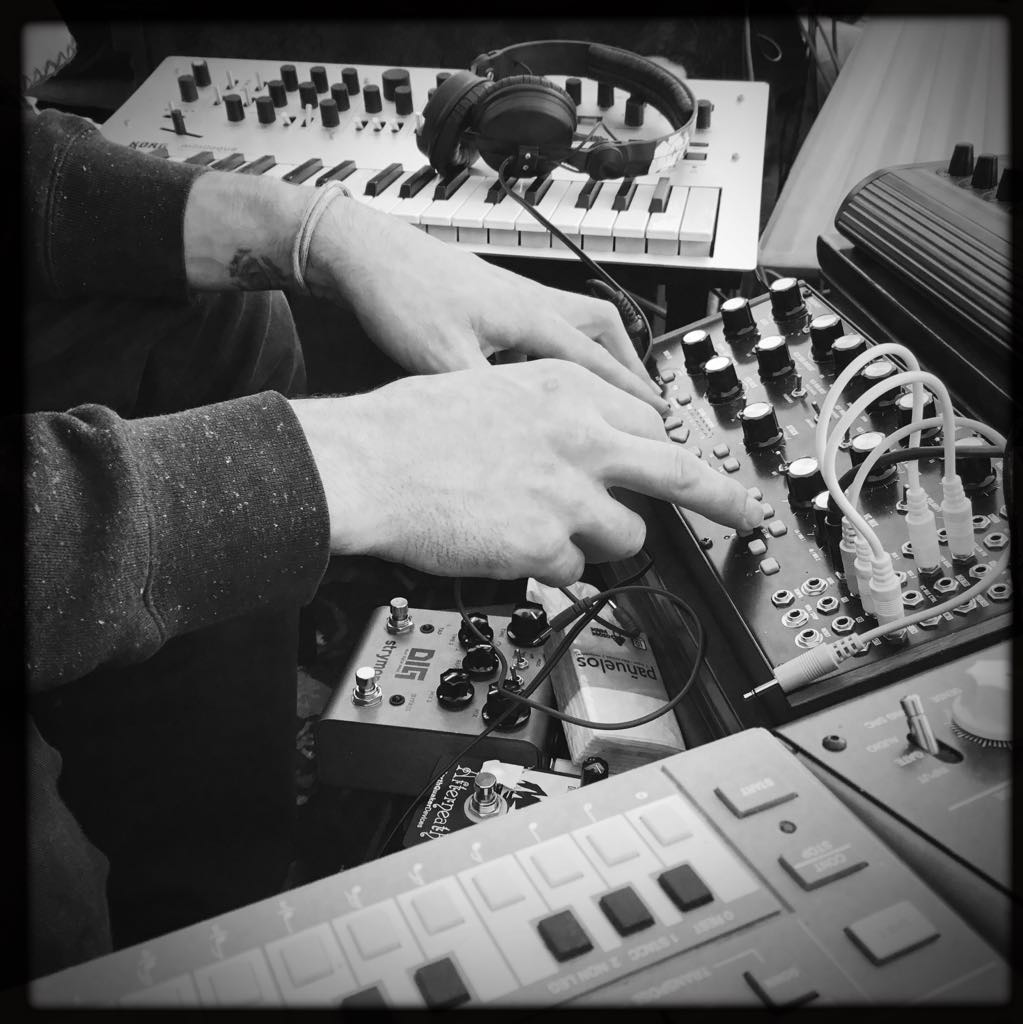
I caught the modular bug around five years ago, although I am happy to say that I think I’ve finally healed! I began by just checking out modules, reading through manuals, and also the invaluable Muffwiggler forum and various modular-focused Facebook groups. This all led into a deeper understanding of synthesis and a need to get even more out of the box. I slowly fell out of love with machines that didn’t have “one knob per function” and we started to evolve our studio concept towards a more hands-on experience. We sold a bunch of gear that didn’t fit the new concept—the most regrettable piece being a SCI Sixtrak—in favor of more knob-friendly machines, like the Vermona Perfourmer.
Meanwhile, I was constantly designing various “dream systems” on Modulargrid, and I borrowed a Clavia Nord Modular from tINI, which I of course eventually bought, and that got me started with the patching process.
The trigger to buy my first modules came after reconnecting with my friend Francesco Devincenti, from my early Berlin days. He showed me his system, which was half full of self-built modules, we made a couple of patches, and then it was game on. I bought my first case while on a trip to New York, which eventually became my custom liveset case that houses all the power supplies, a couple of drum machines and effects, and all the MIDI clock devices, and I started buying, selling, and trading modules. Eventually, I landed in the happy place I’m at now, where I can say I’m satisfied with the modules I have and I definitely don’t need to expand, and I’ve actually cut it down to two systems rather than three.
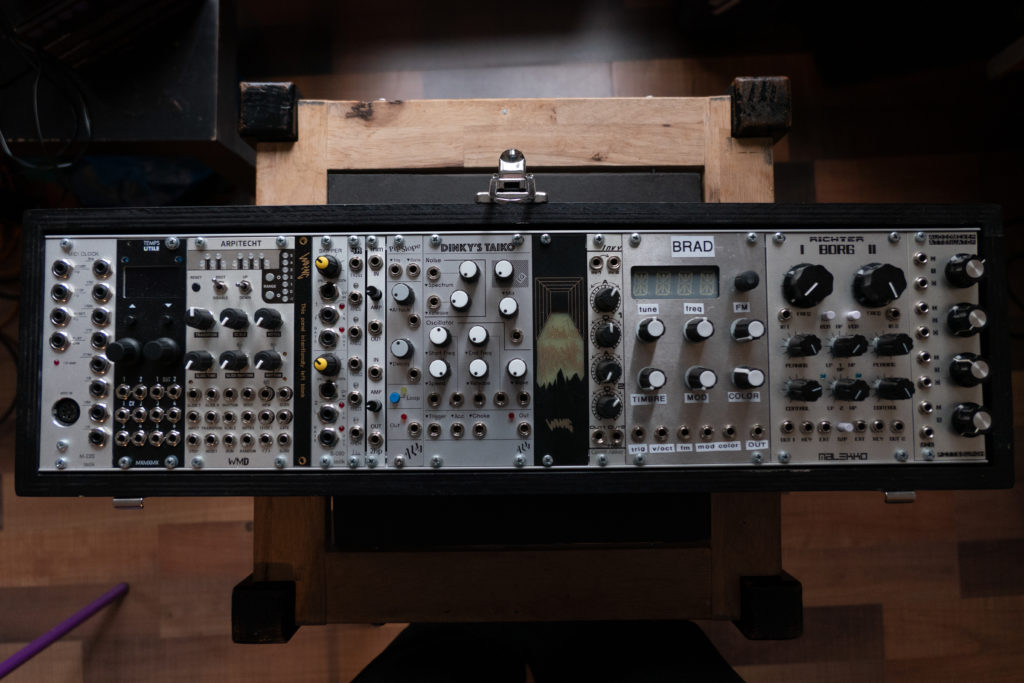
I have one Intellijel 7U 8hp travel case and a 104hp travel skiff. They’re both independent systems, geared towards a generative sound design approach; just feed them a MIDI clock and they can be easily integrated in the studio, on stage, or in whatever session I might find myself in.
The 7U is the more experimental one: it is driven by a Mutable Instruments Marbles, which generates three different gate sequences, which I then process through various probability and logic modules, each with an associated voltage output, which can then be used as either modulation source or pitch sequence.
Further modulations or pitch CVs are provided by the Malekko Voltage Block, Make Noise Maths, or by an Arturia Keystep. For sound generation, it can go both east coast or west coast. Oscillators are the Mannequins Mangrove and the Bubblesounds Vcob. I love to use lowpass gates (Make Noise Optomix, MengQi DPLPG) and pinged resonating filters (Mannequins Three Sisters, Random Source Serge Variable Q VCF), but I can never get tired of the classic OSC+VCF+VCA combination. Effects and further sound generation is provided by the Make Noise Erbe-Verb.
The skiff is more straightforward. Mutable Instruments Braids is the oscillator, and it goes through a Malekko Dual Borg for filter and/or low pass gate duties. I also have an FM drum voice (ALM Dinky’s Taiko) accompanying the synth voice. Gate sequences are mainly handled by an mxmxmx Temps Utile, pitch is generated by a WMD Arpitecht. Plus a couple of utility modules here and there.
You can hear the modular all throughout the Mescaleros album doing various percussion, quirks, bleeps, and noises, especially in “Bobby Peru,” “Teide,” and “Lo Siento.” It is also responsible for the opening/main synth line in “Drumses III,” besides the classic crickets sound!
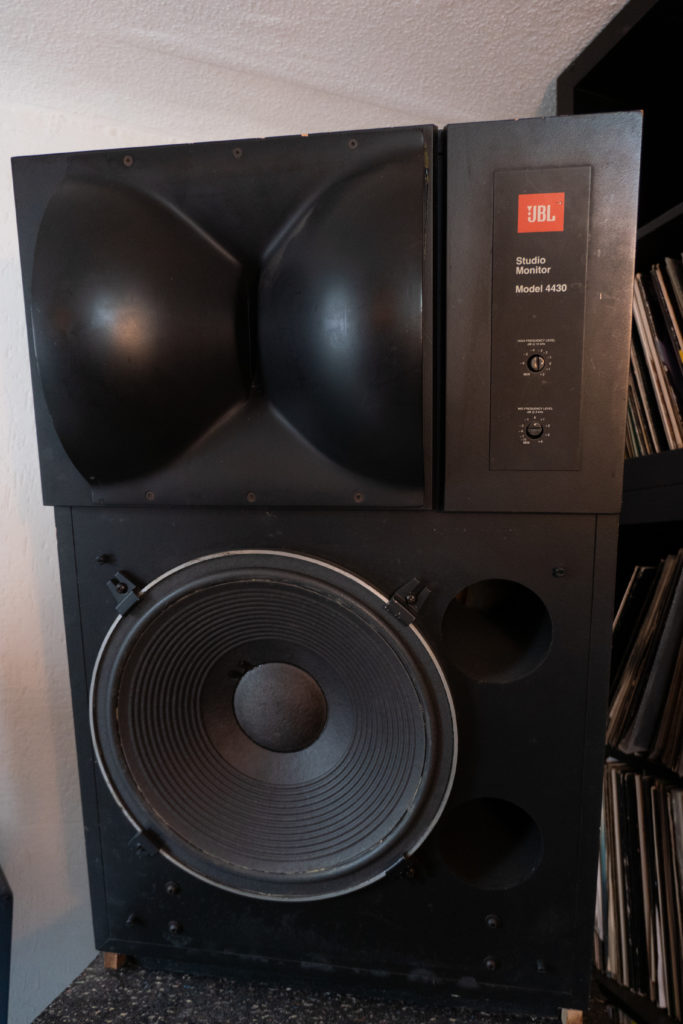
JBL 4430 Studio Monitors
Special mention must go to our JBL 4430 speakers, both for what they do in the recording, editing, and mixing process, and for the story that led them to us.
A few years ago, Jacopo’s dad was working in the south of France. One day while driving through a fancy neighborhood in Cap Ferrat, he noticed these two huge speakers out with the trash, sitting outside a huge villa. They showed some sign of misuse like they had been used as a drink coaster, but apart from the foam ring holding the main cone that was completely gone and needed to be replaced, they looked totally fine. So he picked them up knowing that we would be interested in them and managed to take them back home to the Turin countryside with his tiny Opel Agila. After some months, Jacopo and I managed to find the time to go get the speakers and bring them back to Berlin.
While we were at it, we decided that a proper road trip was in order, and together with the JBLs we loaded up both our dads. Jacopo and I have grown up together, as our dads have been best friends since childhood, and it had probably been 15 years since we went on trip as just the four of us. I actually think the last time was a motorbike and camping weekend sometime in the late ‘90s or early ‘00s. The road trip was a blast! We got the JBLs safely to Berlin, had the foam ring refitted, built some huge stands, and they have served us loyally through the years.
The great thing about these speakers is that they can give you the feel of a club sound system while still being a linear studio monitor. They are designed to diffuse the sound pretty linearly throughout the room, and definitely do a good job at that, providing a great stereo image in a wide sweet spot. The exotic horn tweeters provide a beautiful high end, which doesn’t get tiring, even after prolonged use, while the 15″ drivers provide a huge low end and punchy mids. They have been a staple in countless commercial studios since the early ‘80s, and there’s a reason why.
HUGO
“Frankenster” MIDI Guitar
I’ve been told that a musician is someone who loads instruments worth €5000 into a car worth €500 to drive 100 kilometers to a club where they will be paid €50 euros. I was shocked when I heard this, but it motivated me and I wanted to show that it’s not right, so for Triptease, I decided to use a guitar that I found close to a rubbish bin—and I only ride taxis and my fee is €5000. Joking! We tour with a van, but the guitar story really is true.
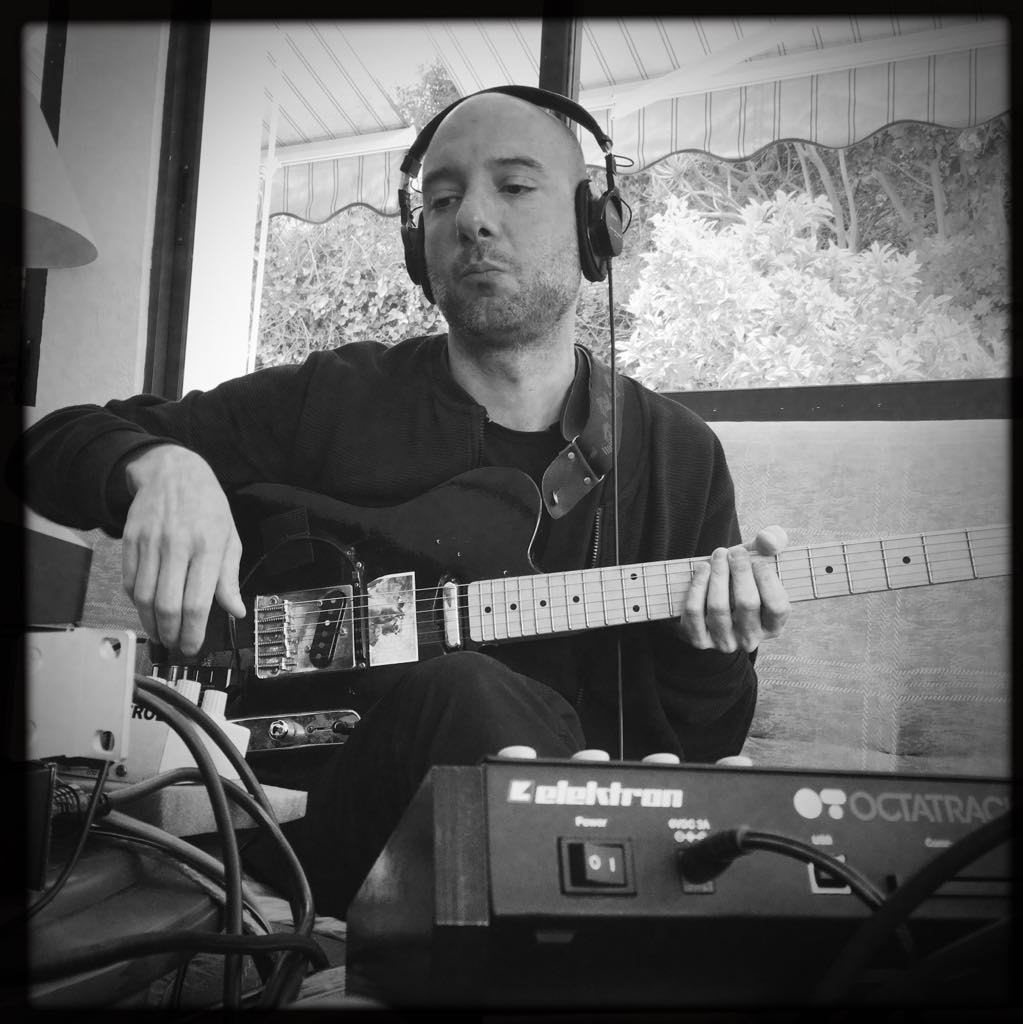
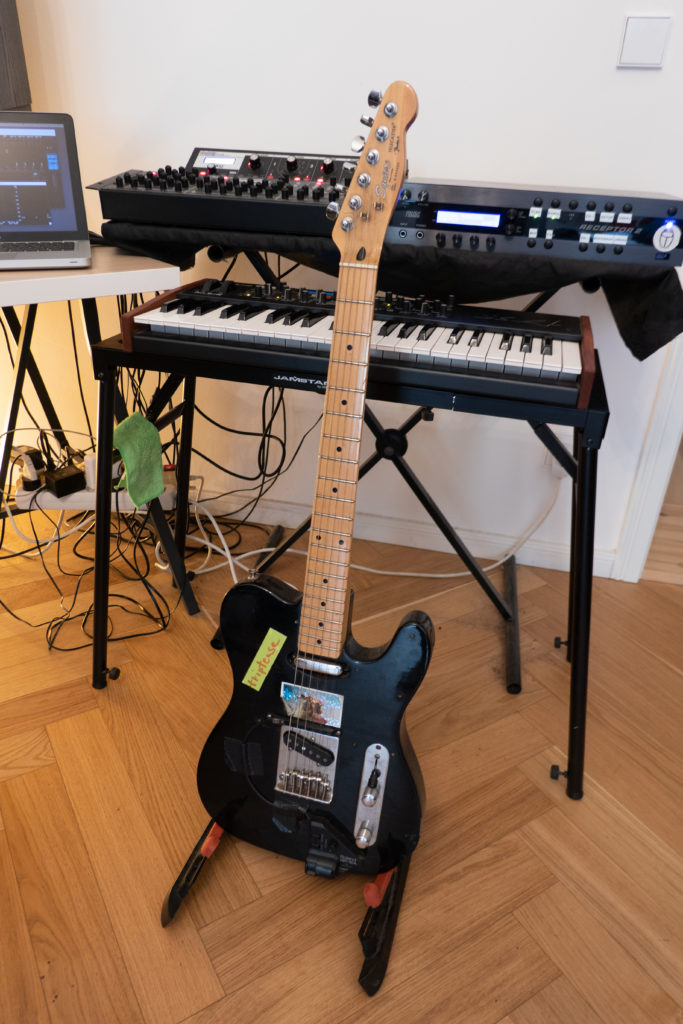
One night, after a studio session while cycling back home, we noticed a guitar case standing next to a bin on the street. Inside was a black Fender Telecaster that was to become my new MIDI guitar, now known as the “Frankenster.” Luckily, I still had a Roland GK-2A MIDI pick up and the GI-10 interface from my old Stratocaster, which was stolen, and so I went on and installed it on the “new” instrument.
With the MIDI Guitar, I play the Muse Research Receptor 2, which is essentially a PC in a two-unit rack housing purposely built for the touring musician that runs your choice of VST instruments, samplers, and effects, with the UI (User Interface) and I/O (Input/Output) of a classic hardware synth module. Playing MIDI guitar gives me a more creative approach to electronic music, which is usually written with keyboards, DAWs, and drum machines, but the guitar allows me to integrate my “classical” knowledge into the world of electronics in a way that is more organic to me.
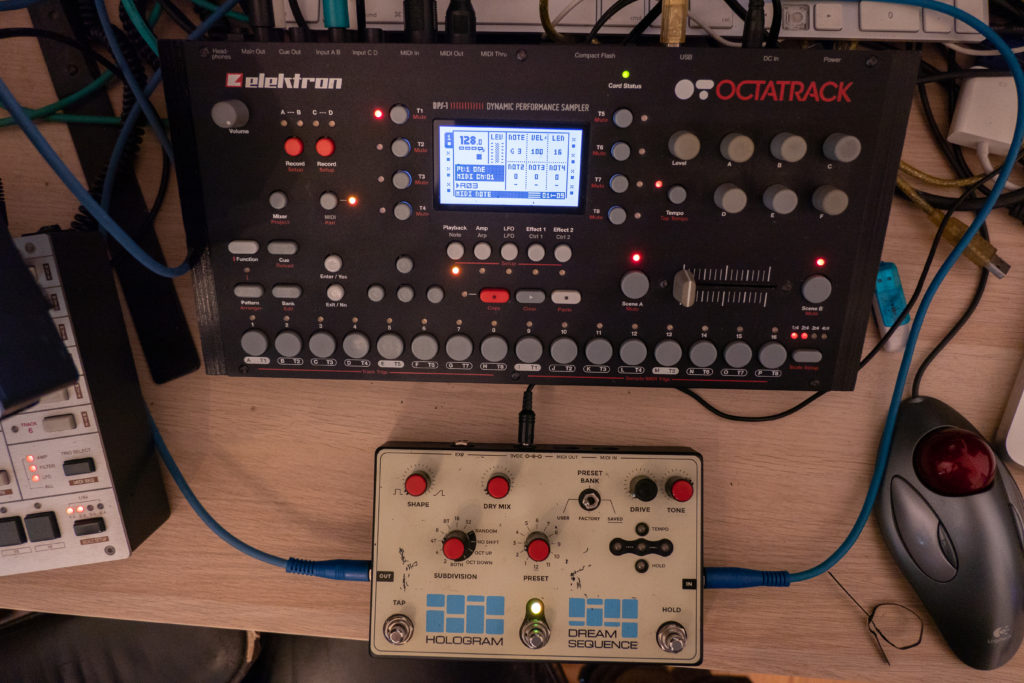
In “Teide,” for example, I made the bassline using the MIDI guitar, playing the Receptor loaded with a beautiful electric bass patch from Spectrasonics Omnisphere. That weird bass line in “Bobby Peru” is the MIDI guitar playing Native Instruments Reaktor inside the Receptor, and we routed the signal through the Hologram Dream Sequence pedal.
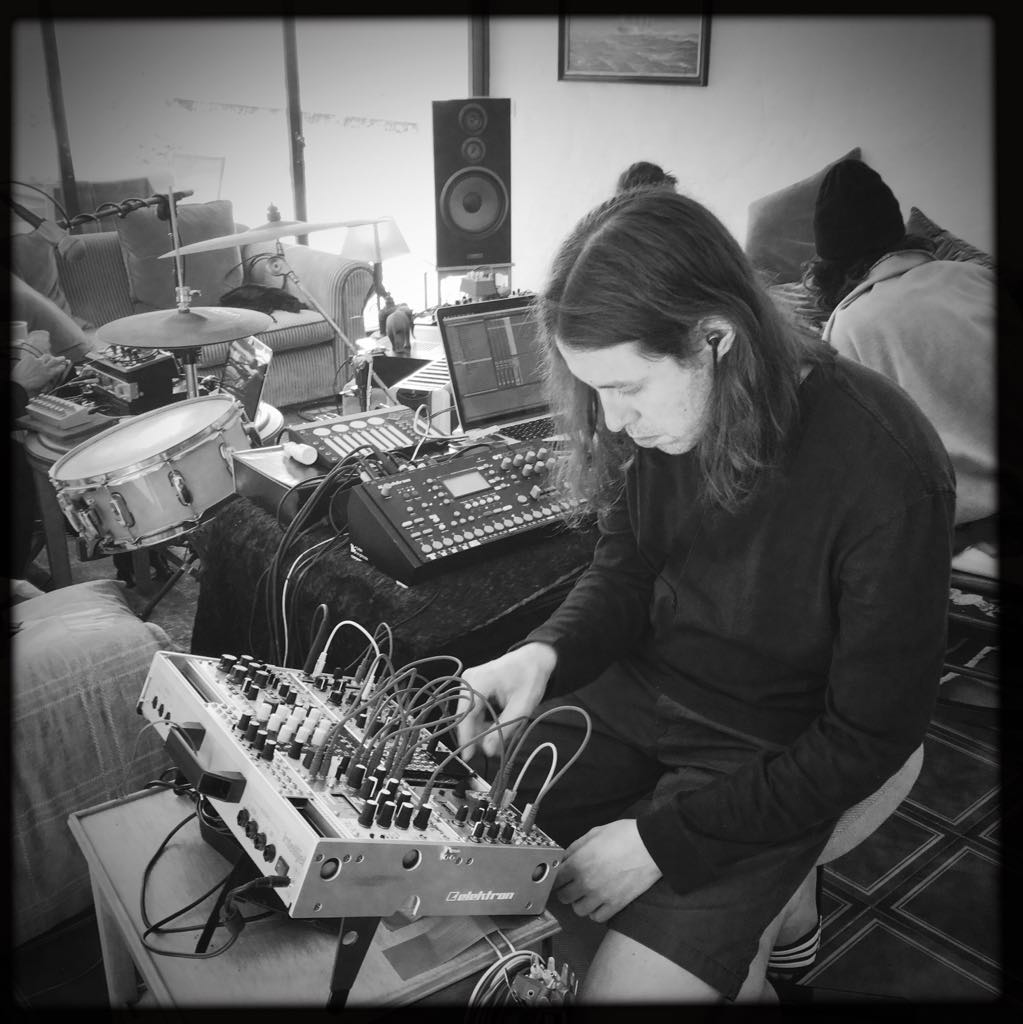
Elektron Octatrack
Another essential is the Octatrack from Elektron. I like mentioning the Swedish company because for many years it has been delivering inspiring music machines that we all love. You can listen to the way I used the Octatrack in “Duodular.” The strings and weird vocals are cuts from my personal collection of movies and radio samples loaded into the Octatrack and treated with its internal filters and effects. The Octatrack does not need big introductions. It has almost unlimited sampling memory (based on the size of your Compact Flash card), good editing functions over the samples, the infamous audio and MIDI sequencer, three LFOs per track, good effects, and routing over eight tracks. It sounds like a dream—or a trip?
Lead photo: Jacopo, Topper, Francesco, Hugo.
‘Mescaleros’ LP is out April 3 via Visionquest on vinyl and digitally.
Tomorrow, Friday, March 20, Bandcamp will be waiving its revenue share on all sales.
Most artists and labels have been financially affected by Covid-19, with the majority of their revenue disappearing due to the cancelation of tours and shows, and the closing of clubs and venues. In support, from midnight to midnight Pacific Time tomorrow, Bandcamp is waiving its revenue share—Bandcamp takes 15% of the revenue from digital sales and 10% from sales of physical goods—on all sales, meaning everything you spend on the platform is going directly to the artists and labels.
The scene needs help from fans now more than ever, so trawl Bandcamp, load up your cart, and support your favorite artists and labels.
Although Red Axes—Iraeli’s Dori Sadovnik and Niv Arzi—have previously released LPs on I’m A Cliché and their own Garzen Records, this self-titled new album is their first body of work written and conceived specifically as an album-length listening experience. It flows through a variety of stylistic detours, highlighting their ears as both keen listeners and skilled DJs.
The album also marks the 10th year of the Red Axes collaboration, and captures their enthusiasm for clubbing with their rock music backgrounds. We can expect a “melting pot of post-punk, new wave, and a club sound of both old and new,” brimming with jagged guitars, spacey arpeggios, and hypnotic vocals.
Red Axes have previously released on Dark Entries with 2017’s Nyx Tape and last year’s Voom.
Alongside today’s announcement, Red Axes have unveiled “Sticks & Stones” featuring Adi Bronicki, which you can stream below.
Tracklisting
01. They Game 02. Zeze 03. Shelera 04. Hold 05. Sticks & Stones (feat. Adi Bronicki) 06. Moonlight 07. Break The Limit 08. Watching You 09. Brotherhood (Of The Misunderstood) (feat. Autarkic) 10. Udibaby (feat. Beatfoot) 11. Arpman
Red Axes LP will be available on vinyl and digitally on May 8 via Dark Entries Records. Meanwhile, you can pre-order here.
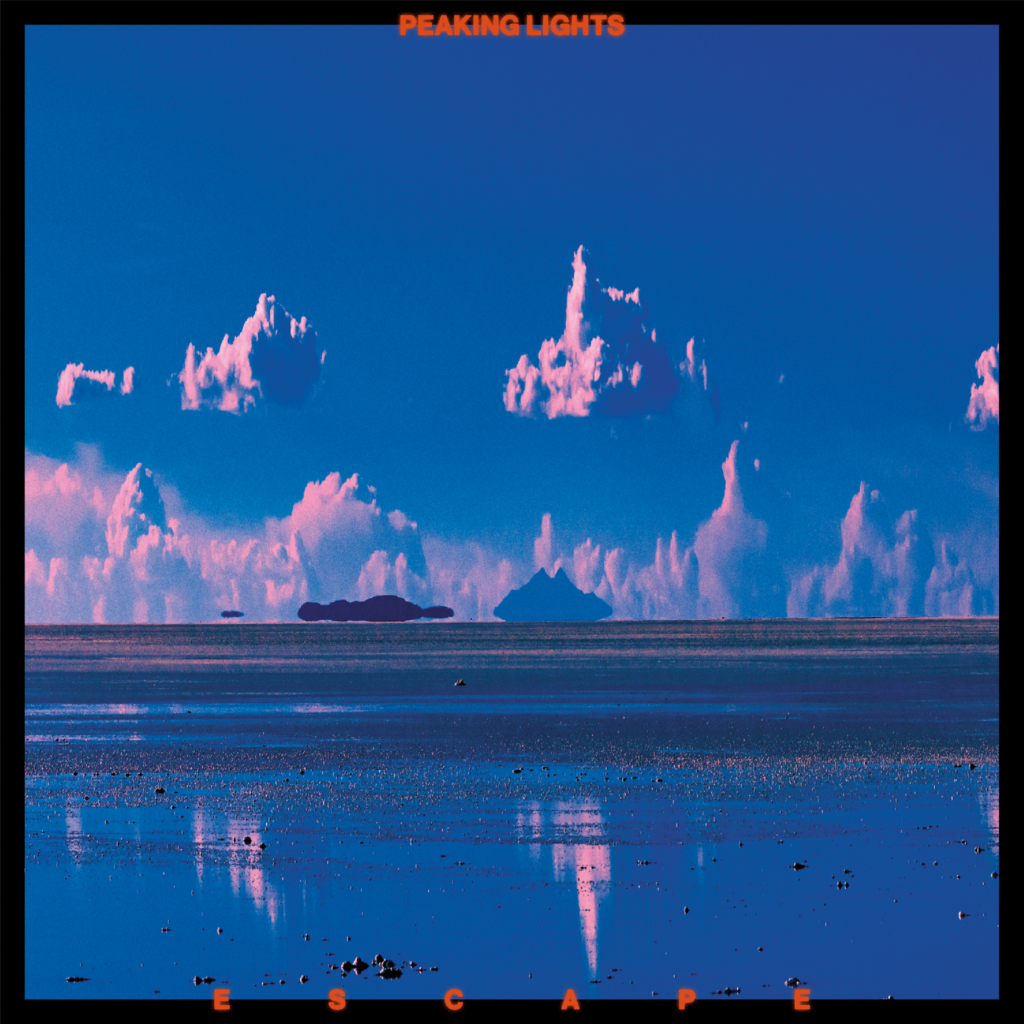
E S C A P E is the cosmic-dub luminaries’ eighth album in total and their second outing on Dekmantel, following the Sea of Sand EP in 2018.
Across 12 tracks, we’re told that the husband-wife duo, real names Aaron Coyes and Indra Dunis, illustrate their pragmatic use of instrumentation and dubbing to create more heady and celestial avant-pop. From the album’s opening, the band’s iconic retro-dub aesthetic kicks in, accompanied by a litany of drum machines, sweeping compressed effects, and Dunis’ hypnotic, serene vocals. Coyes, somewhat of a connoisseur and collector of varying studio gear, meanwhile adopts his steadfast dynamic approach to production, playing with new mixing techniques, tape loops, compression, and effects throughout.
The Amsterdam label adds that the album catches the Californian, now European, natives at their “finest,” replete with atmospheres of homemade-percussive dub, that sit alongside “wondrous landscapes of electronic pop and placid krautrock-like hooks, all tied together by Dunis’ composed and hypnotic vocal charm.”
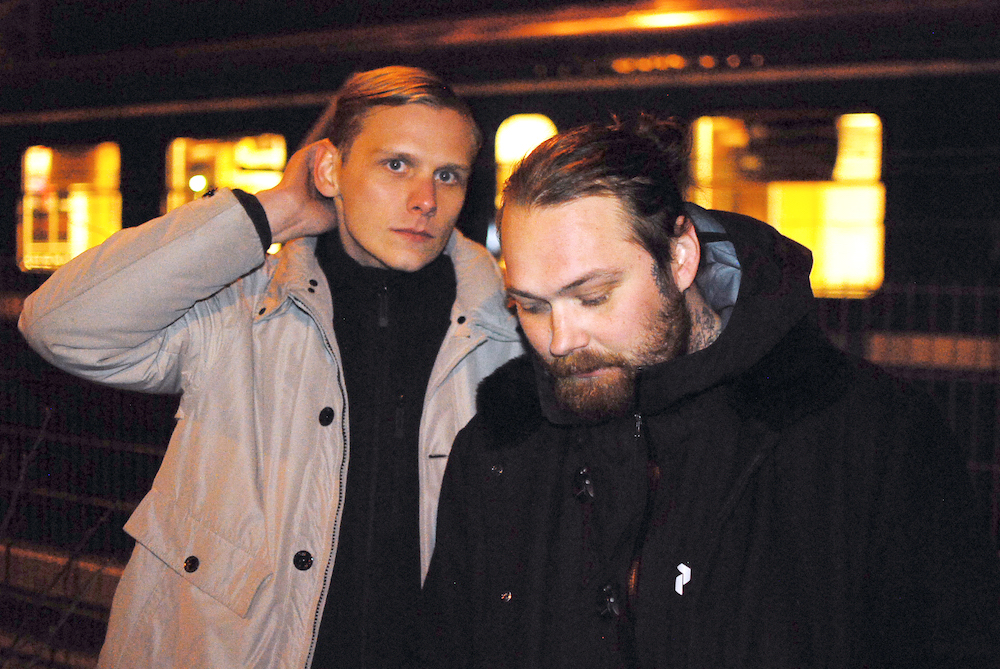
Northern Electronics will release the fourth edition of its Scandinavian Swords compilation series, released across two volumes on May 15.
Scandinavian Swords IIII breaks with its predecessors’ forms, the last of which came out in 2017, in that it’s much longer, comprising 40 tracks. With its release, label heads Anthony Linell and Jonas Rönnberg aim to retain their sure-footed programming while “cutting a new silhouette” for what a Northern Electronics release consists of.
The release’s first part is a triple-LP focused on dance music, while the second, a triple-cassette released at the same time, comprises more abstract and experimental sounds.
Linell and Rönnberg, now called Varg2™, feature on both compilations. Joining them are a slew of new and returning voices, including E-Saggila, Evigt Mörker, JS Aurelius, Korridor, and VTSS.
Tracklistings
Scandinavian Swords IIII: Atlas Of Visions Pt. I
01. Noah Gibson “Returning” 02. The Pelican Company “Temple Bells” 03. Varg2TM & VTSS “VARGTSS1 (Do The Roar)” 04. Anthony Linell “Hallucinations” 05. Exploited Body “She Blames The River” 06. The Empire Line “Træt Av Lagen, Træt Av Systembolaget” 07. Puce Mary Ft. Varg2TM “Violent And Delusional” 08. Fatal “Indolent” 09. Tusagi “Swetti” 10. E-Saggila “Blue Amps” 11. JS Aurelius “Crime Is the Highest Form Of Sensuality” 12. Mischa Pavlovski “Fra Midt Til Slutning II” 13. Free The ID “Red Fall Foliage” 14. Evigt Mörker “Stege” 15. Ulwhednar “Emergency Brake” 16. BHMF “Mörkertal” 17. CA2+ “Taki Patch-Out” 18. Age Coin “No Corner, No Devil”
Scandinavian Swords IIII: Atlas Of Visions Pt. II
01. Anita Falk “Spinal Cord” 02. Ex Ghost “Linjerna Säger ingenting (Utan Det Vakuum Som Omger Dem)” 03. Ano Ton “Disintegrating” 04. Varg2TM “On Your Heart I Make A Hole In The Wall” 05. Matti Bye “Solen” 06. The Dancer “Liquidish” 07. BHMF & Varg2TM “G Stik “RED” (Take Your Whatever) 08. Thoom “The Cowardice of Mine” 09. Rune Bagge “I’m Sitting On The Stars In The Sky Every Night” 10. Chatline “Dreamer Heaven” 11. Jin Mustafa “Hint” 12. Evigt Mörker “Ditt Försvinnande” 13. Internazionale “The Untamed Green” 14. Dream Eater “Flowers Of Neptune” 15. Korridor “Reeds” 16. Soho Rezanejad “This Sea Is Not A Memorial” 17. Anthony Linell “Sarek” 18. Misantropen “Moll 12 (När Jag Dör)” 19. Maria W Horn “Maskinhallen Nocturne” 20. Vallmo “Elephant” 21. Ano Ton “Peripheral Disturbances” 22. Ecco2k “Hi Fever”
Scandinavian Swords IIII is out on May 15. Meanwhile, you can stream The Empire Line’s “Træt av lagen, træt av Systembolaget” in full below.
Tornado Wallace is Lewis Day, one of Melbourne, Australia’s key electronic music DJ-producers. You’ll be familiar with his work through labels like ESP Institute, Sleazy Beats Recordings, and Gerd Janson’s Running Back, where he released his debut album in 2017. After a quiet 2019, at least in terms of releases, he’s set to return later this month with Midnight Mania, a mini-album on Optimo Music. It’s his first full release since his 2017 EP for Animals Dancing.
Day’s earliest musical yearnings developed in his teenage years, when he used his school laptop with a demo copy of Fruityloops and Cool Edit Pro he found in a magazine to make his earliest sketches. He progressed to buy his first hardware, which helped him to make music he felt needed to be heard, and this all led to his earliest outings on Delusions Of Grandeur, purveying a sound heavily shaped by the local house and disco parties he was involved in Melbourne. The result was an almost impossibly funky mid-tempo, sample-heavy house style.
Day’s records have broadly continued in this bracket for the best part of a decade. Across his discography, you’ll find chugging electro, slick and funky house, and pumping techno, all with a certain Tornado Wallace flavor of once-unfashionable sounds like new age, Balearic, and ’80s synth and presented them in new and exciting ways. Demand for his work has taken him all across the world, most recently to North America, where he played the east and west coasts.
This week’s XLR8R podcast is a reaction to life on the road, compiled in Day’s Berlin studio upon his return. Fittingly, it’s as distanced from Day’s dancefloor leanings as you’re likely to hear him, comprised of downtempo piano jams, sophisticated funk, and even psychedelic rock—a peek behind the curtain of Lewis Day’s deeper musical inspirations. Sit down, switch off, and wash your troubles away.
What have you been up to recently?
I’ve just come back from a North American tour which was super fun. And before that, I was in Australia for a couple of months doing some shows and just generally having a laugh. So now I am back home in Berlin and excited to stay put in Europe for the next while, where I can crack on with some music and get my life a bit more organized.
What can we expect with the new album?
It is very much a mini-LP or extended EP. These are five tracks made for the weirder dancefloors across the planet. The music is inspired by the humid decay and rebirth of the mutating life under the shadows.
What is it that draws you to making and producing music?
It’s something that’s always been very fun for me to do. Growing up there were always instruments around the house, and they were more like fun toys to play with than anything I had to study or learn. And making music electronically is just the evolution of that. I still have crazy fun doing it and feel super lucky that I get to spend hours of my day doing it.
Where are your favorite places to find new records?
Digitally I usually have a bunch of Discogs, Bandcamp, and Youtube tabs open at any point. Otherwise, I like to hit record stores when I’m traveling. Most cities usually have at least that one store that is kind of a social hub of the local scene, where new music is represented. It’s always nice to go there and see the people and look at the posters and flyers and get a whiff of what that city’s underground culture is about. And then there’s usually one or two infamously quaint second-hand record spots that are generally disorganized, musky, and impersonal. If I get time to hit both sides of the spectrum, that’s a pretty nice day out.
When and where did you record this mix?
In the past week at my apartment in Berlin.
How did you select the tracks that you included?
I needed a little break from dance music, so this is a selection of music from records I’ve come by in the past six months that have had more of a “home-listening” appeal, if you will.
Do you think deeply about your ambitions in music?
I have done so in the past. My expectations have been long exceeded though, so now I am just water in this ever-moving river. And if it one day stops then that’s cool too. Life flourishes in stagnant pools.
What’s on your horizon for 2020?
There are some remixes coming out soon. And some cool shows and touring. Otherwise, I’ll try to be in the studio as often as possible, and working on whatever presents itself to me next. Oh, and do my taxes.
XLR8R has now joined Mixcloud Select, meaning that to download the podcast you will need to subscribe to our Select channel. The move to Mixcloud Select will ensure that all the producers with music featured in our mixes get paid. You can read more about it here.
Tracklisting
01. Conrad Wedde “Islands” (Field Hymns) 02. Mio Takaki “射程距離” (Canyon) 03. Aragon “Polaris” (Invitation) 04. New World Music “Intellectual Thinking” (New World Music) 05. Larry Heard “Winter Winds & Chill” (Black Market International) 06. Smoke “Shelda” (MPS Records) 07. Alan Tew “The Fence” (Themes International Music) 08. Jack McDuff “Summer Dream” (Chess) 09. Bora Rokovic “Lyrics Without Lyrics” (MPS Records) 10. Gerhard Narholz “Underwater Adventure” (Conroy) 11. Fulvio Maras, Alfredo Posillipo “Sotto La Cascata” (Clac Records) 12. Association P.C. “Mirrored Dimensions” (MPS Records) 13. Osjan “Samotnia = Lonely” (Polskie Nagrania Muza) 14. Armonium “Mescaleros” (EMI) 15. Evaldo Montenovo “Funky Experience” (Telefunken) 16. Os Tincoãs “Chorojõ” (RCA)
I’m A Cliché will start a new chapter with a various artist compilation titled Bongo Beats & Bankruptcy.
Bongo Beats & Bankruptcy is the French label’s second compilation and features 13 tracks across three vinyls. The motive behind it is to mark the start of a new chapter with a “greatly reduced release schedule,” the label explains. Each track celebrates the label’s quirks and eccentricities, serving as a tongue-in-cheek snapshot that captures the label’s DNA.
“Whether they are downtempo, uptempo, or ambient like Orestt’s contribution, each tune on this compilation distills in its own idiosyncratic way I’m a Cliché’s essence: electronic music influenced by club culture but in no way constrained to the dancefloor,” the label explains.
Included is a rare synth track from Ivan Smagghe & Marc Collin as Volga Select. It’s joined by June’s dreamy tune at the crossroads between wave and kraut influences, Coy’s mutant synth arpeggios, and an old-school wave cut by Oliver Decrow mixed by Dunkeltier. Cosmo Vitelli, the label head, also contributes. You can see the full tracklisting below.
Vitelli, a French DJ-producer, created I’m a Cliché in 2004. Yuksek, Simian Mobile Disco, and Azari & III have all released on the label.
Tracklisting
01. Orsett “Luddisme” 02. Awkward Corners “In Slow Motion” (Sunju Hargun Edit) 03. Volga Select “Spione” 04. June “Perspective 4000” 05. Coy “La Cantine Du Vatican” 06. Rouge Mécanique “Skate & Distort” 07. Benoit B “Cosmic Music Style” 08. Fantastic Twins “Read My Palmer, Laura” 09. Oliver Decrow “Opus Pistorum” (Dunkeltier Mix) 10. Cosmo Vitelli “The Horse Incident” (Ft. Andrew Claristidge) 11. Odopt “Annpala” 12. Kriko “We as one in the S.D.T” 13. Linja “Xanandu”
V/A: Bongo Beats & Bankrupcy—The Sound of I’m a Cliché will land on March 27 on vinyl and digitally. Meanwhile, you can pre-order here and stream Volga Select’s “Spione” below.
DVS1, real name Zak Khutoretsky, launched Support Organize Sustain (a.k.a S.O.S.) as an independent initiative to promote community and artistry in electronic music. The inaugural conference was held on October 18, 2019, with a full day of panels, presentations, and roundtable discussions including DJs like DJ Stingray, Dasha Rush, Juliana Huxtable, Josey Rebelle, as well as various promoters and club representatives.
Discussed were six topics, spread over three panels and three presentations. The panels discussed marginalized communities, and brought together promoters from far-reaching areas and artists to talk about their creative drive. The presentations covered issues ranging from global drug laws, no-camera policies, as well as scene ethics and guidelines.
S.O.S. has been invited to host a day of talks during ADD Festival in Athens, Greece on Thursday, May 28, and plans on building additional content with locals as well as international voices to add to the material from last year.
“While the first conference was completely self-funded by the group, moving into the future, we hope to establish S.O.S. into a fully functional non-profit organization,” DVS1 explains. “Once this is legally established, we can sustain and grow the project through fundraising.”
Khutoretsky’s aim’s to eventually spread S.O.S. beyond Europe. “We hope to be able to create an online application for people to reach out to S.O.S. and request our presence or help,” he continues. “Once we can budget a yearly amount, we hope to set aside financial allotments to take this international and open up the dialog directly with people in areas that need to be heard.”
You can read more about S.O.S. here, and watch the panels from the first conference below.
PANEL: Putting the Art in Artist | Finding and maintaining your artistic voice––Dasha Rush, Josey Rebelle, DVS1, DJ Stingray.