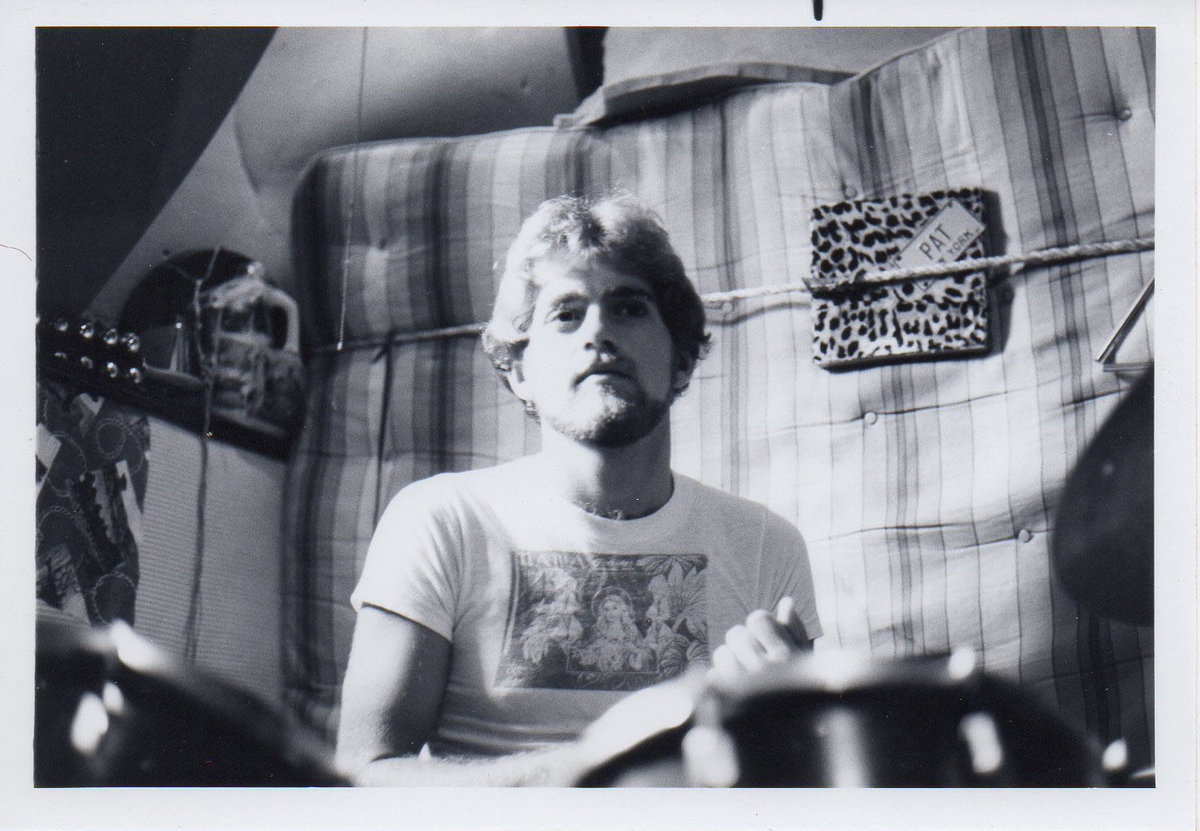
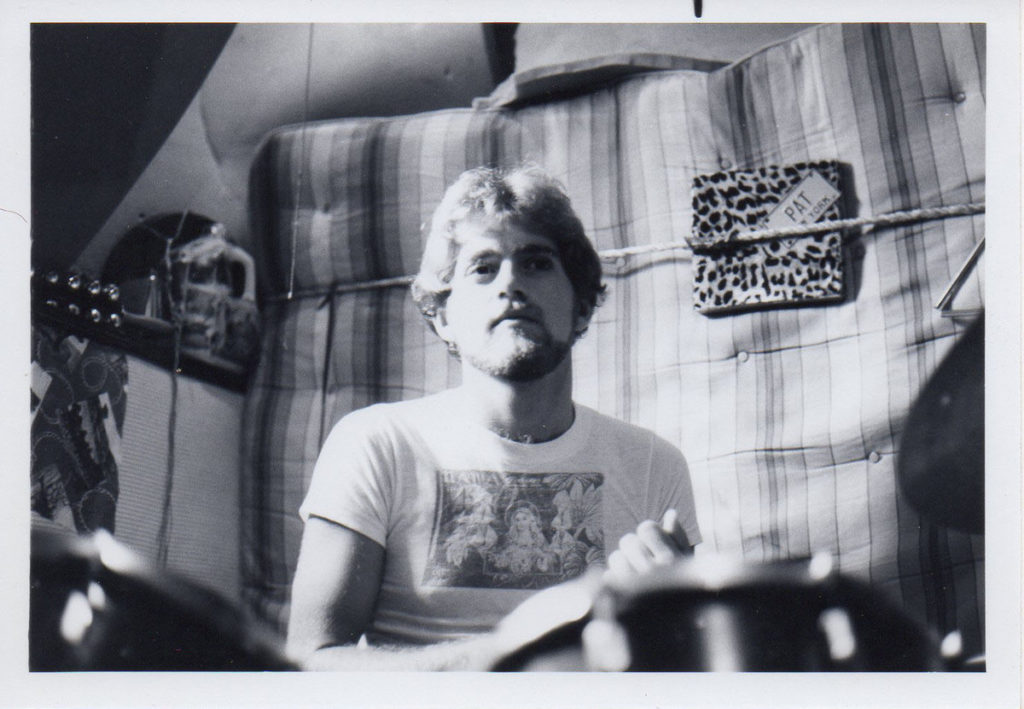
Best known for his production on chart-topping disco anthems such as Sylvester’s “You Make Me Feel (Mighty Real)” or his own “Menergy,” Cowley, who passed away from AIDS-related illness in 1982, left behind a substantial body of work. Since 2009, San Francisco’s Dark Entries has been working with Cowley’s friends and family to go through it, resulting in several archival albums, including the recent Mechanical Fantasy Box. Some Funkettes is the the latest addition to this series, and it showcases Cowley’s early musical interests and charts the development of his production techniques. It arrives in time for what would have been his 70th birthday.
The release opens with Cowley’s instrumental rendition of “Do It Anyway You Wanna,” the disco classic by People’s Choice. There’s also a psychedelic reworking of the Temptations’ “Papa Was a Rolling Stone,” retitled “Papa Wuzza Rollinston,” plus a cover of Donna Summer’s “I Feel Love.” The record closes with the dub version of “Spiked Punch,” which highlights developments in Cowley’s recording and synthesis techniques by way of its resonant burbles and spring reverb-laden passages.
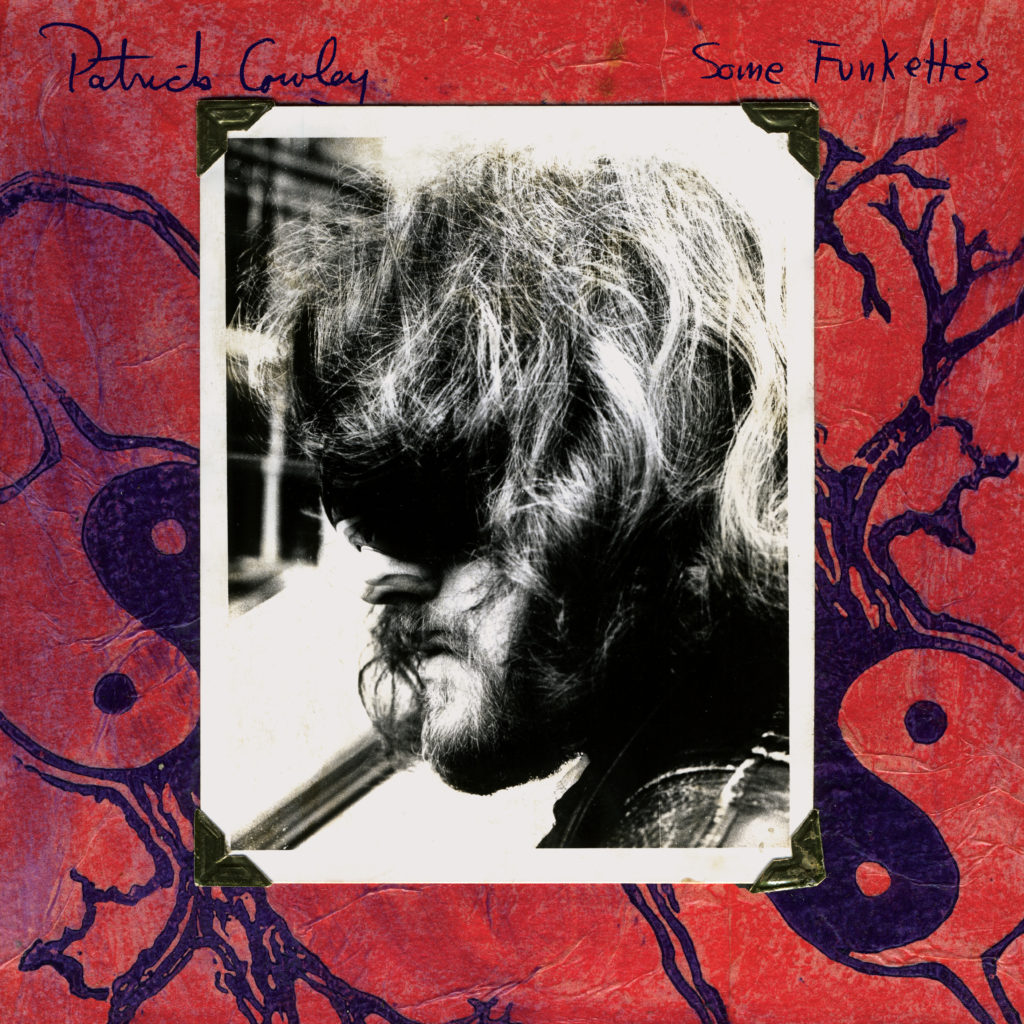
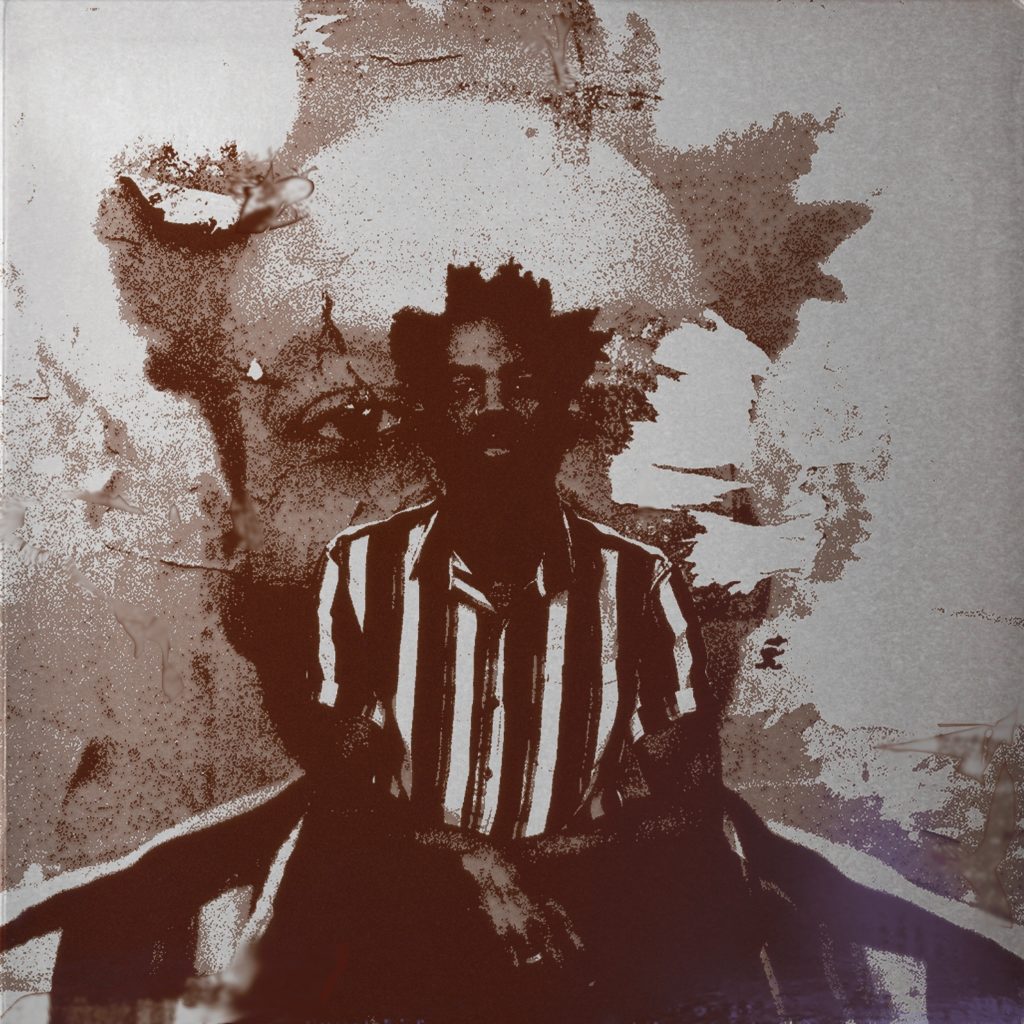
The record was made possible with help from Cowley’s brother Jim and his former studio-mate Maurice Tani. All songs were mastered for vinyl by George Horn. The sleeve is a collage designed in 1975 by Cowley’s former roommate Francesca Rosa that was found covering a reel-to-reel box. It features a yin-yang symbol and a photograph of a scruffy 24-year old Cowley, to which the label added his original handwriting.
Each record comes with an insert featuring a four-page essay by Rosa as well as a postcard featuring liner notes and a photograph by Cowley’s roommate and best friend, Theresa McGinley.
Vocal versions of “Papa Wuzza Rollingston” and “Do It Anyway You Wanna” are included as bonus tracks on the digital and CD releases.
Tracklisting
01. Do It Any Way You Wanna 02. Papa Wuzza Rollinston 03. Spiked Punch 04. I Feel Love 05. Dynomite 06. Spiked Punch Dub 07. Do It Any Way You Wanna (Vocal)* 08. Papa Wuzza Rollinston (Vocal)*
Some Funkettes LP is scheduled for October 18 release. Meanwhile, you can pre-order here and stream clips below.
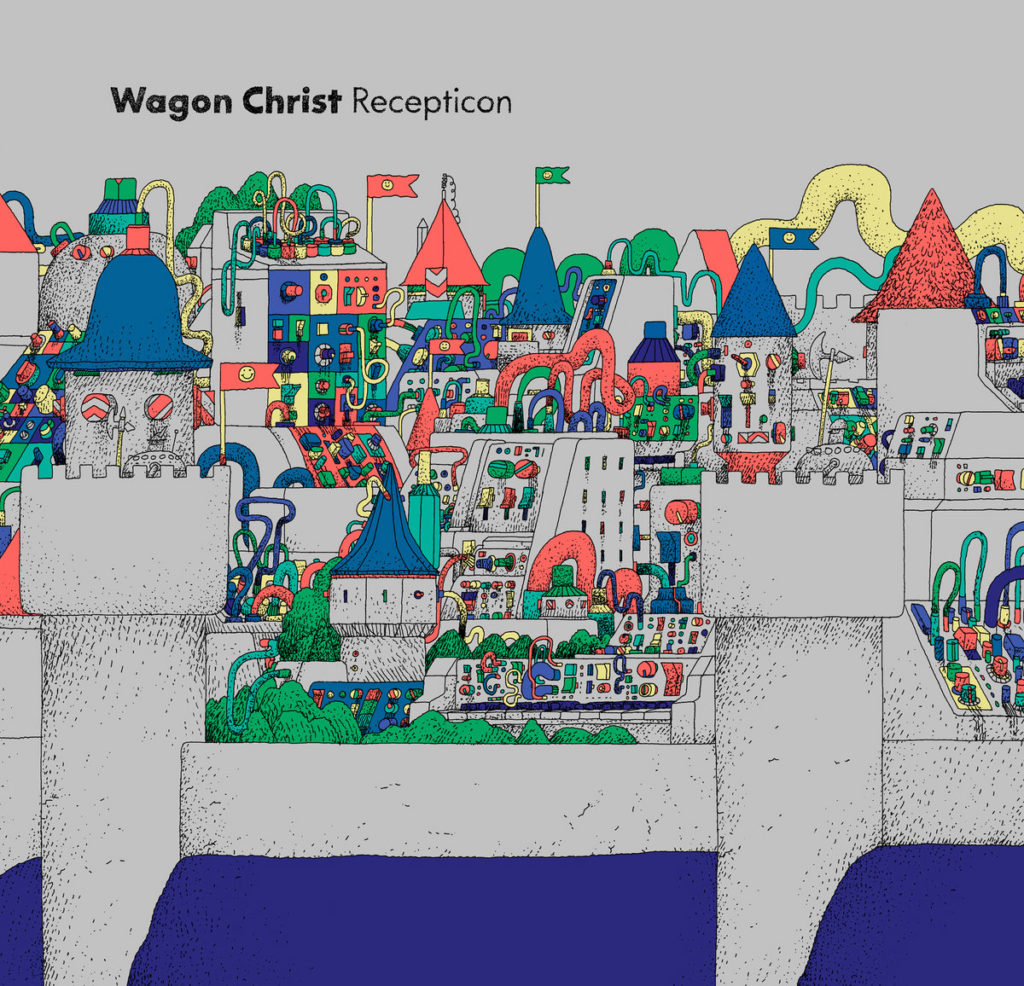
Luke Vibert will release Recepticon, his first Wagon Christ album in nearly a decade.
Vibert, a Cornwall, United Kingdom native, has been at the forefront of electronic music for the last 25 years, earning himself a cult-like following for his many recording aliases like Amen Andrews, Kerrier District, Plug, Spac Hand Luke, Ace of Clubs, and Luke Warm. He also releases music under his own name.
Launched in 1994, Vibert’s Wagon Christ moniker has been key in pioneering the trip-hop or downtempo genre of electronic music. It sees him creating, sampling, and using various instrumental hip-hop and funk riffs, found electronic sounds, rare breakbeats, outlandish spoken word samples, and carefully mined sound bites, all bound together with those thick Wagon Christ grooves. Vibert last adorned the alias with 2011’s Toomorrow on Ninja Tune.
We’re told that Recepticon follows the same combination of “mind-warping sampladelic electronic music.” It comes via People of Rhythm Records, packaged with new artwork and visuals by illustrator Celyn Brazier, who illustrated the previous Wagon Christ releases. It’s available on color double vinyl, CD, and digital formats.
For more information on Vibert, check out his XLR8R podcast here.
People of Rhythm is a record label, performing arts presenter, and a creative music production company. Previous label releases include Vibert’s Turn EP.
Tracklisting
01. Hello 02. Boogie Serious 03. Hazlehertz 04. Alright 05. U R Here 06. Never Odd Or Odd 07. Special Designer Song 09. Bleep Me Out 10. Same Ol’, Same Ol’ Recording 11. Likewutchyadoo 12. Innosynth 13. Recepticon 14. Lunderneath 15. Lavengers
Recepticon LP is out on October 24. Meanwhile, you can pre-order here and stream clips below. “Special Designer Song” is available in full.
Planningtorock is the chosen alias of celebrated gender-queer producer Jam Rostron. Originating from Bolton in the north of England but based in Berlin, Germany since 2002, Rostron has since relocated to Tallinn, Estonia to begin their fifth studio album, scheduled to land in 2021. It will follow PlanningtoChanel, a five-track EP of music created for Chanel’s Autumn-Winter 2020 fashion show earlier this year, made in collaboration with Michel Gaubert, the brand’s sound director.
Rostron began releasing music in 2004, upon landing in Germany, but it wasn’t until their debut album, 2006’s Have It All, that their exhilarating electronic pop with pitched-down vocals took shape. After collaborating with The Knife and Mt. Sims on a Darwin-inspired electronic opera, Tomorrow, In a Year, Rostron caught the attention of James Murphy who snapped them up for his DFA label. W, Planningtorock’s second album, surfaced in 2011.
The release of W triggered a period of change in Rostron. They changed their name and, creatively lost, struggled for inspiration, all before “Patriarchy Over And Out,” which inspired a new beginning of being more politically expressive and has paved the way for two more albums, most recently 2018’s Transome. With songs about their childhood in England, the album was the most poignant realization of their bold and buoyant pop yet.
Nestled in their Estonia studio, Rostron has been enjoying having a routine, away from the planes, trains, and live events. As with so many artists, it’s given them the chance to catch up on the music they’ve missed and to make more for others to enjoy. Their XLR8R podcast is the first taste of these new experiments, laden with unreleased remixes and original productions, plus some of the records that have inspired them to make them. It’s one hour of spellbinding dance music in Rostron’s inimitable style.
01. What have you been up to recently?
I’ve been more stationary than I’ve been in the last 17 years. Not being able to tour and travel has meant that I’ve been home more and in the studio every day. I love this daily routine without weeks away. But I do miss performing. It has been quite a busy few months for me recording and making a lot of remixes, or “Planningtorock versions” as I like to call them.
02. What music have you been listening to during lockdown?
It has been a great time to discover new music and great artists. I’m in love with a track called “Crush on You” by Bored Lord. India Jordon’s new EP, For You, is so good. My dear friend Arca‘s new album, KickI, is gorgeous. She’s on fire! I’ve been listening to Eris Drew and Chika, and I love the new track by Biig Piig called “Don’t Turn Around.”
03. Can you briefly talk us through your latest EP, PlanningtoChanel?
Michel [Gaubert] and I have known each other for a while. Michel used “Patriarchy Over and Out” for a Fendi show back in 2012. We both met in Berlin last year and he told me that he wanted me to compose music for a Chanel show but wasn’t sure when. Then earlier this year Michel called with the invitation and went on to explain his vision for the Chanel fall/winter 2020/21 ready-to-wear collection and shared two great tracks as references. The first was from the 1970s film “Donkey Skin” and the second was by the 1980s French singer Mylène Farmer. Both classic tracks with lots of character. I set out to create songs that were suspenseful and dramatic with a quality of agelessness to them. Like you wouldn’t know exactly when they were made or if they came from a film soundtrack. I wrote the string arrangements first and then recorded my voice. It was super fun. Pitching each vocal created a virtual queer choir that is the heart of the EP.
04. Where and when did you record this mix?
End of July here in Tallinn, Estonia, where I’m recording my fifth Planningtorock album.
05. What can we expect with the mix?
For this mix, I wanted to be playful and include raw unfinished Planningtorock sketches together with some songs I’m listening to right now. It was fun to make. It also includes some unreleased Planningtorock tracks and some recent remixes I’ve made. I guess I’ve been making a lot of mixes or playlists lately, and I wanted to go about this one differently.
06. Where do you envisage it being listened to?
Actually I think this mix can be listened to in many different situations. I’ve been listening to the mix whilst drawing. It’s nice to listen to when your driving or by the beach if you’re lucky to be near one!
07. What’s next on your horizon?
I’m currently writing a new album. I can’t believe it’s my fifth! I feel so grown up! Also, lucky for me I’m writing a lot of music for other artists which is a lot of fun. It’s always nice to facilitate another cutie’s story.
08. What are your longer-term ambitions with music?
The Black Lives Matter movement has changed what releasing music means to me. While writing “All Love’s Legal” back in 2014, I knew exactly what making music was for me. That music was a way of talking about things and connecting. As a white person, I’m thinking about how I can become a better ally daily in the fight against racism. We’ve all got to. find our own way and music is my way to do something. Through my music, I meet a lot of white people on and offline and can talk about racism. With every Planningtorock release, there will be a donation made to an anti-racist organization. A donation will be made to the Marsha P. Johnson institute with PlanningtoChanel.
XLR8R has now joined Mixcloud Select, meaning that to hear the podcast offline you will need to subscribe to our Select channel, or subscribe to XLR8R+ to download the file. The move to Mixcloud Select will ensure that all the producers with music featured in our mixes get paid. You can read more about it here.
Full XLR8R+ Members can download the podcast here.
Tracklisting
01. Planningtorock “Touch” (Unreleased) 02. Planningtorock “Much to Touch” (Muchness Version) (Human Level / DFA) 03. Azari & III “Reckless for your Love” (Turbo Recordings) 04. Inner City “Good Life” (Virgin Records) 05. Arca “Non-Binary” (XL Recordings) 06. Planningtorock feat. Joy Leah Joseph on live drums “Soft” (Unreleased) 07. Planningtorock “Non-Binary Femme” (Human Level / DFA) 08. Robyn “Ever Again” (Planningtorock Remix) (Konichiwa Records) 09. ** “***” (Planningtoriskit version) (Unreleased) 10. Planningtorock “Jam Fam” (Maxi version) (Human Level / [PIAS]) 11. Aquarian Jugs “Histories Not the Past” (Unreleased) 12. Planningtorock “My Fire” (Unreleased) 13. Joyce Simms “All and All” (Warlock Records) 14. Planningtorock “Jam of Finland” (Human Level / DFA)
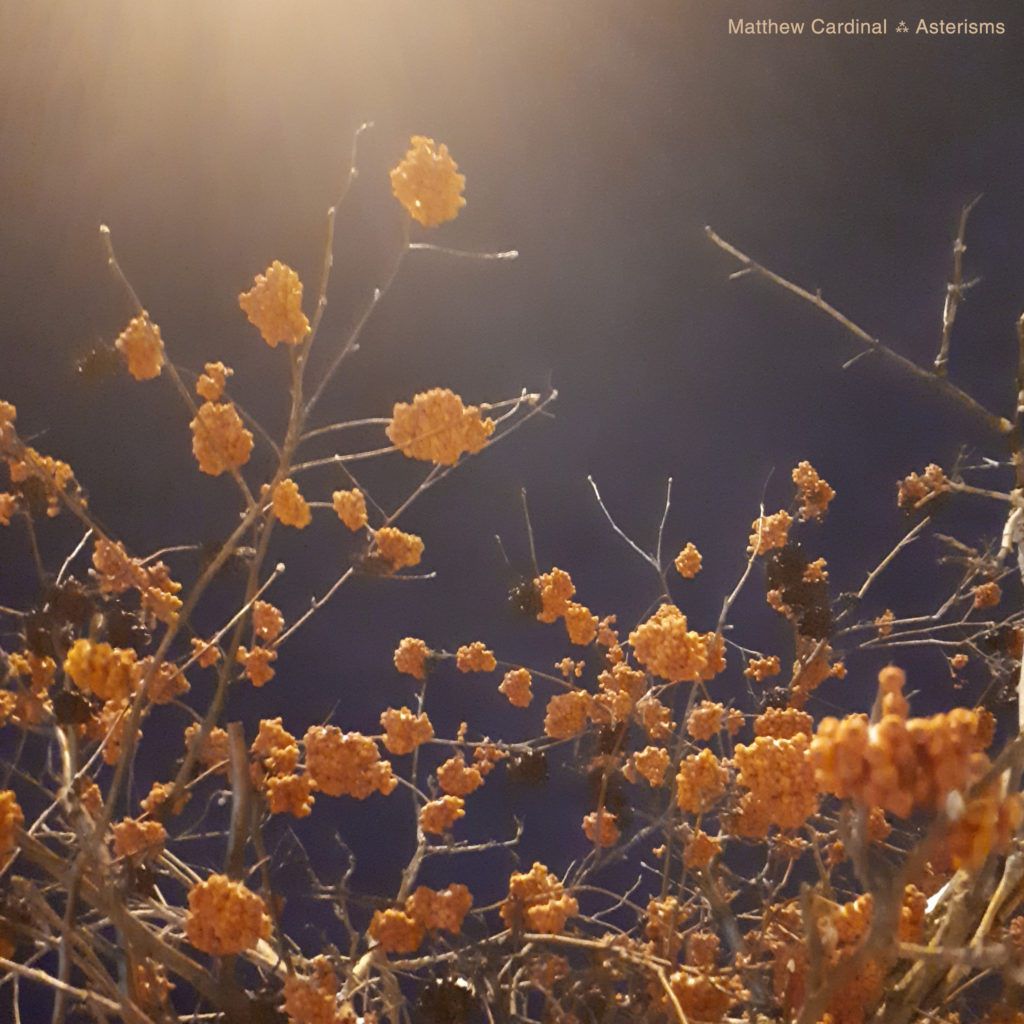
Asterisms is a dazzling collection of ambient electronic music that crystallizes moments in the Edmonton-based musician’s life. It’s described by the label, Arts & Crafts, as an audio journal that explores “captured moments of experimentation and expression,” drawing attention to where Cardinal was musically, mentally, and emotionally in these moments.
Cardinal created it using analogue synthesizers, a small modular system, samplers, electric piano, and processed voice. Each sonic entry came out naturally in improvisational waves, recorded often in single days if not single takes, usually set up on the floor of Cardinal’s bedroom.
We’re told that the album calls to mind the luxurious minimalism of Brian Eno, Erik Satie, Steve Reich, and Glenn Gould, and the swirling influence of Fennesz, Boards of Canada, and Slowdive.
Alongside the announcement, Cardinal has shared “May 24th,” the result of experimenting with generative synthesis and syncing external equipment, playing around and having multiple sound sources playing the same melody.
It’s accompanying video, streaming below, is shot by visual artist SCKUSE, or Stephanie Kuse. Inspired by Cardinal’s night-time flash photography, Kuse set out to create “something soft, hypnotic, and pretty to suit the music that also reflected the dreamy and nostalgic nature of his photos,” she recounts. She spent a few evenings out collecting footage until she stumbled on the right material— wildflowers and grass going in and out of focus as the camera trailed behind. The footage was processed through an old television to enhance the vibrancy and to add subtle distortion.
Cardinal is known for his work in nêhiyawak, the moccasingaze trio whose debut album, nipiy, is currently nominated on the 2020 Polaris Music Prize Shortlist.
Tracklisting
01. Dec 31st 02. May 25th 03. May 24th 04. Dec 4th 05. May 7th 06. Mar 12th 07. Sep 7th 08. Aug 23rd 09. Sep 11th 10. Jan 8th 11. July 23rd
Asterisms LP will be released on October 27 on digital and vinyl formats. Meanwhile, you can stream “May 24th” below and pre-order here.
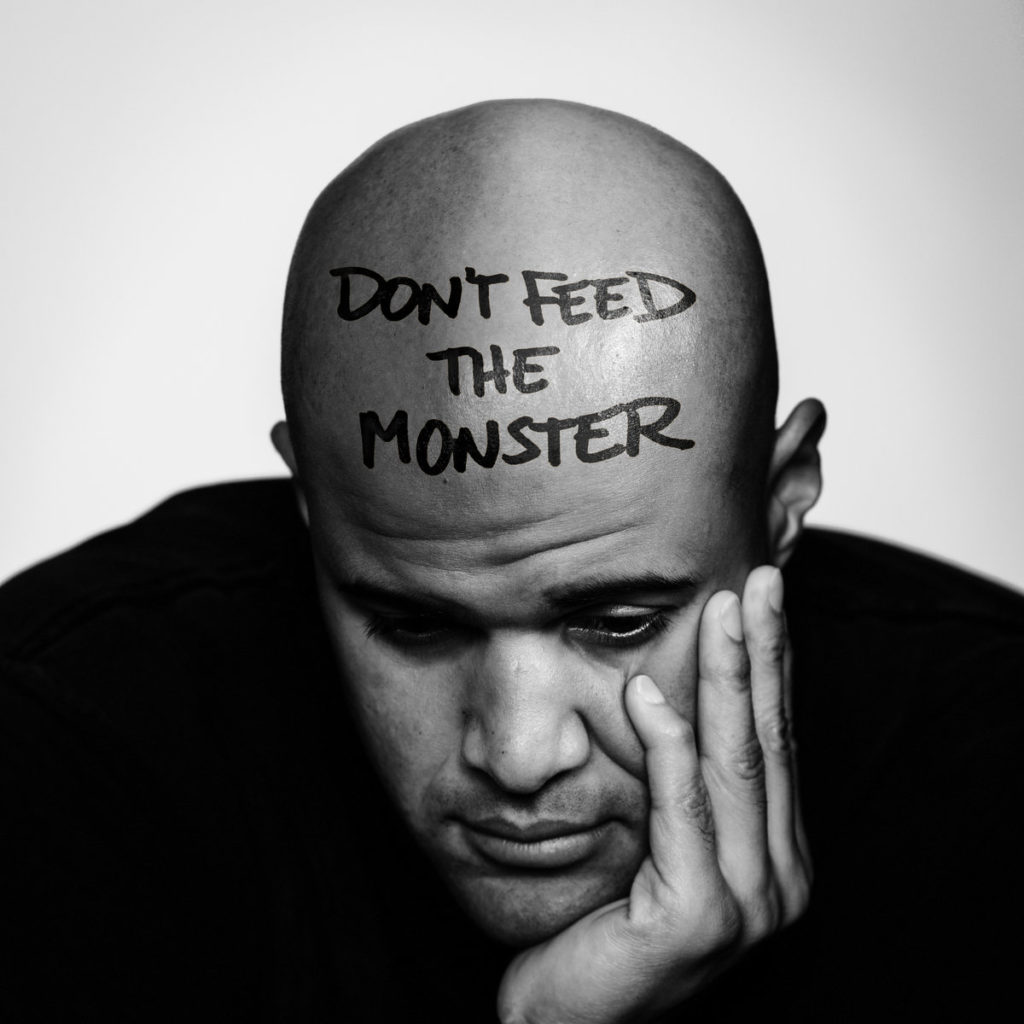
New York’s Homeboy Sandman has announced his new album, Don’t Feed The Monster.
Don’t Feed The Monster is the second album that Homebody Sandman, real name Angel Del Villar II, has released on Mello Music, based in Tucson, Arizona. He worked with Stones Throw Records before dropping the Dusty LP last year. It’s produced entirely by Quelle Chris, who adds his vocals on “Hello Dancer.” Alejandro “Sosa” Tello Jr. is on mixing and mastering duties, having worked with Homeboy Sandman for a majority of his career.
Reflecting on the album, Homeboy Sandman says, “I was having a hard time and this record saved me. Thank Quelle and thank God and shout to Gabor Maté.”
Tracklisting
01. Trauma 02. Extinction 03. Stress 04. Hello Dancer (feat. Quelle Chris) 05. Waiting On My Girl 06. Shorty Heights 07. Scare You 08. Don’t Look Down 09. Monument 10. Triple Warmer 11. Biters 12. Alone Again 13. Walk By Faith 14. Gestation 15. Straight
Don’t Feed The Monster LP is scheduled for October 16 digital release. Meanwhile, you can pre-order here and download “Trauma” below for free.
San Francisco’s Public Release will put out a new V/A compilation featuring Tim Sweeney‘s first solo production.
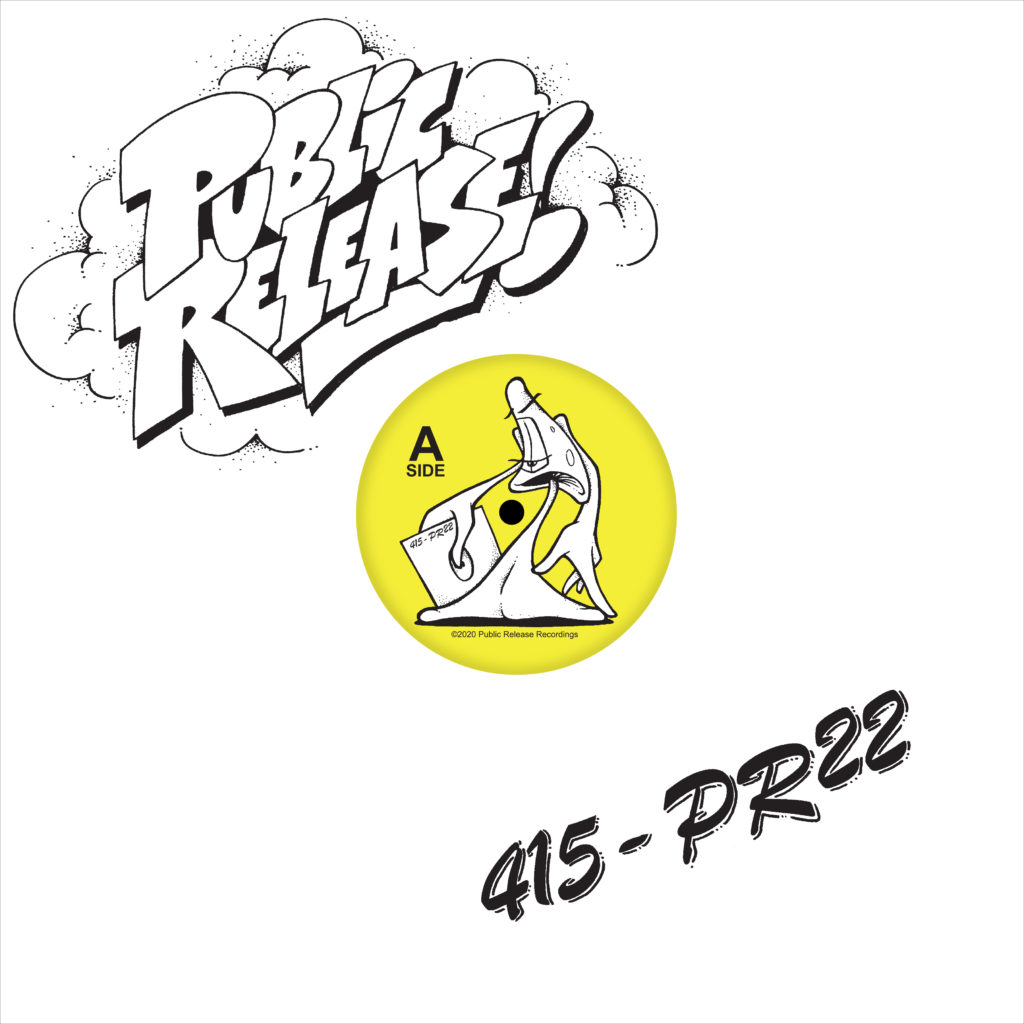
415-PR22 features six new tracks from Public Release’s global family, aiming to take a snapshot of the label’s discography in recognition of its past, present, and future. Besides Sweeney of Beats in Space, the compilation features Tendts, London veteran Richard Sen, and Earth Boys. Debuting on the label are Metropolitan Soul Museum and Fran-key.
Public Release is founded in 2009 by Eugene Whang. Sweeney actually opened the label with Stop Sitting Around / Get Me A Doctor, comprising three Italo disco edits.
Tracklisting
A1. Tendts “Slice the Top” A2. Richard Sen “Abstract Dance” A3. Tim Sweeney “8th & Broadway” B1. Earth Boys “Eboys 2020” B2. Fran-key “Summer Into Winter” B3. Metropolitan Soul Museum “Stoneman”
415-PR22 is scheduled for October 2 release on vinyl. Meanwhile, you can hear clips below and pre-order here.
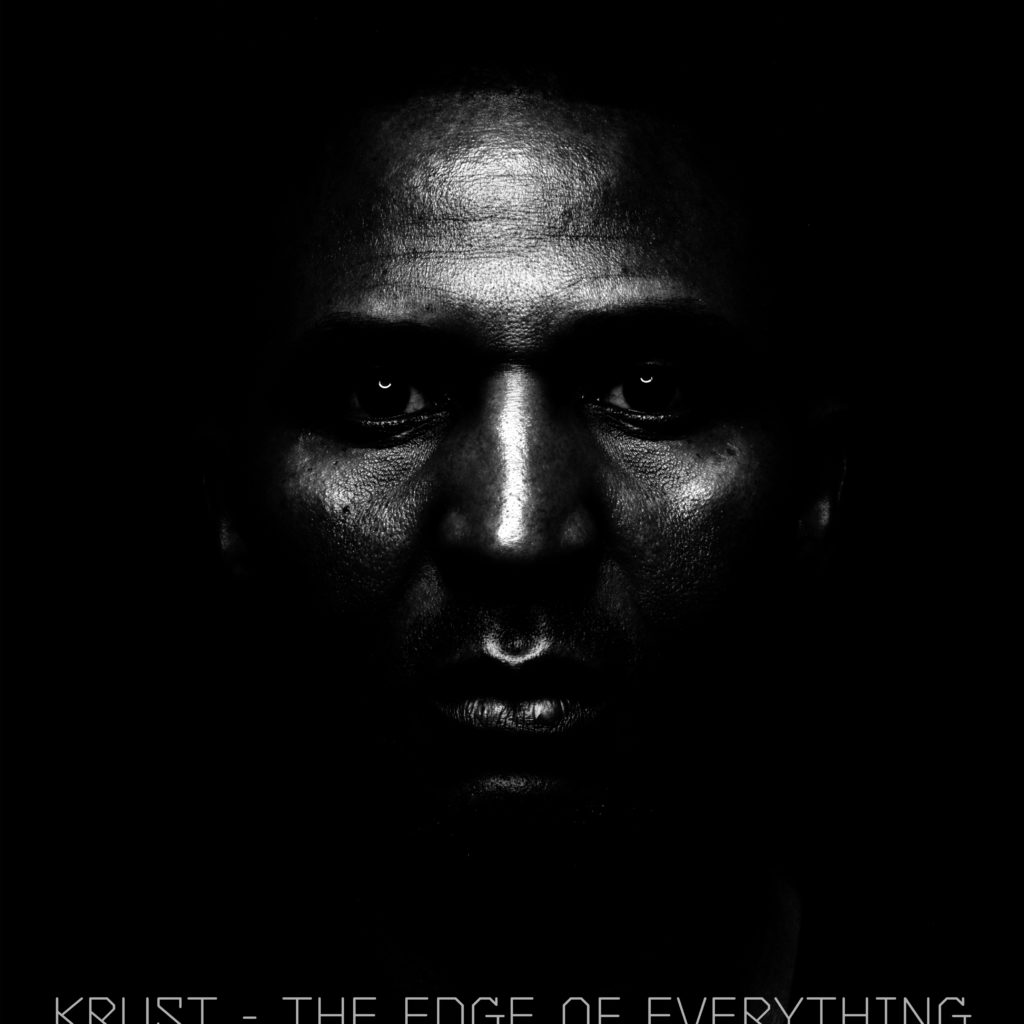
Bristolian master Krust will present The Edge Of Everything, his first album in 14 years.
Krust, real name Kirk Thompson, made his recording debut in 1989 with UK top 10 single “Wishing On A Star” as part of Bristol collective Fresh 4.
As acid house splintered and evolved into hardcore, and then onto jungle, Thompson began a prolific two decades, gaining widespread recognition as a pioneering, envelope-pushing drum & bass artist. He’s the man behind Full Cycle Records with Roni Size. And alongside Size, plus Die, Suv, and MC Dynamite, Krust formed Reprazent, who won the 1997 Mercury Music Prize for New Forms, released on Giles Peterson’s Talkin’ Loud.
Thompson has also released as Gang Related, Glamour Gold, and Kamanchi. His first solo single in 10 years, The Portal / Concealing Treachery, was released on Doc Scott’s 31 Records in 2018, before this year’s The Fundamentalist. His last solo album, Hidden Knowledge, came in 2014.
We’re told that The Edge Of Everything is Thompson as futurist revisionist, making exhilarating, standout music of depth and substance. The sound is unmistakably Krust, Crosstown Rebels, the label, explains, but now wider, deeper, freer, more intense, and more fully-realised.
Tracklisting
01. Hegel Dialect 02. Constructive Ambiguity 03. Negative Returns 04. Antigravity Love 05. The Dust Fell Off 07. 7 Known Truths 08. Deep Fields Of Liars 09. Keter The Heavenly 10. It’s A Lot 11. Space Oddity 12. Only God Can Tell
The Edge Of Everything LP is scheduled for November 6 release. You can pre-order here and stream “Constructive Ambiguity” in full via the player bellow.
The video features Turning Jewels Into Water—the duo of Haitian-born drummer, DJ, educator, and electronic music artist Val Jeanty and Indian-born drummer, producer, and educator Ravish Momin—performing three tracks from their newest album, Our Reflection Adorned by Newly Formed Stars. On a setup that included digital turntables, a percussive sampler, and various live and MIDI percussion, the duo streamed in unison from two different locations, performing “Flower In Flames,” “Our Reflection Adorned by Newly Formed Stars,” and “Crushed Petals.” Following each track, both Jeanty and Momin talk on their processes, setup, and the ethos of the project with Asheville Rhythm’s River Geurgeurian.
The new album dropped last month on FPE Records and is a masterclass in rhythm, instrumentation, and sampling, touching on dub, South African gqom, and eastern rhythmic styles. The duo worked with an ensemble of musicians from around the world, including Iranian singer/daf player Kamyar Arsani (based in Washington, DC) and friend Mpho Molikeng, a master musician of South African indigenous instruments, based in Lesotho.
You can watch the live performance and interview below, with the album available for purchase here.
AIDA is an Iranian-born, Canadian-raised artist based in San Francisco. By 2017, AIDA had become a staple in Vancouver’s music scene, and this paved the way to tours through Europe and North America. (Her 2019 performance at Bass Coast Festival was one of the event’s stand-out sets.) The dichotomy of east and west inhibits her being and infiltrates her sound as she masterfully blends traditional music from around the world with groovy house, techno, and colorful breaks, making for a rich sonic experience. When she’s not touring, she’s working as a lead product designer at a financial technology startup, working a busy music career around a demanding nine-to-five.
2019 was a breakthrough year for AIDA the DJ, but she’s also a skilled producer. You’ll find her early studio experiments sprinkled through her sets, and among the first is “Yek o Do,” which she contributed to this month’s XLR8R+. The track is a “modern love song” that she produced several years ago overlooking the mountains of the pacific northwest. With more tracks on the way, AIDA offered to walk XLR8R through her techniques for inspiring her to create.
There are a finite number of ways for an artist to approach skills of a technical nature, yet infinite ways one can approach creativity. Although creative and technical growth are equally important in your process, I find creative inspiration to have the power to shape an artist’s imagination in ways that add unique purpose and meaning to their work. All of that lies in storytelling, getting the imagination of the audience going, provoking thought, or amplifying feeling. This, to me, is the interesting part of creating. For these tips, I want to share a few approaches I take to inspire creativity within production.
Study Arrangements Using a Pen and Paper
This tip is about studying the arrangements of music you admire and drawing it out on paper. This allows you to learn about how different arrangements can be used for different types of storytelling so you can create unique arrangements faster and with a goal in mind.
Anyone who has read stories or watched enough films can recognize the classic plot-line: the story begins; the audience gets to know the players in the story; the story moves up towards a climax; and then it comes down into a resolution. Electronic music, for the most part, unfolds with a similar pattern. There is an introduction; then tensions and releases; then an outro. Music geared for the dancefloor especially has a classic pattern, with a small and then a larger breakdown.
As an artist, while you have full control over how you write each of these sections, it can be challenging to break the mold of this arrangement. This is when studying the works of people you admire to see how they’ve structured their songs can be beneficial. The easiest way to do this is to study a single track.
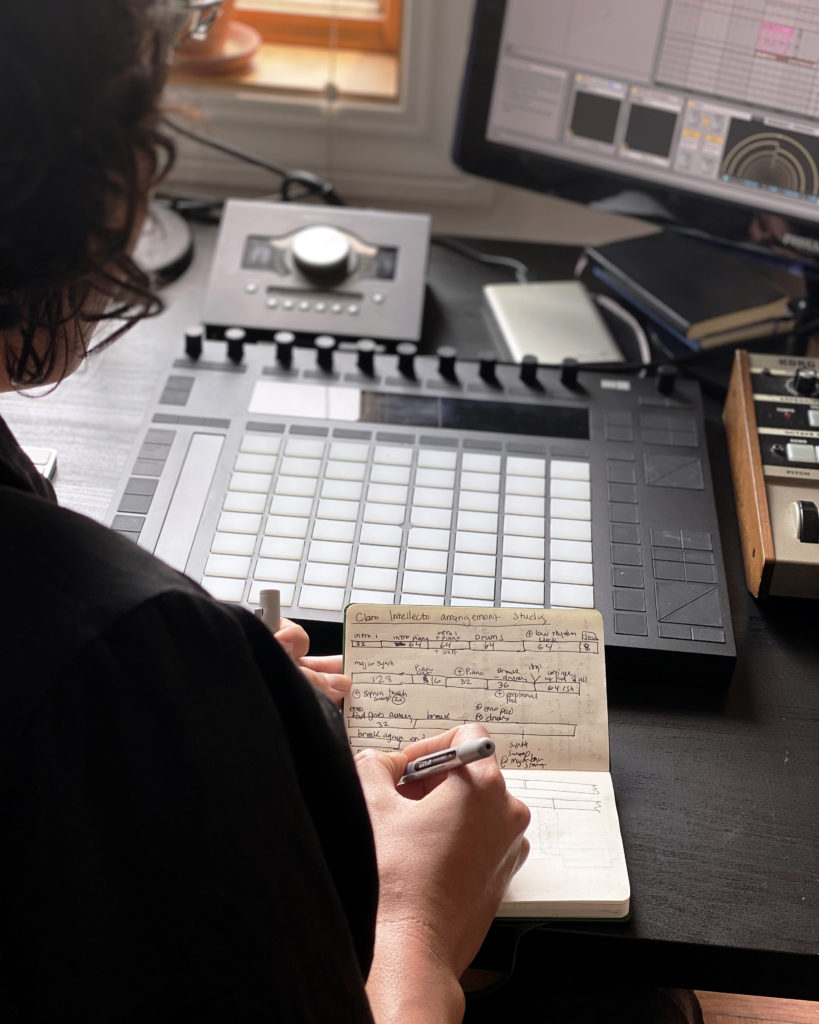
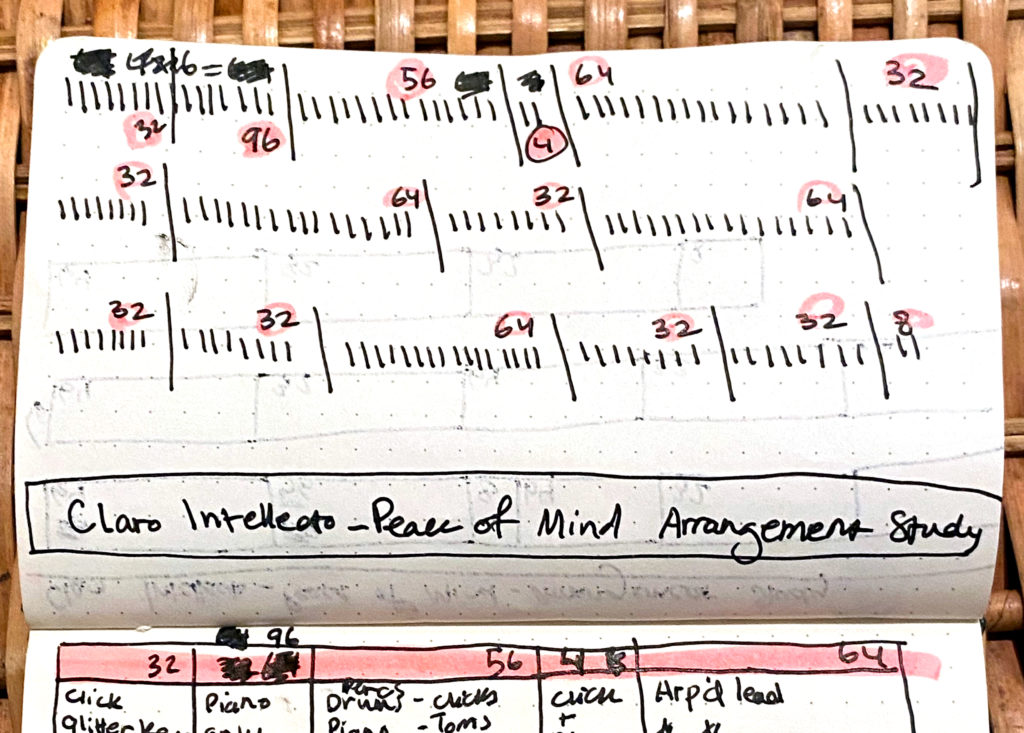
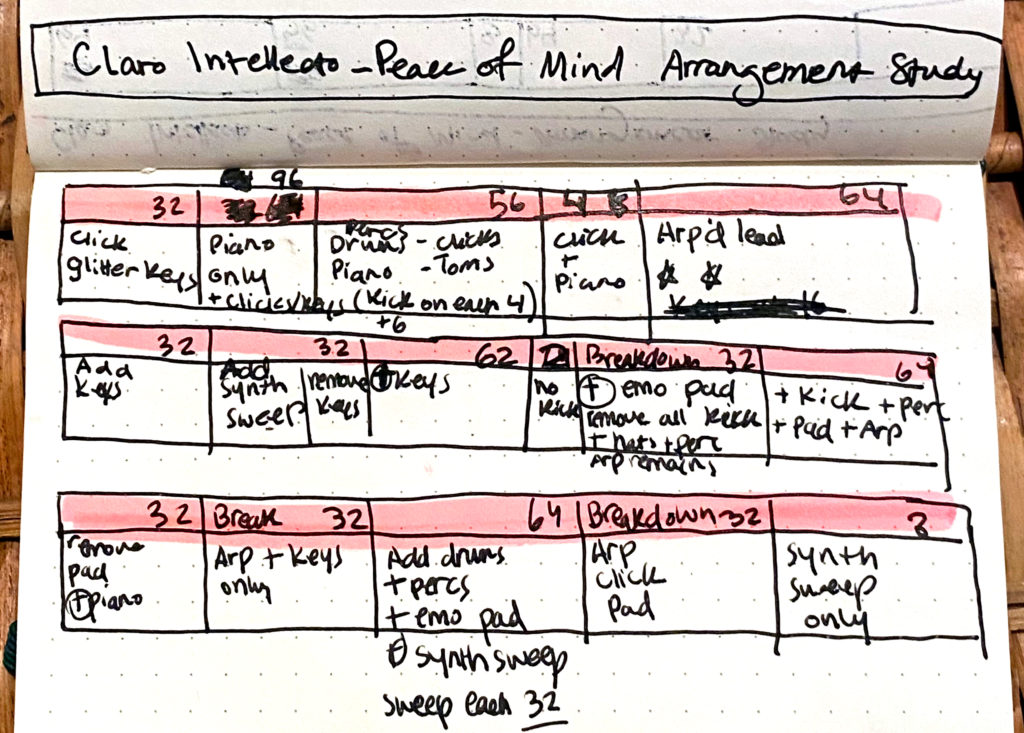
Here is how: find a track that you want to use as inspiration, and then grab a pen and paper and just start listening. I usually listen at least twice. The first time I only count the bars that pass and break up the song into sections: intro, verses, breakdowns, and other sections that stand out based on varying elements. Write down the instruments that are present. In the example below I have studied Claro Intelecto’s “Peace Of Mind” on Electrosoul. In this example, you will see how I have counted the number of bars and marked them off in sections. Each line represents four bars.
Arrangement study part one: count the bars that pass and break up the song into sections
Once you have listened to the track once through and counted the bars in each section, I suggest you start listening from the beginning again. This time, listen for three things: (i) sounds and instruments that go in and out; (ii) the effects that are used; (iii) and abstract feelings and vibes. You should also record anything else that stands out.
Here is a picture of the second round of listening to the same track. This time, I have written the instruments and sounds that I see coming in and out. What became valuable information for me was identifying that the synth sweep, emotional pad, and arpeggiated lead were contributing to the complex emotions that this track triggers in me. That’s the type of emotional trigger I want to create in my music.
Arrangement study part two: note the instruments and sounds that come in and out.
You can listen to the track as many times as you wish, and you’ll note different things each time. Once you’ve finished, you should have a visual layout of the full track on paper, which you can file and go back to whenever you want. For example, if I listen to a song that makes me feel nostalgic and full of emotion, I’ll note it down and then whenever I want to create that feeling in a track that I’m making, I can go back to these layouts and understand how other artists have made this feeling in their work. This practice also allows me to visualize the structure of different songs and this opens up so many new possibilities, meaning I don’t stick to one arrangement due to ease and comfort.
Draw Your Own Arrangement Ideas on Paper
Following the last tip, this tip is about drawing your own arrangement ideas on paper. I find this method to be very useful for capturing a moment of inspiration, especially when hit by an idea while being away from my studio; essentially, I can work from notes rather than bits and pieces of memory.
I often get random bursts of inspiration while driving, bored, or passively hearing other music, so if my notebook is not available, I record my voice by either singing something or explaining the idea with words. Then I bring that into my notebook at the next chance. Additionally, while working on a track, you can draw and redraw iterations of your arrangements as the track is in progress or as new ideas come to you. I tend to make at least four drawings when working on a single track.
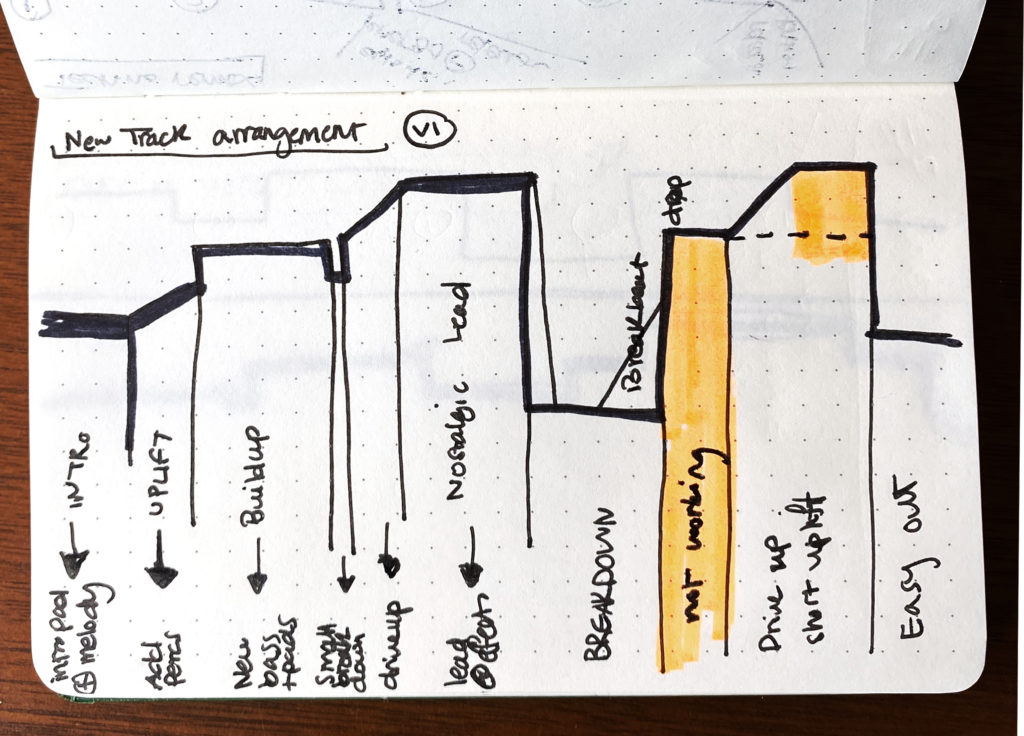
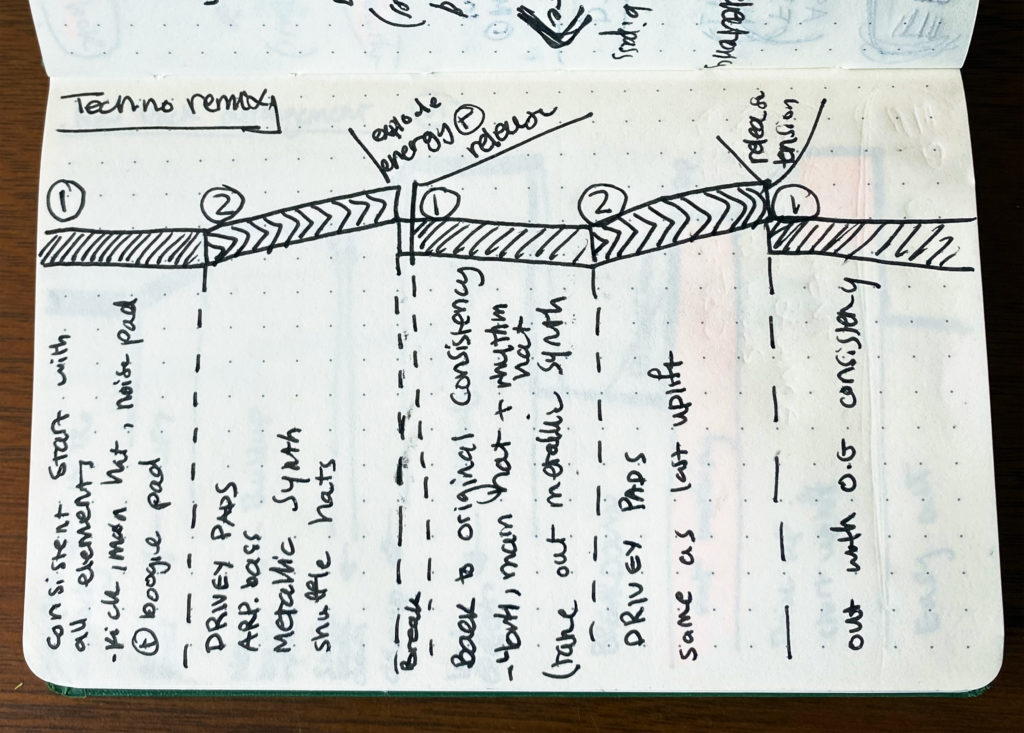
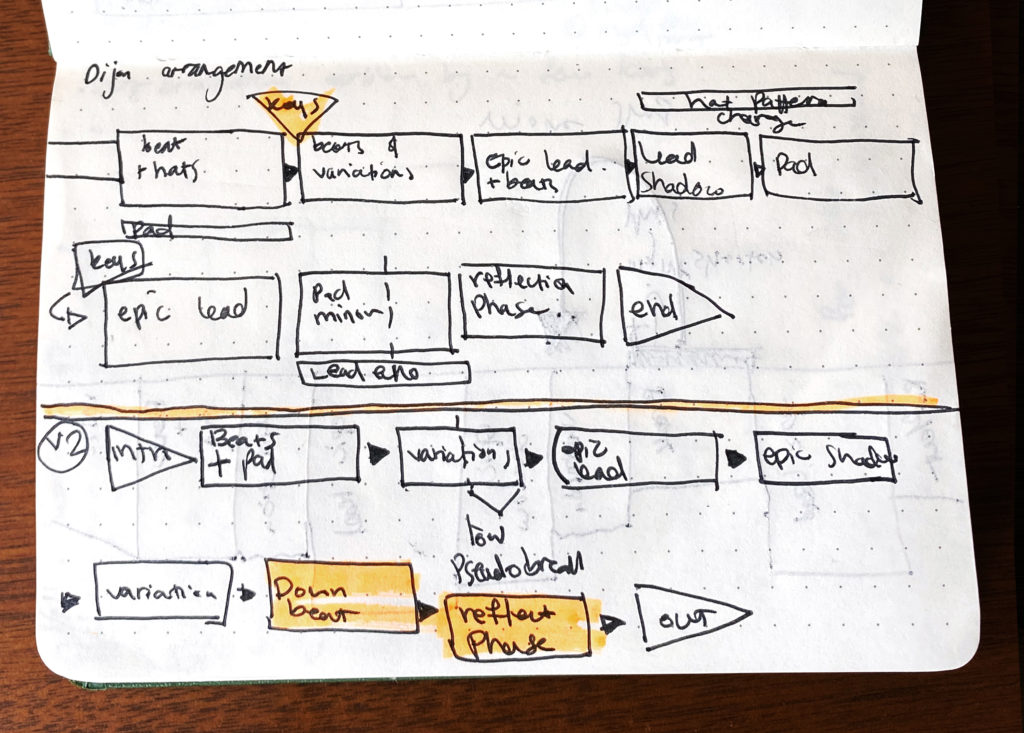
My drawings are different based on the idea that I have. Sometimes my ideas include areas of tension and release, and sometimes they are relatively linear. Below you will find three examples:
A typical arrangement to show areas of tension and release.
This first drawing shows how I drew an arrangement with the tensions and releases in mind. Thinking of it just like a graph, and starting from left to write, I drew straight lines for areas of linear progression (i.e verses, repeating the same loop for a number of bars). For areas that are building tension and leading to a climax, I drew a sloped diagonal line moving up. For breaks, short or long, I drew dips in the arrangement. The depth of each dip can identify its impact (a short four-bar break from your kick drum would mean a shallower dip in the drawing; while a major breakdown would mean a much deeper one). This drawing contains mainly the arrangement phases, but you can record as many details as you like in your drawings.
An arrangement drawing for a linear techno remix
In contrast, this second drawing is of a relatively linear techno remix I am working on. You will see much fewer dips and inclines, and a lot more detail in writing.
The final drawing shows two versions of the same arrangement I have drawn while simultaneously working on the track, focusing on each section as it leads into the next with markings of ideas that have come to me at various times throughout the process.
With this method, two main elements are being removed: audio and time. The only sense that is at play here is visual. Limiting sensory inputs to this level opens up space for imagination. Since my brain is not occupied with other aspects, I am able to write a storyline by purely looking at the track from a new perspective. This gives more purpose and meaning to my work and makes for a more captivating experience for the listeners.
From Paper to DAW, Creating an Outline Before Adding Details
Once you’ve learned to study the arrangements of others and draw your own, it can be helpful to translate your drawings into your DAW. Going between DAW and paper allows me to think and test ideas a lot faster than trying arrangement ideas inside the DAW alone, because drawing and redrawing is a lot faster than creating, un-doing, and saving new versions of a file.
I use Ableton Live, so this tip refers to Live‘s interface.
To explain this tip, I will draw a parallel to the most basic rule of fine arts drawing, with the example of drawing a portrait of someone’s face. To draw a portrait, first you must draw an outline of the face, then identify the right placement of the facial features, and lastly add details to the features. Beginners in fine arts usually start with the eyes and add all the details, then they draw the nose, usually in the wrong place. Back to music production: when you make a drawing of your arrangement and figure out the general skeleton, you’re essentially making an outline before you focus on details, saving yourself from having to move multi-layered sections around later.
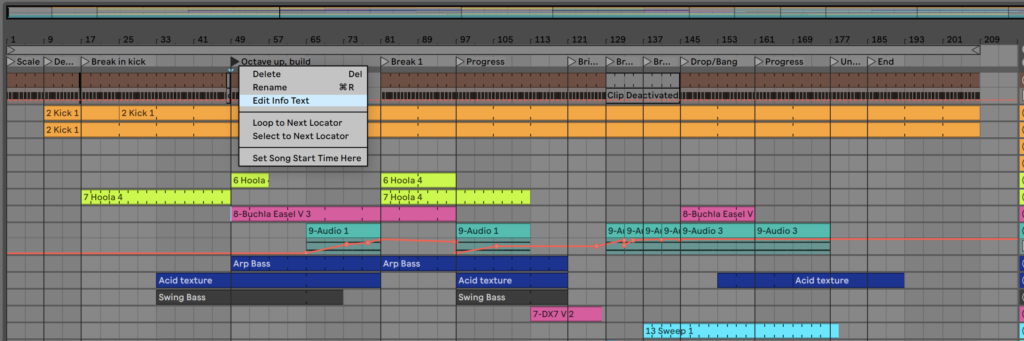
Your drawing of an arrangement should consist of marks or points where specific events in your story happen, and how many bars go in between each event. You can translate your arrangement from paper to Ableton by inserting “locators” on your digital arrangement. It’s easier to add “locators” when you have some primary elements, like drums and a basic melody, so you can listen and count the number of bars passing.
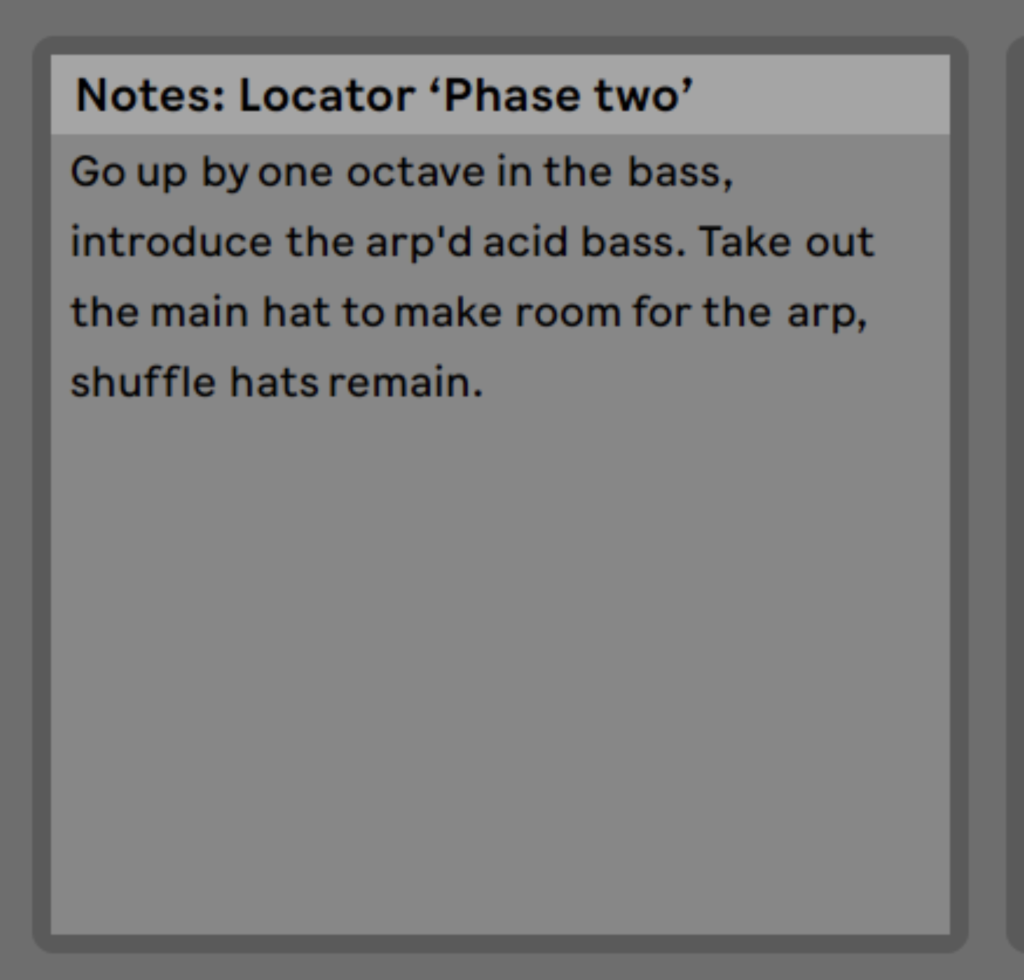
Start laying out the primary sounds in your arrangement with your paper drawing in mind. For each marker or point you’ve created in your drawing, place a “locator” on Live—or whatever DAW you’re using—after the desired amount of bars. Name each “locator” to identify a point in the story and add further explanations inside the “locator’s” notes placed on Live’s “tips” section. This is a good way to create the skeleton of your arrangement as a starting point, and to note your ideas down quickly. My notes usually consist of the key the track is in, the elements I want to add to that “locator” later, and any other ideas that I have.
AIDA uses “locators” to translate her drawings to Ableton Live.AIDA’s notes usually consist of the key the track is in, the elements she wants to add to that “locator,” and any other ideas that she has.
Use Reflection Studies to Look at Your Work from New Perspectives
This tip is about a technique I use to gain new creative perspectives on a project. When you are stuck with your work for long hours, you become numb to the big picture, and you end up lost in minor details. Every artist, regardless of medium, experiences this.
This is an important part of the creative process, but it’s also good to learn to stretch yourself the other way so you can view your track from a new perspective. Reflection studies are a method of listening and reflecting on a track that allow me to introduce more creativity into my process. Here is what to do.
After you’ve reached a point where your arrangement is complete and you’re pleased with the general skeleton you’ve laid out (at this point I usually have most of my sounds with room for a few more instruments and effects), leave the track be for a while. Don’t listen to it. Let time pass. A week or two. This is a marination period for your ears.
Then, when you come back to it after some time, listen to it with your body turned away from your DAW. Look at the floor or out the window to avoid distraction from your DAW. Avoid focusing on any specific detail. You want to pay attention to the journey, the story, and the arrangement. Keep your attention spread across as many layers as you can.
As you listen, ask the following questions: (i) how is everything dancing together? (ii) does the story have a good flow? (iii) do the flow or individual elements have a purpose?
Then, once the playback has finished, grab a pen and paper. Start jotting down all your immediate reflections. Criticize your track. Note the story you imagined and the vibe you picked up. Also, think of a creative solution for each criticism and write that down as well before you get into your DAW. For each point or criticism that you note, you want to have at least a first step towards improvement imagined and planned out, otherwise you could forget what the true idea or thought behind the criticism was later.
Once you get critical through as many lenses as possible, you start to pin-point improvement areas you may not have otherwise noticed. This could lead to more interesting arrangements, and more organized and consistent storytelling.
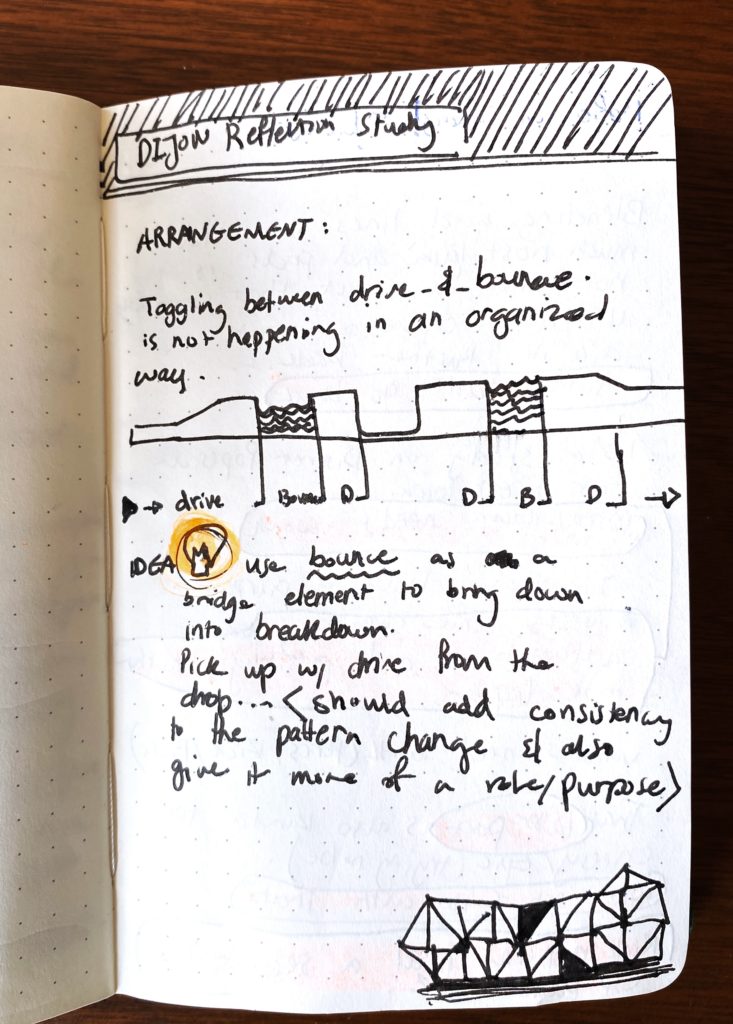
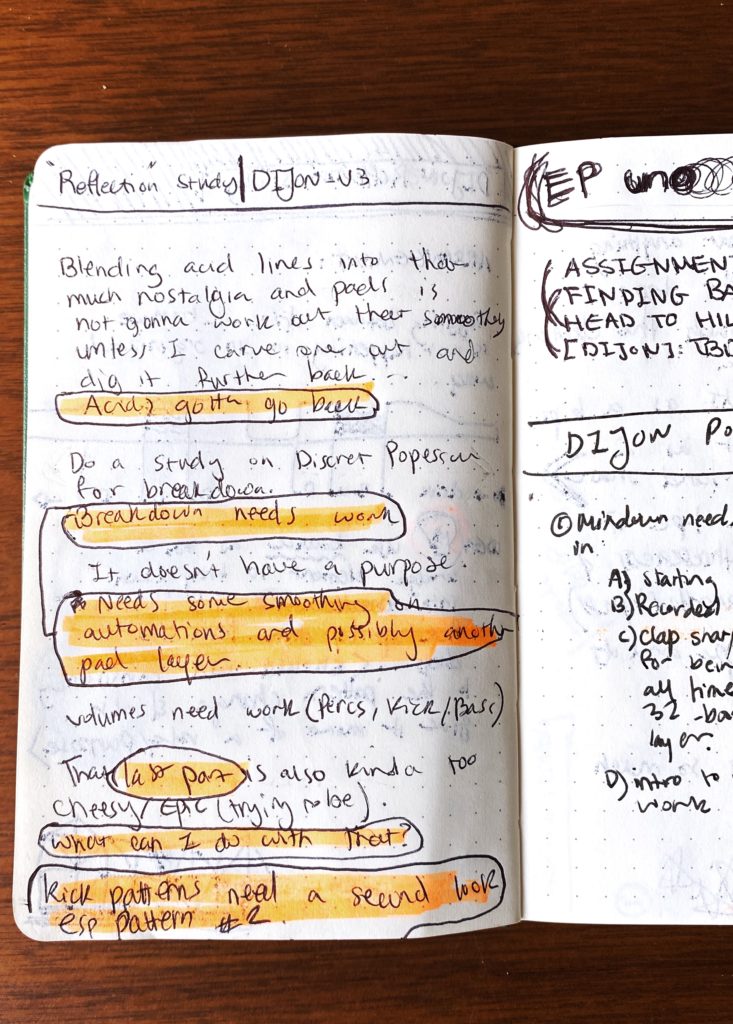
In the following images, you can see the results of a reflection study I did on a track I am working on. I realized that certain parts are not successfully leading into others; that some sections are missing a purpose in the story and need reconsideration; and that certain sounds or patterns need to be revisited.
AIDA uses reflection studies to look at her work from new perspectives. AIDA uses a reflection study to identify areas of improvement.
Use the Listener’s Experience to Drive Your Production
A key component of successful storytelling is putting yourself in the shoes of the audience. This tip touches on thinking about your audience’s emotions to deliver your musical story effectively.
I think most artists, regardless of medium, tend to create based on their own preferences, unless they have user experience training or are able to actively ignore the voice in their own head and imagine the audience.
In my day job I am a Product Designer, also known as a User Experience Designer. In short, I take a user-first approach in order to create designs that are useful and meaningful. I gain this knowledge through research, conversations with the audience, and by putting myself in their shoes. I think about their feelings at any given moment, what purpose they hope to satisfy, and how they can be surprised or delighted. Approaching music production in this way can lead to some creative outcomes.
In your production, think about ways to add interesting twists or surprises for the listener. Think about how they could be feeling with the track at each moment, and what you want them to feel at any given point in a way that satisfies the way you want the story of that track to unfold.
For example, in the recent track I released on XLR8R+ called “Yek O Do,” I intended to tell a distant love story, one that happened in the past, of which the details are faintly remembered but the feelings are still strong.
With this, I immediately immerse the listener in a floaty and dreamy atmosphere. After creating the main pads and melodies and playing it out for different people, I recognized that it takes each person to their own very specific dreamland, as I intended. My listeners tend to look to the top right as their eyes glaze over with imagination, exactly as I hoped.
My second intention was to keep the dreamland experience consistent, yet to smoothly tap into a love story with short vocals that translate from Farsi to English to say “One and two, me and you.”
One thing I personally stay away from in production is forcing feelings with elements that are trying too hard or too loud. In my main breakdown I had a violin sound that was like your classic heart-wrench violin sound that was crying for attention. After some reflection studies—see above—I realized that the violin contradicted the silkiness I was going for. I did not want the listener to get on the floor and start crying, so I swapped it out with a gentle string with a short release. Then I added two more pads to support the string and the fuzzy atmosphere.
Coming out of the breakdown, I wanted the listener to ease back into the groove rather than to get dropped into it again, so I resorted to a short breakbeat pattern in my kick drum that eventually stumbles back into a four-to-the-floor.
In your production, thinking about your story, the feelings that contribute to it, and the way the story unfolds can define the sounds you use and how you introduce them. You could select a nostalgic lead and introduce it suddenly as the protagonist of the story in order to surprise the listener. Conversely, the lead could be a supporting element to another sound, so it could come in slowly and in the background with reverbs and delays.
Selecting your sounds based on the type of surprise you want to create for the listener, and how you want them to feel, can unleash creative ways of matching sound and mood that is signature to only you as a producer.
Josh Johnson will release Freedom Exercise, his debut album, next month.
Johnson is a Los Angeles-based multi-instrumentalist who has made a name for himself over the past decade through recording and gigging with Jeff Parker, Kiefer, Makaya McCraven, Miguel Atwood-Ferguson, Leon Bridges, and Marquis Hill. Relocating from Chicago eight years ago, the transition earned Johnson a weekly spot with Jeff Parker at the Lodge Room in Highland Park. Freedom Exercise is a reflection of the vibrant music that emerged from this residency.
Artists across the album include Aaron Steele on drums/percussion, Anna Butterss on bass, Gregory Uhlmann on guitar, and Josh Johnson on saxophones, mellotron, prophet 6, percussion, synth, ms-20, wurlitzer, flute, bass clarinet, synth bass, and a sampler.
“Asymmetrical but still inviting, Johnson’s compositions spotlight his sensitivity and restraint,” Northern Spy Records, the label behind the release, tells XLR8R.
Tracklisting
01. Nerf Day 02. 856 03. Western Ave 04. Bowed 05. Eclipsing 06. New July 07. False Choice 08. Punk 09. Simple Song 10. Return Recoil
Freedom Exercise LP is scheduled for October 9 release on vinyl and digitally. Meanwhile, you can pre-order here and stream “856” and “Western Avenue” via the player below.